Search


26 Mar 2026
Search
26 Mar 2026

Please allow ads as they help fund our trusted local news content.
Kindly add us to your ad blocker whitelist.
If you want further access to Ireland's best local journalism, consider contributing and/or subscribing to our free daily Newsletter .
Support our mission and join our community now.
To continue reading this article, you can subscribe for as little as €0.50 per week which will also give you access to all of our premium content and archived articles!
Alternatively, you can pay €0.50 per article, capped at €1 per day.
Thank you for supporting Ireland's best local journalism!


Paramilitary involvement in racist violence in Northern Ireland has served to “exacerbate” anti-immigration unrest in the region, an independent commission has warned.
The Independent Reporting Commission (IRC), which was set up to monitor progress toward ending paramilitarism in Northern Ireland, also expressed concern that members of the illegal terror groups were encouraging young people to get involved in the disorder.
In its eighth annual report, the IRC noted that the 2024/25 financial year was the first since records began to be collated in 1969 that there had not been a security-related death in the region.
While welcoming that “positive development”, the commissioners cautioned that paramilitarism remained “resilient” within communities in Northern Ireland and they called for “urgent” action to tackle the “live and serious” issues posed by the groups.
“The intimidation, coercive control and threats linked to paramilitary groups persist, and the structures of paramilitary groups that continue intact can be used to facilitate organised crime and other forms of violence,” said the commissioners.
“A particularly serious manifestation of that reality over the last two years has been the link between paramilitarism and racist violence connected to the issue of immigration.”
The reporting period fell outside the racist unrest that erupted in parts of Northern Ireland in June, but it did cover the anti-immigration unrest that flared the previous summer following the Southport stabbings.
The commissioners noted that race hate violence had risen notably in 2024/25 as they highlighted Police Service of Northern Ireland (PSNI) figures showing that the period had witnessed the highest number of instances in the 20 years such figures have been recorded.
While police have said individuals linked to paramilitary groups have been involved in recent racist disorder, officers have said there is no indication that the violence has been organised or sanctioned at a leadership level.
The IRC report said: “The point is not whether the involvement was ‘organised’ or not. The reality is that the participation of individuals and groupings of individuals with clear links to paramilitarism in racist violence has undoubtedly served to exacerbate the situation in Northern Ireland in terms of anti-immigration unrest.
“This deeply worrying development… is further evidence of the risks attached to the continuation of paramilitarism and its structures, and further underlines the urgency on bringing it to an end.
“Another concerning factor in the racist unrest in Northern Ireland is the level of involvement by young people.”
The commissioners said there had been previous claims that paramilitaries had exploited children by encouraging them to take part in riots in 2021.
They added: “Similar indicators of child criminal exploitation are alleged to have also been present in the unrest during 2024/25. It is concerning that so many children have come into contact with the criminal justice system as a result of their involvement, and many do not appear to understand the potential life-long consequences of their actions.”
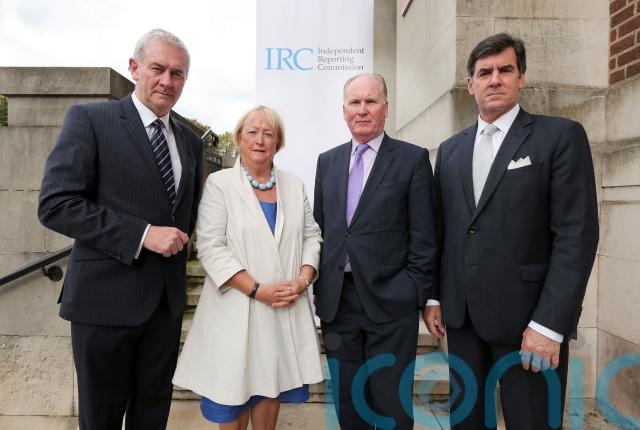
The four IRC members are former US special envoy to Northern Ireland Mitchell Reiss, former human rights commissioner and political leader Monica McWilliams, solicitor John McBurney and former Irish diplomat Tim O’Connor.
The commissioners noted that a Stormont Executive programme to tackle paramilitarism and organised crime is due to end in 2027.
They stressed the need to continue to invest in efforts to combat paramilitary activity beyond that date.
“We recognise that the current fiscal environment is challenging; however, strategic investment now will help avoid significantly greater costs for Northern Ireland in the future,” they said.
“If paramilitarism is not brought to an end, it will continue to create unmanageable strain on public finances through its direct and indirect harms. In our engagement with victims and survivors, the overwhelming message has been the prevention of any future harm. It is a key reason why the work of ending paramilitarism, once and for all, remains an urgent one.”
The UK and Irish governments recently appointed an “interlocutor” to examine whether a formal process of engagement with paramilitary groups in Northern Ireland is required to bring about their disbandment.
The move to appoint Fleur Ravensbergen came after the IRC recommended the approach.
Ms Ravensbergen is a conflict resolution and negotiation practitioner and a lecturer in conflict resolution and governance at the University of Amsterdam.
In their eighth annual report, the commissioners welcomed the interlocutor’s appointment.

Subscribe or register today to discover more from DonegalLive.ie
Buy the e-paper of the Donegal Democrat, Donegal People's Press, Donegal Post and Inish Times here for instant access to Donegal's premier news titles.
Keep up with the latest news from Donegal with our daily newsletter featuring the most important stories of the day delivered to your inbox every evening at 5pm.

This publication supports the work of the Press Council of Ireland and Office of the Press Ombudsman, and our staff operate within the Code of Practice of the Press Council. You can obtain a copy of the Code, or contact the Council, at www.presscouncil.ie, Lo-call 1800 208 080 or email: info@presscouncil.ie.