Search


12 Mar 2026
Search
12 Mar 2026

Please allow ads as they help fund our trusted local news content.
Kindly add us to your ad blocker whitelist.
If you want further access to Ireland's best local journalism, consider contributing and/or subscribing to our free daily Newsletter .
Support our mission and join our community now.
To continue reading this article, you can subscribe for as little as €0.50 per week which will also give you access to all of our premium content and archived articles!
Alternatively, you can pay €0.50 per article, capped at €1 per day.
Thank you for supporting Ireland's best local journalism!

Late Fr. Jim Conlon, James Murcott & Les Gornall receiving UK Pollution Abatement Technology Award in 1986 for the large-scale high solids farm digester and fibre separation plant at Bethlehem Abbey.

On March 4, 2026 Northern Ireland lost a remarkable pioneer.
Rev. Fr. Jim Conlon, who was for many years the farm manager at Our Lady of Bethlehem Abbey, Portglenone, died peacefully after a life devoted to faith and stewardship of the natural environment and quiet contemplation.
The legacy he left is great.
Those who worked with him knew that beneath his gentle manner lay a rare courage.
In the early 1980s Fr. Conlon raised the issue of the impact that modern farming was making on the environment with his Cistercian community and they made a decision that would transform the Abbey farm. Rather than follow the increasingly chemical-dependent model of modern agriculture, he chose to farm “more wholesomely,” as he often described it. Artificial fertilisers, herbicides, and pesticides were removed from the system. In their place came a careful rebuilding of soil fertility, pasture diversity, and nutrient cycling. Energy to heat the monastery would come from manure.
Fr. Conlon’s vision was boldly practical. Working with Leslie Gornall a research student at the University of Ulster and biogas pioneer James Murcott of Farm Gas Ltd., he helped create one of the earliest full-scale farm anaerobic digestion systems in the United Kingdom and Ireland. The digester, commissioned in 1985 at Bethlehem Abbey near Portglenone, processed manure from 300 beef cattle and 27,000 broiler chickens along with silage effluent and other organic wastes. Remarkably for its time, it worked. The system generated renewable biogas to heat the Abbey and dry organic grain, while separating nutrients so that valuable phosphorus could be captured in compost products and nitrogen returned to pasture.
Fr. Conlon did far more than approve the project; he made it work on the ground. As farm manager he oversaw the daily operation of the livestock, the feeding of the digester, and the development of an integrated system that linked renewable energy, compost production, crop drying, and organic farming. The compost produced at the abbey became a successful commercial peat substitute and a range of golf course greenkeeping products, while the farm shop sold ‘Abbycorn’ organically grown stone ground oats dried using energy from the digester.
Under his guidance the farm itself changed. Diverse grass and clover pastures rich in medicinal herbs replaced chemically managed fields. Nitrogen came from clover and digestate. Even weed control was approached creatively: Rumex seed heads (Docks) were harvested before ripening and used as digester feedstock. The results were striking. Livestock health improved dramatically, veterinary interventions dropped sharply, and the farm demonstrated that ecological farming could also be economically successful at full scale. Organic beef was made possible.
Fr. Conlon never sought recognition for these achievements but national and international awards followed this pioneering adventure. Visitors who came to see the digester and composting systems were welcomed with quiet warmth and a simple explanation of how the farm worked. Northern Ireland consequently has more biogas plants per head of population than any country in the UK. To him the work was not about technological novelty but about care for creation, good husbandry, and the well-being of the community.
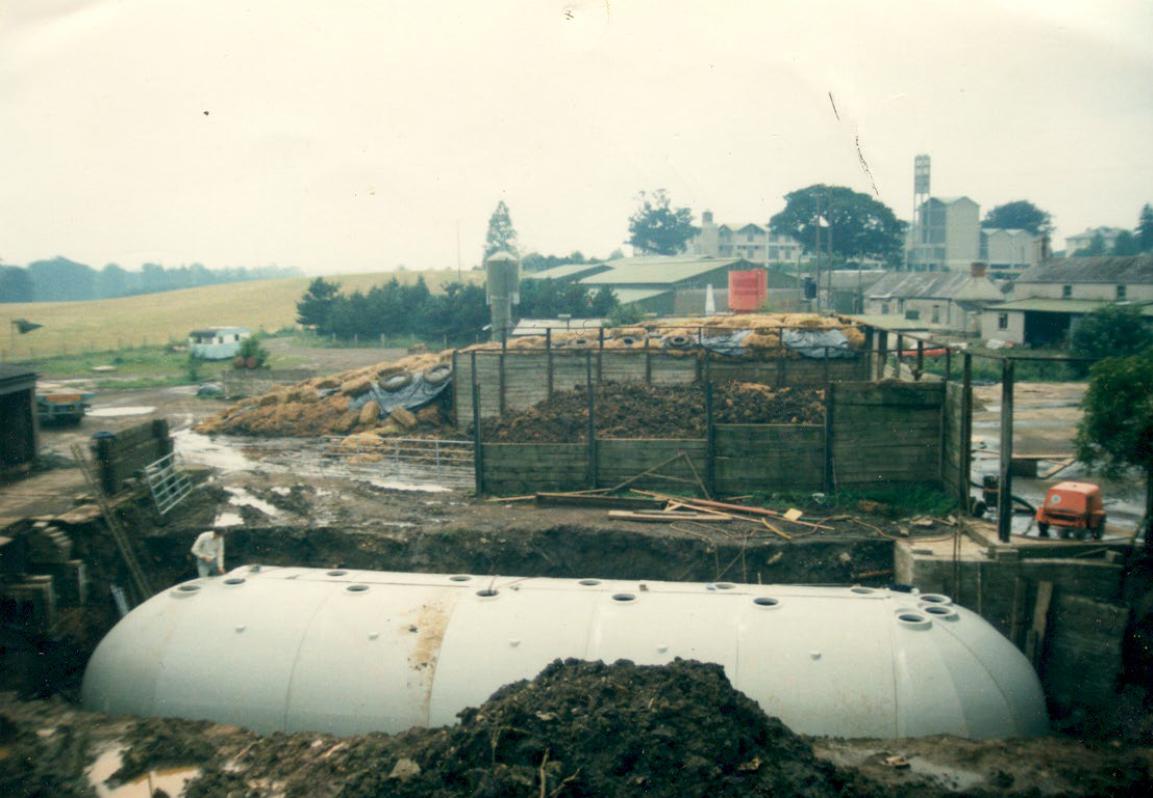
ABOVE: The Farm Gas digester at Bethlehem Abbey, James Murcott supervising construction.
Today, as the world searches urgently for ways to produce renewable energy, restore health to soils, and reduce agricultural pollution, the example set at Bethlehem Abbey appears more relevant than ever. Much of what Fr. Jim Conlon helped pioneer—integrated digestion, nutrient recovery, and wholesome farming—has become central to modern thinking about sustainable agriculture.
READ NEXT: Park residents demand an end to violence
Those who worked with him remember not only his vision but his humility and kindness. In a time when agriculture was moving rapidly toward industrialisation, Fr. Jim Conlon quietly showed another path.
We have lost a gentle priest, a wise steward of the land, a true pioneer and a valued friend but the world noticed that this farm waste digester opened the gateway to large scale organic farming and that set up a chain reaction in Germany that led to tens of thousands of anaerobic digesters being built and the German electric railway system being disconnected from fossil fuels. It opened the market for peat substitutes and demonstrated a simple way of removing phosphorus out of Lough Neagh while supporting climate change goals and improving the health of soil.
He walked the spiritual path with practical feet and his footprints can be seen everywhere.

Subscribe or register today to discover more from DonegalLive.ie
Buy the e-paper of the Donegal Democrat, Donegal People's Press, Donegal Post and Inish Times here for instant access to Donegal's premier news titles.
Keep up with the latest news from Donegal with our daily newsletter featuring the most important stories of the day delivered to your inbox every evening at 5pm.

This publication supports the work of the Press Council of Ireland and Office of the Press Ombudsman, and our staff operate within the Code of Practice of the Press Council. You can obtain a copy of the Code, or contact the Council, at www.presscouncil.ie, Lo-call 1800 208 080 or email: info@presscouncil.ie.