Search


15 Mar 2026
Search
15 Mar 2026

Please allow ads as they help fund our trusted local news content.
Kindly add us to your ad blocker whitelist.
If you want further access to Ireland's best local journalism, consider contributing and/or subscribing to our free daily Newsletter .
Support our mission and join our community now.
To continue reading this article, you can subscribe for as little as €0.50 per week which will also give you access to all of our premium content and archived articles!
Alternatively, you can pay €0.50 per article, capped at €1 per day.
Thank you for supporting Ireland's best local journalism!


On the first May Bank Holiday of 2025 in the corner of a Derry city centre bar, a local musician, acoustic guitar in hand, mounted a small platformed area and opened his upcoming set by cordially welcoming his audience with a hearty ‘Cead Mile Failte’.
As the music ensued, that audience mainly comprised of a group of American visitors on a tour of the city, enthusiastically applaud the first couple of Irish themed songs. It is then, the singer begins to explain portions of his native city’s history including its huge contribution to the overall story of Irish music and to most if not all its genres. The narrative also contains a lengthy explanation why he believes that Feis Dhoire Cholmcille has been at the core of that contribution for over a century.
Thomas Sweeney is now best and widely known for leading the band ‘The Hitmen and Her’. But before his journey into rock and pop, his childhood and his youth were filled with singing lessons and very successful outings at many feiseanna.
“My musical journey began at primary school. I went to St Eugene’s Primary School in Francis Street, always known locally as the ‘wee nuns’. It was one of those ‘wee nuns’ that started me off in music and her name was Sister Cecilia. She was knee-high to a grasshopper herself and she absolutely loved music.
"She played piano and although she was principal of the school, I think music was her first love. Any opportunity she got, she played the piano and got the kids singing along and organising choirs. I have very fond memories of those days. I don’t know what it was, but she must have seen glimmer of talent in me even as a youngster and she absolutely nourished that talent”, Thomas said.
READ NEXT: Musical journey turns ‘full circle’ for Derry Feis choir adjudicator
As the encouragement from Sister Cecilia continued, even at such a tender age, Thomas was regularly plucked from the ranks of the school choir and was performing solos at very visible school events like Holy Communions and Confirmations.
He said: “I was only six or seven years old at that time. Then Sister Cecilia encouraged me to enter the feis. And that’s when my feis journey began. In those days a note was sent out to your mum and dad to see if anybody was interested in entering the Derry Feis. Sister Cecilia impressed upon my parents, especially my mother, that there was a wee bit of talent there and I should enter. I entered the feis somewhere around 1975 or 1976 and the first song I ever sang was in Irish. I can remember being so nervo
"us on the Guildhall stage. As a child, everything looked massive including the stage. But then I took to it like a duck to water to be honest.
“I am from Eden Terrace, and I still remember being sent around the corner to Sibeal Sharkey’s house with my feis money to enter and Sibeal writing my entries in the big ledger. The Sharkey family are still involved at the heart of the organisation which is fantastic and they should receive great praise for that”.
Now armed with a bit of confidence to match his burgeoning talent, Thomas was then advised to take the next step and attend singing lessons.
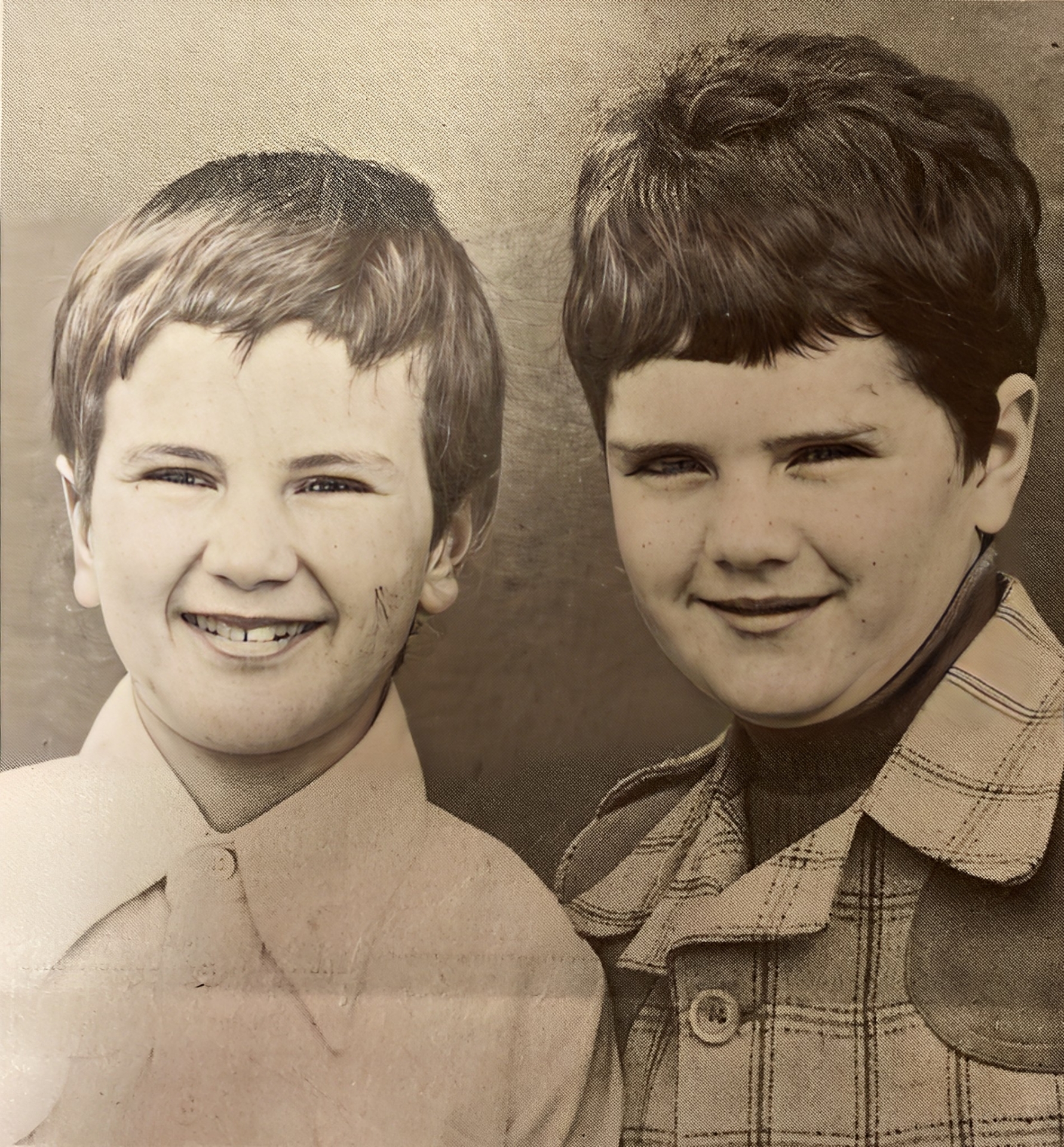
A Derry Journal feis picture from 1977 showing Thomas Sweeney who was runner-up in the Boys Vocal Solo aged 7 – 8 years. Pictured right is Chris McCallion who won the competition. The competition was held in St Eugene’s Parish Hall, otherwise remembered as the Stardust.
“That’s where my relationship with James MacCafferty and the MacCafferty family began. I stayed with James right up until my voice broke around the age of 12 or 13. He was just such a wonderful, wonderful man. I can never repay what I learned from James. It wasn’t just about singing; it was about performing a song and telling a story in a song.
"I then went back to James when I was 14 and my voice started coming back again and did another few lessons with him. To be honest, when I reached 16 or 17, I went to the ‘dark side’ and started playing in bands and I haven’t stopped playing live music ever since. I have no doubt in my mind it all began at Derry Feis.
“I remember James himself telling me that the classical singing route was not for everyone. If you were enjoying what you were doing and playing music that was good enough and I still, after all these years and at the age of 56, absolutely love performing. I really do. I was really good boy soprano, but when the voice came back again, my mother was really, really hoping that it would come back as a tenor voice. It didn’t. It came back as more of a baritone voice. That’s the luck of the draw.
“At that stage I was singing in St Eugene’s Cathedral Choir, and I was the youngest singer there at that time, which was around 1988. We were performing pieces like Handel’s ‘Messiah’. Donal O’Doherty was the musical director at that point, and we were doing concerts and so on. But there just something inside me that felt it wasn’t floating my boat as much as pop and rock music. I moved across to that style at the age of 17. I formed my first band and the only time I’ve ever stopped is when I moved with my job to Scotland for two years,” Thomas added.
However, the gratitude or respect for his roots in the more classical singing tradition was never abandoned, and when his teacher and mentor James MacCafferty passed away aged 80 in 1995, Thomas penned a song in honour of him called ‘The Music Man’.
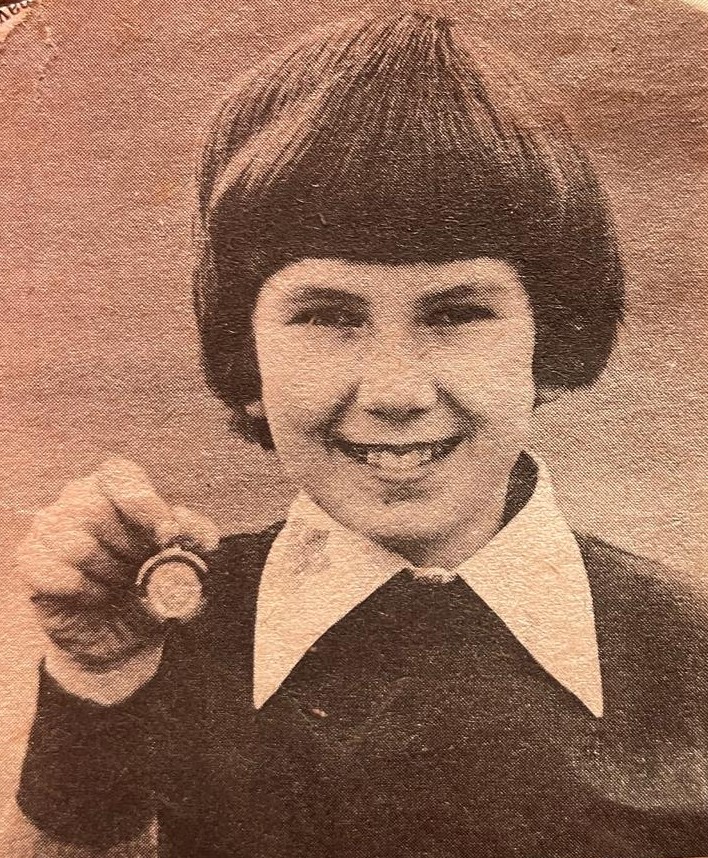
Thomas pictured when he won the Boys Irish Solo aged 10 – 11 at Feis Dhoire Cholmcille.
Returning to talking about Derry Feis, Thomas recalled that Easter week itself was “wonderful”.
He continued: “There was always camaraderie between the fellas you were singing with. Of course, there was a bit of competition and rivalry in wondering who was going to win. But in a nice way. There was never any backstabbing. Everybody was encouraged whether you were the worst singer or the best singer in the world. You were treated the same, you got your two minutes of fame up on that stage and that’s what I loved about it.
“It was character building for the future in your own life. That’s what it has done for me. It has given me confidence, and it gave me the opportunity to go out and perform from a young age. Derry Feis led onto other feiseanna like Moville Feis, the Londonderry Feis, Carndonagh Feis and things like that. It was great”.
Like a hefty percentage of parents associated with Derry Feis, Thomas’ said his mum Rose was “the absolute feis mother”.
Thomas added: “She just loved it. I think looking back on it, she would have loved to have been doing it herself. She was there every single time. When my mum passed on a number of years ago, my sister found upstairs in a cupboard in her room a big brown envelope. Inside was every single one of my feis critiques from adjudicators over the years. I still have every single one of them”.
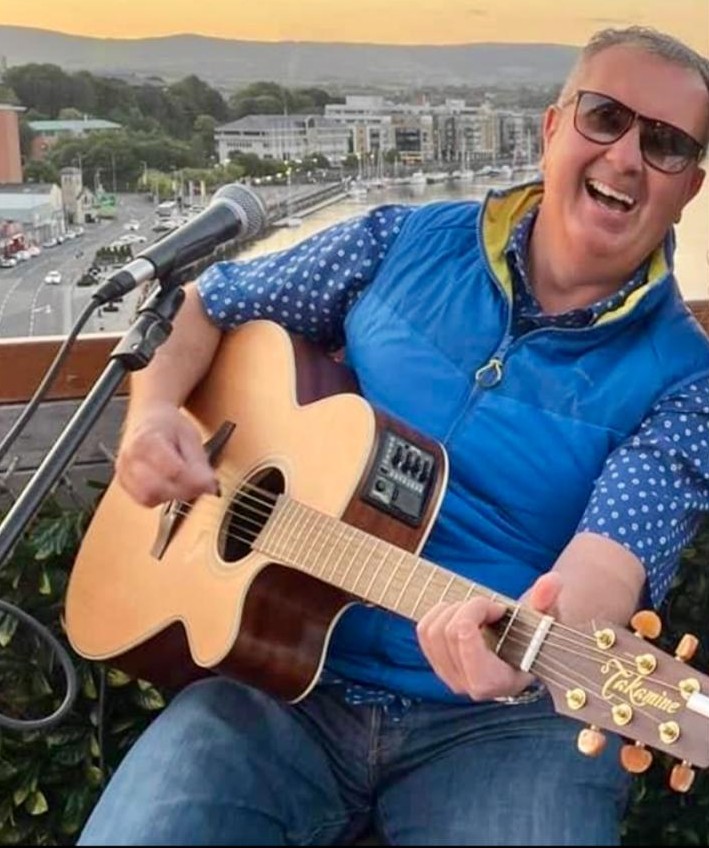
Thomas pictured doing what he loves the most – performing live.
The importance of Feis Dhoire Cholmcille in influencing the cultural landscape of Derry and far beyond is something that Thomas Sweeney fundamentally believes can never be overestimated. He never misses an opportunity to inform people from all over the world about how the institution has moulded many globally known names in the arts, while at the same time giving every child the chance to get up on stage just once.
"It’s a sink or swim experience in his estimation and he asserts that not liking it is just as valid as blossoming as a performer because of it.
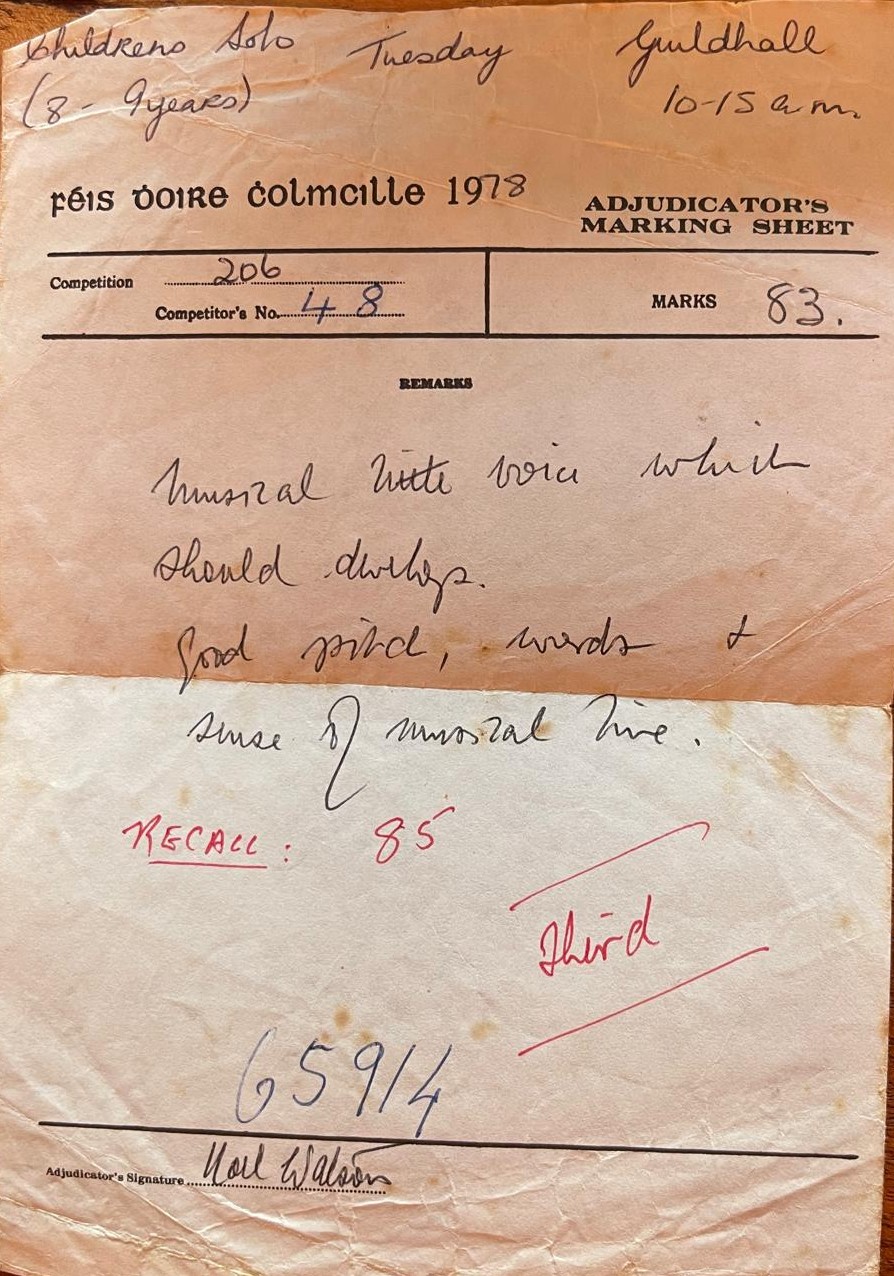
After his mum passed away, Thomas discovered that she had carefully stored all his Derry Feis adjudication sheets. This one from 1978 shows that he placed third in the Children’s Solo aged 8 – 9 at the Guildhall with a mark of 83.
“There are probably as many people who were overwhelmed by the feis stage as there are those who loved it. That’s ok. It’s not for everyone, but the feis gives you the chance to find out,” he said.
“I’ve been entertaining tour groups to the city for years now. I always tell them about Derry Feis, especially when I am in the Taphouse and the Guildhall is literally next door and the importance of the Guildhall to the history of the feis is obvious.
READ NEXT: Derry Feis named as Best Cultural Festival for Irish Arts 2025
"I have told Americans, Canadians, Australians, New Zealanders, people from Eastern Europe and from Asia and Africa about Derry Feis. The feis is part of the history of this place and its importance and its influence remains enormous”.
Feis Dhoire Cholmcille runs this year from Tuesday 6 April to Friday 10 April at St Columb’s Hall and The Playhouse, Artillery Street. Competition details can be found at www.derryfeis.com.

Subscribe or register today to discover more from DonegalLive.ie
Buy the e-paper of the Donegal Democrat, Donegal People's Press, Donegal Post and Inish Times here for instant access to Donegal's premier news titles.
Keep up with the latest news from Donegal with our daily newsletter featuring the most important stories of the day delivered to your inbox every evening at 5pm.

This publication supports the work of the Press Council of Ireland and Office of the Press Ombudsman, and our staff operate within the Code of Practice of the Press Council. You can obtain a copy of the Code, or contact the Council, at www.presscouncil.ie, Lo-call 1800 208 080 or email: info@presscouncil.ie.