

Derry Defective Concrete homeowners urged to join Council register

Derry City and Strabane District Council has re-opened its register of property owners within its area who “suspect their residence/dwelling has been impacted by defective blocks”.
The move has been welcomed by Derry man Danny Rafferty, chairperson of the NI Defective Homeowners (NIDCH) campaign group.
NIDCH was established following a public meeting in the city in May. It comprises homeowners, initially mainly in Derry, impacted by defective concrete blocks and products which originated in Inishowen in County Donegal.
In 2022, the Beragh Hill Road home of Mr Rafferty and his wife Kathleen became the first one in the North to be confirmed as deteriorating due to the use of defective concrete blocks and products in its construction.
Speaking to The Derry News, Mr Rafferty urged affected homeowners to register with Derry City and Strabane District Council at the following link: https://www.derrystrabane.com/services/building-control/defective-blocks.
“All people have to do is email: [email protected] with the following details,” said Mr Rafferty, “your name; the affected property address; a contact number; and a copy of testing/documented evidence, if available, to show your property has been impacted by defective blocks.”
On its ’Defective Blocks’ web page Derry City and Strabane District Council (DCSDC) said: “We no longer require property owners to have evidence of this by an authorised defective blocks testing organisation or structural engineer.”
It added: “However, it is important to note that DCSDC cannot carry out any form of defective blocks testing on any property within the city and district. We recommend property owners who wish to carry out testing to seek the advice of a structural engineer, in the first instance, who would be best placed to advise further.
“We are carrying out a data collection exercise only, which will allow us to quantify how many homes/properties within the Derry City and Strabane District Council district that may be affected by defective blocks.”
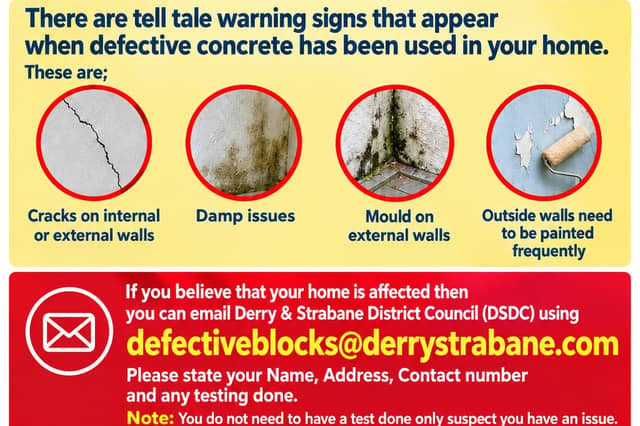
Mr Rafferty highlighted that NIDCH had produced an information leaflet to complement the information on the Council web page.
I have been contacted by people throughout County Derry and Tyrone who suspect their homes are affected by defective concrete blocks which are crumbling as a result of Internal Sulphate Attack. I also have reason to believe that social housing developments in the city are affected.
“People may have heard about the defective concrete crisis in the Derry City and Strabane District Council area known as Internal Sulphate Attack,” he said.
“Defective concrete products both blocks and poured concrete were manufactured in Donegal. These defective products were distributed throughout the west of Ireland for over 30 years,” he added.
“These blocks were transported across the border to Northern Ireland and used to build homes. A few homes have already come forward and have tested positive.
“There are tell-tale warning signs that appear when defective concrete has been used in your home. These include: cracks on internal and external walls; damp issues; mould on external walls; and outside walls needing to be painted frequently.
“I would urge affected homeowners to register their details with Derry City and Strabane District Council, but please note, they do not need to have a test done, they only need to suspect they have an issue.
“Derry City and Strabane District Council will then collate this information, and our aim is to have a scheme brought before the Department for Communities (DFC) in Stormont to support affected homeowners,” said Mr Rafferty, who is also the official spokesperson in the North for the 100% Redress Party which has four elected Donegal County Councillors and a TD, Charles Ward.
“The really shocking thing about this situation is the quality of the concrete blocks and products coming out of quarries in Donegal are still not being tested by the Irish Government,” he added, “which is absolutely criminal. Anyone who buys a block from the Republic of Ireland would need to exercise caution.
“I have been contacted by people throughout County Derry and Tyrone who suspect their homes are affected by defective concrete blocks which are crumbling as a result of Internal Sulphate Attack. I also have reason to believe that social housing developments in the city are affected,” said Mr Rafferty.
In May, The Derry News asked DfCif it intended to initiate legal action against the Irish State for allowing an unregulated industry to sell defective concrete blocks and products across the border, into the North and on into Britain and Europe.
It also queried how DfC was going to ensure certified chartered engineers involved in testing homes in the North for defective concrete blocks and products used a recognised British or EU testing standard.
This is because Irish Standard (IS) 465 was designed by the Irish Government, to test for mica, in Donegal. The ‘mica theory’ for defective concrete blocks and products has subsequently been disproved, and Internal Sulphate Attack is now the internationally recognised, scientific cause of the deterioration.
A DfC spokesperson said: “The regulation and testing of construction products is a reserved matter within the United Kingdom.
“The Ministry for Housing, Communities and Local Government is responsible for Construction Product legislation and associated standards supported by the Office for Product Safety and Standards as the regulatory body. The Department for Communities will therefore not be initiating legal action.
“While there is currently no evidence to suggest a systemic issue with defective blocks in Northern Ireland, the Department will continue to monitor the situation and take appropriate action should further evidence come to light.”
The Derry News contacted the Ministry for Housing, Communities and Local Government and the Office for Product Safety and Standards. At the time of publication, no response had been received.