

Can Slaughtneil claim crown as Ulster’s greatest club side?
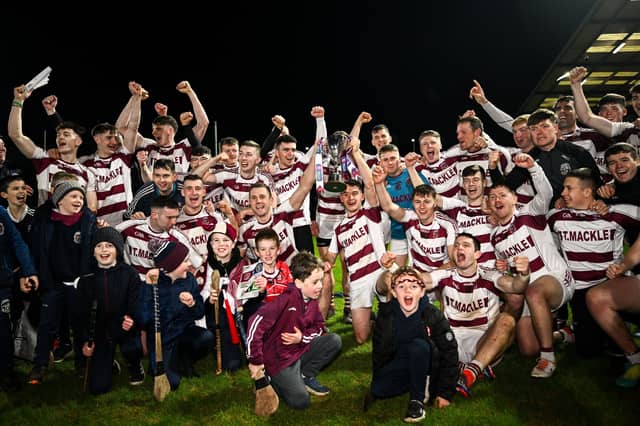

How the Derry kingpins compare to Cushendall, Dunloy, Loughgiel.
Slaughtneil bid to become Ulster’s greatest.
Slaughtneil have dominated the Ulster hurling landscape since their breakthrough provincial crown a decade ago. The Derry kingpins have now won 14 consecutive county titles and six Ulster crowns since 2016, establishing themselves as one of, if not the, greatest Ulster club hurling teams of all time.
This Saturday, the Derry men will bid to do something they have never done before, as they go in search of an unprecedented three-in-a-row Four Seasons Cups when they take on Down champions Portaferry at the Box-It Athletic Grounds in Armagh.
Across the border in Antrim, Cushendall, Dunloy, Loughgiel and Ballycastle have all had their time at the top of the ladder. But Slaughtneil have managed to marry the traditions of the old club game with the demands of the modern era, remaining local and holding onto the parish’s best players to sustain a level of dominance rarely seen in the club game, particularly given the pressures facing rural clubs in modern Ireland.
Across the province, there have also been some remarkable juggernauts down through the years and, even further down the ladder, simply incredible runs of consecutive county titles. In Armagh, Middletown won seven in a row between 2019 and 2025. In Cavan, Mullahoran won 21 in a row at one stage, while in Tyrone, Éire Óg’s six-in-a-row run came to an end this year as Lámh Dhearg finally ended their drought.
But as Slaughtneil now embark on a potential seventh provincial title in ten years, where do they sit in the pantheon of Ulster greats?
Cushendall: The Historical Benchmark
Cushendall sit at the top of the Ulster roll of honour with 12 titles, although their success has been spread across several different eras since their first provincial triumph in 1981, with their most recent coming in 2023.
The Glens men have also produced some of the great figures of Ulster hurling, including Terence McNaughton, Leonard McKeegan and, in the modern era, the legendary Neil McManus.
Their longevity is arguably the club's most impressive trait. Cushendall did not dominate one generation of Ulster hurling; they have set the standard as one of the province's premier clubs for more than four decades in a place where hurling is akin to a religion.
Slaughtneil’s 14-year run is extraordinary, but Cushendall’s ability to remain at the peak of both Antrim and Ulster hurling across multiple decades is equally impressive, particularly in a Saffron championship famously cutthroat and difficult to emerge from.
McQuillan’s Ballycastle: 1978-1986
The men from the north coast enjoyed a remarkable period of dominance in the provincial game that mirrors Slaughtneil’s modern-day hegemony.
They won three Ulster crowns in a row from 1978 to 1980, as well as back-to-back titles in 1983 and 1984. Ballycastle returned to the summit again in 1986, cementing their place as one of the all-time great Ulster hurling sides. They also became the first club from the northern province to reach an All-Ireland final, back in 1980, when they came up short against Galway’s Castlegar.
That great team of the late seventies was heavily backboned by the Donnellys: Cormac, Dessie and Terrance, all of whom were part of all six of Ballycastle’s Ulster titles.
In more recent years, Ballycastle have fallen down the pecking order in Antrim, with their most recent provincial success now dating back to 1986, when Paul McKillen was their marquee player. However, there have been signs of serious renewal. This year with a young team, they reached the Antrim quarter-finals before being beaten by Cushendall, suggesting that the north coast club may yet have another chapter to write.
Dunloy: 1994-2003
Dunloy have 11 Ulster Senior Club Hurling Championships to their name, making them second in the roll of honour, with much of that concentrated in their four consecutive provincial titles between 2000 and 2003. From their breakthrough Antrim title in 1990 until the end of that era in 2003, Dunloy collected nine county crowns and seven Ulster titles while reaching the All-Ireland final on no fewer than four occasions.
The great Lavey team of that era locked horns with Dunloy in three Ulster finals, with the Cuchullains establishing themselves as the kingpins of Ulster hurling during the 1990s. Slaughtneil’s present-day dominance is comparable to that of Dunloy at the beginning of the millennium, but they still have some way to go to match both their provincial haul and their record of All-Ireland final appearances.
Loughgiel: 2010-2013
Loughgiel’s greatest argument comes from what they were able to achieve beyond Ulster. The Shamrocks put together a remarkable four-year run between 2010 and 2013, capturing four consecutive provincial crowns, but it was what followed their 2012 success that truly elevated that team into the pantheon of Ulster greats.
That year, Loughgiel secured a second All-Ireland senior club title, having first reached the summit in 1983 under the captaincy of the legendary Niall Patterson. Almost three decades later, the Shamrocks were back on top of Ireland, defeating Limerick’s Na Piarsaigh and Offaly’s Coolderry on their route to the national decider.
The 2012 final itself became synonymous with Liam Watson, who delivered one of the greatest individual performances the club championship has seen. Watson finished with a remarkable 3-7 as Loughgiel overcame Coolderry to lift the Tommy Moore Cup.
Slaughtneil: 2013-Present
Fourteen county titles in a row speak for themselves, particularly given what came before it.
Between 1965 to 2012, Slaughtneil managed to win just six Derry Senior Hurling Championships, as Kevin Lynch’s and Lavey dominated the club scene. Since then, however, they have had a copper-fastened grip on the Fr Collins Cup, with few ever coming close to toppling them.
They have beaten Kevin Lynch’s in eight of the last nine Derry finals, with their latest victory arguably among their most impressive. Paul McCormack’s side played the majority of the game with 14 men after Brendan Rogers’ 25th-minute red card, but experienced campaigners such as Cormac O’Doherty, Shane McGuigan and Chrissy McKaigue stood up to the challenge alongside emerging players such as Conor Coyle, Deaglan McNamee, Cathal O’Mianain and Shea Cassidy.
The Derry kingpins have also contested 10 of the last 12 Ulster finals, winning six and becoming the first club from Derry to lift the provincial title.
They have yet to translate that dominance to the All-Ireland stage, however, falling at the penultimate hurdle every time. Their inability to reach a national final may yet count against them when comparing their record with the very greatest, but to their defence, they are still a long way from being finished, with another generation beginning to emerge.
For now, they have a compelling claim to be the defining club team of the modern Ulster era.
Whether that makes them the greatest of all time is another question and depends on how much longer their incredible run will last and whether or not they can add an All-Ireland crown to an already extraordinary list of honours.