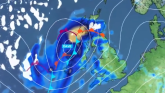
Storm Dave is expected to hit the North this weekend.
Search


04 Apr 2026

Please allow ads as they help fund our trusted local news content.
Kindly add us to your ad blocker whitelist.
If you want further access to Ireland's best local journalism, consider contributing and/or subscribing to our free daily Newsletter .
Support our mission and join our community now.
To continue reading this article, you can subscribe for as little as €0.50 per week which will also give you access to all of our premium content and archived articles!
Alternatively, you can pay €0.50 per article, capped at €1 per day.
Thank you for supporting Ireland's best local journalism!


The length of time between albums is something that varies artist to artist. Some people, like Willie Nelson, release at least two a year. Others wait a bit longer.
Guns N’Roses had 15 years between ‘The Spaghetti Incident’ and ‘Chinese Democracy’, MC5 waited 53 years before releasing their third album ‘Heavy Lifting’ last year and the Pixies released ‘Indie City’ twenty-two years after ‘Trompe Le Monde’.
This week, I’m talking to Martin Malone and Jane Breen of Innocents Abroad, who are about to release their third album, ‘Late Spring’, only 37 years after their second album ‘Eleven’.
The album, which shows the clear influence of groups like R.E.M., 10,000 Maniacs and Husker Dü, is out on March 30th and I caught up with Martin and Jane (guitar and bass, respectively) to talk a bit about it and the group in general:
“Innocents Abroad were originally founded in Liverpool around 1985. We did two albums in the eighties, ‘Quaker City’ in 1985 and ‘Eleven’ in 1988. We played a lot around Liverpool and London and were courted for a brief while by the majors, taken out to dinner a few times. The very thing that’s probably our strength now was our kryptonite then. Word got out that we sounded a bit like R.E.M., who we loved so that wasn’t a problem for us.
READ MORE: MacD on Music
“At first that seemed to be a positive thing but then they went cold on us. You could see them all sending messages ‘They sound a bit like R.E.M.’ and we were saying that, if we do, this band was going to go stellar and make people a lot of money. At the time, that was a bad thing to sound like them. It’s mainly Pete’s [Peter Mills, vocals] voice. He’s always sung like that. His band before he started with me, he sung like that. I’ve always played guitar like that, even before I’d heard Peter Buck.
“We got a Guardian review of ‘Eleven’ and they described us as a home-grown answer to, yes, the R-word. By that time, we’d come apart. We all had different things to do. We were young men. I was about to move to the Middle East for a year, Pete was doing his PhD, Stuart [Hilton, drums] was going to the Royal College of Art.”
“We didn’t speak to one another for thirty years because bands, especially your best shot bands, don’t work out the way you’d hoped, it’s quite like the end of a marriage. We didn’t fall out, but we just didn’t speak to anyone. I was obsessed by the fact that the second album didn’t sound how I’d heard it in my head. I trained to be a sound engineer in Manchester in 1990 and then in the ‘90s I did my own stuff. I was in a band called Eskimo Chains and I did a couple of solo albums that sounded like I wanted them to. I got to a certain point in my life when the law of diminishing dignities kicked in and I got tired of working with musicians, so I transitioned from being a songwriter to being a poet.”
“A few years ago, Pete, who’d been my songwriting partner, started talking again and started having the odd reunion about ten-fifteen years ago. Pete came up to my house in Scotland at the time and we said, for the craic, why not make the album we wanted to make in the 80s and things spun out from there. We consciously sat in a room to see if we could write songs again and we came out of the session with two or three ideas that I’d developed. Once I’d recorded them in my home studio we thought ‘yeah, we’re on to something here’.
“Subsequently to that we got back in touch with our original drummer Stuart, and I met Jane through almost a novel’s worth of circumstance, and we became an item. I knew Jane had been a musician in a previous life. The old bass player wasn’t really an option and I just said to Jane ‘you’d been a musician once. Let me teach you a bit of bass’.
“She’s worked bloody hard, considering she’d never picked up a bass beyond three years ago. Because of magic links with people in this little Scottish town, I started working with a German producer Victor Hilderbrand and he said, ‘why don’t you record the album with me in Berlin?’ and we thought, at our age, now’s our chance to have a Berlin period, so we went and recorded the album there last spring.”
And that’s it from Martin Malone. Now, onto other business. Last Friday saw the release of the new single from acclaimed solo artist and former bass player for Van Morrison, Clive Culbertson. The track, ‘How Can You Say’, is a re-imagining of an almost 40-year-old track and features Deep Purple’s Simon McBride on guitar.
Finally, time for the socials (or social, in this case). Innocents Abroad can be found on Facebook and Instagram @innocents_abroad. Their new album ‘Late Spring’ is out on March 30th and will be available on Bandcamp and all good streaming services

Subscribe or register today to discover more from DonegalLive.ie
Buy the e-paper of the Donegal Democrat, Donegal People's Press, Donegal Post and Inish Times here for instant access to Donegal's premier news titles.
Keep up with the latest news from Donegal with our daily newsletter featuring the most important stories of the day delivered to your inbox every evening at 5pm.

This publication supports the work of the Press Council of Ireland and Office of the Press Ombudsman, and our staff operate within the Code of Practice of the Press Council. You can obtain a copy of the Code, or contact the Council, at www.presscouncil.ie, Lo-call 1800 208 080 or email: info@presscouncil.ie.