

Paul McFadden on McGuinness: Rebuilding the peace without enigmatic leader
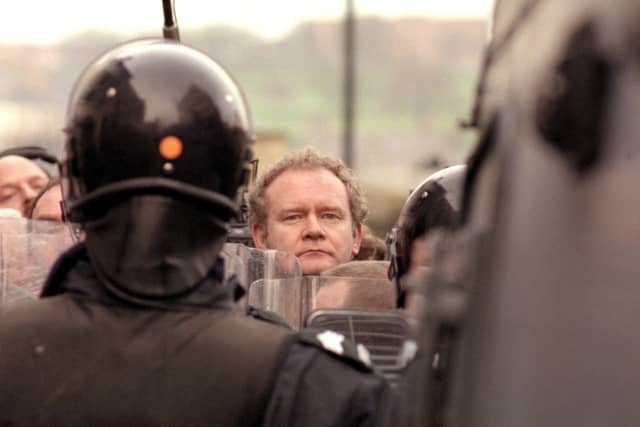

Former Radio Foyle journalist Paul McFadden, who interviewed Martin McGuinness many times, reflects on the impact of his departure from the political stage.
I can still remember the first time I saw Martin McGuinness, consciously at least. Our family were on holiday in Buncrana, so it had to be August. It must have been 1971 or ’72, when I would have been 10 or 11 years old. Well over 40 years later I can still recall the frisson of excitement when he was sighted briefly in Castle Avenue, one hot summer afternoon, and the whisper went around, “There’s McGuinness”. He was spoken of sotto voce and with a sense of near awe. At the time, he himself was only 21 or 22 but already he had a fearsome reputation. And there was one other thing I remember: they said his hair was dyed. Martin McGuinness’s appearance got people talking again recently. He turned up at Stormont, gaunt and clearly unwell, to offer “friendly advice” in a feeble voice to his Executive colleague, Arlene Foster. He urged her to step aside temporarily over the RHI scandal. The First Minister ignored the warning and has since become a former First Minister. In politics it is nigh on impossible to map out a future course – even for the short term – with any degree of certainty. Many years ago, Harold MacMillan identified the destabilising factor: “Events, dear boy, events.” These have a habit of sweeping us off in unforeseen and unforeseeable directions. Journalists have reflected recently on the ‘journey’ that Martin McGuinness has been on, which brought him from being ‘Britain’s number one terrorist’ – according to ITV’s The Cook Report – to an international statesman, gracing the Oval Office in Washington. It has, by any measure, been a remarkable migration. Anyone who dared suggest in the early 1970s that the unpolished, awkward-looking young man who was second-in-command of the Provisionals’ Derry Brigade would one day shake hands with Queen Elizabeth II would have been locked up (or worse). His journey has, indeed, been remarkable although perhaps the even more remarkable thing has been the fact that so many others have been making their own personal pilgrimages as a result.\ It was astonishing to hear the North Antrim MP, Ian Paisley, sympathising with Mr McGuinness on his illness on BBC television last Thursday evening and thanking him for going on his “remarkable journey”. Not only had it saved lives, Mr Paisley said, it had “made the lives of countless people in Northern Ireland better”. At a time when public confidence in our teetering institutions has gone so far beyond rock bottom that it could almost be classed as fracking, the MP’s remarks injected a degree of humility and a note of humanity into proceedings. They may even have given us grounds for hope, although experience – and history – suggest otherwise. Less than 18 months ago, DUP ministers – with the exception of Mrs Foster – played a kind of ministerial hokey-cokey at Stormont in a row over the status of the IRA ceasefire. Ian Paisley’s comments last week suggest that he, at least, has accepted Sinn Féin’s bona fides. For a long time unionists reserved a particular venom for Mr McGuinness, whom they suspected of being the architect of much of the violence of the Troubles. The Observer newspaper said: ”While others threw stones and petrol bombs, launched sniper attacks on British soldiers, planted bombs and sacrificed personal lives for the cause, he did it all to Olympic standards.” Ultimately, though, these impeccable paramilitary credentials – and the fact that he had always a proud and unapologetic Republican leader – allowed him to sell the peace process to his own deeply sceptical community. As controversy after controversy rocked the power-sharing Executive, the Maze-Long Kesh set-back, Red Sky, NAMA – the selling became harder and harder. Mr McGuinness disclosed last week that gestures such as meeting the Queen, going to the Somme, going to Flanders’ fields, the many other act of reconciliation that he had been involved in, had been “a bridge too far” even for some mainstream republicans “not because they were opposed in principle to it but because there was no reciprocation coming from the DUP”. The events of Christmas week – Speaker Robin Newton’s performance and Paul Givan’s Líofa bursaries decision – ultimately did for the Executive. Recent events have also highlighted two of the most important aspects of Martin McGuinness’s character: the charm that has won over many civil servants and eventually even his former nemesis, the late Lord Bannside (Rev Ian Paisley); and the steeliness that saw him rise from his sickbed to confront Arlene Foster face-to-face. Paisley the Younger has appealed for “a second chance to get this [power-sharing] right”. That will be a decision for an exasperated electorate. And it will have to be done without arguably the most enigmatic figure in local politics: the hard man-nice guy, the uncompromising warrior who became one of the most accommodating of peace-builders. “Obviously I will not be ever again an elected representation,” Mr McGuinness said last week, “but I would hope that I would have a key role to play in terms of continuing to build support for the peace process, build support for unity, build support for reconciliation.” Martin McGuinness has more immediate problems to deal with. Many of his staunchest former enemies have wished him well in his fight to restore his health. That is shaping up to be the toughest battle of his life. Now the job of rebuilding the peace will fall to others. It will be an immense job without him.