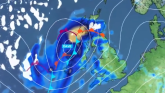
Storm Dave is expected to hit the North this weekend.
Search


04 Apr 2026

Please allow ads as they help fund our trusted local news content.
Kindly add us to your ad blocker whitelist.
If you want further access to Ireland's best local journalism, consider contributing and/or subscribing to our free daily Newsletter .
Support our mission and join our community now.
To continue reading this article, you can subscribe for as little as €0.50 per week which will also give you access to all of our premium content and archived articles!
Alternatively, you can pay €0.50 per article, capped at €1 per day.
Thank you for supporting Ireland's best local journalism!


There were about 1,000 workers employed by Du Pont Construction at their Maydown site at the end of the 1960s.
Electricians, bricklayers, plumbers, pipe-laggers, joiners, painters, labourers and tradesmen's mates came from far and near.
The project was to build the Orlon and Lycra plants as well as a huge boiler house.
I got a job as the project reached its final phase. It was to last one year.
My first day at the chemical plant was a daunting one.
I had never been on a building site before.
Safety rules were drummed into me and about twelve more rookies at the main office.
They were:- no smoking on site except in designated areas like the huge canteen; no running or horse play at any time; protective glasses and helmets to be worn at all times, safety belts to be worn whilst standing on scaffolding and ladders; all ladders to be tied off and no lighters or matches to be carried beyond the security gatehouse.
We were told in no uncertain terms that any breach of these rules would, not could or maybe, result in instant dismissal.
With the indoctrination complete we were led to be kitted out.
I was to be in the testing squad (later to be named F Troop) with the plumbers. My title – pipe-fitters mate. The storekeeper supplied us with a large pair of gloves and an even larger yellow helmet adjustable to fit all sixes.
On one side of the helmet was a white sticker with a spade drawn on it. He then asked me what size of shoe I wore.
“Nine,” I replied, whereupon he thrust a pair of black steel toe-capped boots into my arms.
I tried them on after I prised them from the plastic bag surrounding them.
I smiled, they seemed to fit. Several days later I had to cut them at the back to ease the pain. Someone told me I should have ordered a size bigger than my shoe size.
My senior foreman turned out to be a surly six-foot tall Derry man who shall remain nameless. There was no welcome from him. I think I'd interrupted his tea-break.
“You Gallagher? Follow me!” he ordered. “And don't dawdle!”
He led me on a long march. I never knew Du Pont was so big. When I was up in Creggan it could barely be seen nestling at the mouth of the river Foyle. Now it looked like a town of pipes, scaffolding and roads with steam hissing from every flange. I followed the foreman, up ladders, across roofs, almost into mid-air. He stopped near a small platform jutting out from a flat roof. Two men were struggling to position a large pipe there. I felt sick when I looked over the edge. There was barely enough room for them without me joining them.
“Here you – greenhorn. Come here!” shouted the foreman. “This here's Bob Trotter.” He tugged at my arm and ushered me forward, smiling.
“When you're finished helping out here, I want a word!” he said but he left as briskly as he'd come.
Trotter was the testing squad foreman. He was skinny with black hair and he spoke very fast.
He beckoned me to come even closer and lend a hand. I inched forward and caught a glimpse of the black tarmac and little figures far below. I felt light-headed.
“Don't like heights then, eh, son!” he said. “Well. We'll soon fix that. Here - hold on to this here pipe and keep it steady for the welder. Don't look when he's welding!”
I did as I was told. The welder had to help me back unto the roof when he was finished tacking the pipe into position. I was rooted to the spot but he took pity on me and told me to sit down for a while. My first day couldn't have been worse.
My next few months were spent trailing after a Belfast man called Benson. There seemed to be an awful lot of Belfast men on the job in skilled positions like plumbers, electricians, pipe-fitters and welders. Most of them stayed in digs around Hawkin Street. They were all ex-shipyard workers and were getting old.
One of them, an old guy called Morrison, must have been getting on for 75 years old, if he was a day.
He wore faded brown overalls and flapped his hands behind him when he walked.
Everybody, the mates especially, hated to be partnered with him. He once fitted water pipes and taps to the newly finished laboratories in the Orlon building.
While testing his handiwork for leaks he left the taps on overnight and flooded the third floor. He went home and forgot to turn off the pump. A leak developed.
Workers coming in the next morning couldn't get up the stairs because the water was gushing down on them.
The testing squad had it easy. Out job was to replace or build small sections of pipework or change faulty gaskets. We tested all pipework, flanges and welds for leaks.
We had a work-hut which had hundreds of rolls of red rubber hoses in them.
What we did was pump air or water at pressure into pipes and then watch a pressure gauge needle we would install to make sure it stayed at a certain level for a given period. If the needle dropped there was a leak.
One morning we were tasked to test a main pipe running right through the plant to the jetty where ships came in to load and unload.
I remember the day well. It was mid-winter and raining heavily and we were all decked out in yellow plastic coats, glasses, gloves and boots and our helmets. Since it was a massive pipe, the two plumbers I was assisting reckoned it would take an hour to fill and pressurise it.
We connected our hoses and the gauges to the pumping machine and retired to a nearby dry spot to await developments. Occasionally I was sent out to see if anything was happening. The needle on the gauge didn't budge. After an hour and a half the plumbers changed the gauge and tapped the glass thinking it was useless. About twenty minutes later we learned the truth. The pipe we were pumping water into wasn't complete.
There was a section missing and our water was pouring into a large hole being dug by B. Mullan Contractors. The fire brigade had to be summoned to pump it out. Our gang earned the nick-name F Troop after that.
It wasn't all fun though, especially when you had to crawl on hands and knees at a great height to test a flange for leaking air by pouring washing up liquid around it looking for bubbles. I never did master heights and couldn't believe my eyes sometimes as I watched steel erectors standing on thin beams, eating sandwiches at lunch-time, chatting as if they hadn't a care in the world. Painters were the same, no fear.
My most frightening experience occurred one cold winter morning. I was asked to go up 30 feet to the top of scaffolding to retrieve some tools needed for our next job. There was no ladder leading to the top. I decided to climb up the outside of the scaffolding. Nearing the top my right hand glove stuck to a patch of ice on a scaffold pole and came off. Luckily, I grabbed hold with my left hand, or I would have been a goner. Two days later I saw what could have happened to me. A painter fell from a similar height unto a concrete floor. We rushed to help him. At first sight I thought he was splattered on the ground but thankfully the red liquid spreading out all around him, was not blood. It turned out to be red oxide he had been using to coat steel. He was lucky – he only ended up with two broken ankles and a broken wrist.
In the one and only winter I spent at Du Pont Construction I almost came down with pneumonia.
For days I had been feeling unwell with a flu bug. Having to push start the wreck of a car we used for a 'lift' each morning at 7.30 a.m. didn't help. My job at that time was to paint white serial numbers on hundreds of cold, cast iron valves. I had to do this in the open air. I wore a long overcoat, scarf and balaclava but I still shivered uncontrollably.
If it hadn't been for a bricklayer from Tyrone coming along and telling me to 'wise up' and go home, I think I would have been found frozen to the spot. Even though it was 5 p.m. I had to seek permission to go home as it was Wednesday and for four days a week we were required to work from 8 a.m. till 7.30 p.m.
When the job finally began to run out of steam the pay-offs started. Each week a list would be posted in the canteen or on a work hut. To tell you the truth I was getting bored and hoped to go sooner rather than see it drag out. There was nothing to do all day now, except to look busy and try to avoid the Yanks. Bets were taken on who would be next for the chop. I was a young man of 19 then and I couldn't have cared less but some of the older workers did.
It was sickening for me to watch a man praying with Rosary beads that he wouldn't get picked for a while longer. Yet, we all knew it was inevitable that we would go out the gates for the last time some day. But then we realised that from the first day we were taken on.
Sometimes when I'm up around Glenowen Park or Creggan Country Park I stare out towards the river Foyle and Du Pont and somehow I can't imagine that I once worked there or that I had contributed anything to the making of that chemical plant.
Unlike other jobs I have been in, where the pay was less, I can't feel nostalgic about the time I spent there.
If I went back there tomorrow I would still be a greenhorn.

Delays are expected in Coleraine tomorrow (Saturday).
Team at Adriennes retirement

Heather Nicholl has been announced as a finalist in the Health and Fitness Personal Trainer of the Year category.
Sinn Fein's Creggan office

Professor Colin Harvey of Queen's University.

Subscribe or register today to discover more from DonegalLive.ie
Buy the e-paper of the Donegal Democrat, Donegal People's Press, Donegal Post and Inish Times here for instant access to Donegal's premier news titles.
Keep up with the latest news from Donegal with our daily newsletter featuring the most important stories of the day delivered to your inbox every evening at 5pm.

This publication supports the work of the Press Council of Ireland and Office of the Press Ombudsman, and our staff operate within the Code of Practice of the Press Council. You can obtain a copy of the Code, or contact the Council, at www.presscouncil.ie, Lo-call 1800 208 080 or email: info@presscouncil.ie.