

THE WARRIOR'S CODE - Usain Bolt - a hero we can believe in

"Where have all the good men gone And where are all the gods? Where’s the street-wise Hercules To fight the rising odds? Isn’t there a white knight upon a fiery steed? I need a hero I’m holding out for a hero ‘til the end of the night. He’s gotta be strong And he’s gotta be fast And he’s gotta be fresh from the fight” Bonnie Tyler
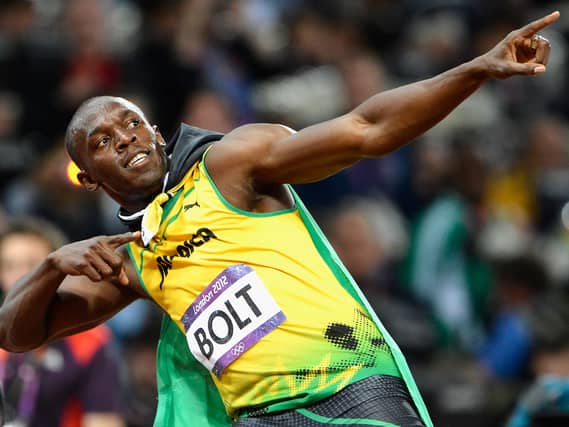
THE low snap of a single gunshot bursts from eight speakers at once to break the deathly silence that had descended on the Bird’s Nest stadium. The colour schemes of their Lycra uniforms are different — the red, white and blue of the United States, the green and yellow of Jamaica — in a race that has been billed universally as ‘good versus evil’. Hearts beating, we hold our breath and watch. And wait. And hope. The importance of a quick start is crucial. Our hero’s specialty throughout his storied running career has been the 200 metres, and that’s a distance for which the start isn’t as important. Over the longer race you can make up for lost time. That’s not the case in the 100m. Usain Bolt is the biggest man in the pack. He’s a beast of a man - six feet five inches tall, and 15 stone. That makes him three inches taller and twenty pounds heavier than the second-biggest competitor. When the other men reach their top speed, their limit, the world record holder continues to accelerate. Nobody has ever moved this fast before under his own power. Usain Bolt’s top speed is simply significantly higher than anyone else’s. Ever. Several metres before he crosses the finish line, he brings his fists up and thumps his chest – the victorious warrior has triumphed once again. “Are you not entertained?” he seems to say. When Usain Bolt crossed the line 0.01 seconds ahead of his twice-banned American rival Justin Gatlin to retain his world 100m title last week, it wasn’t just yet another victory over the doubters. For those who had painted this battle as a nothing less than clash of good against evil in light of the doping issues that have left this sport on life support, Bolt’s victory in the Bird’s Nest stadium, where he made his name, may have even secured its future. The Jarrow Arrow speaketh
“He’s saved his title, he’s saved his reputation – he may have even saved his sport,” enthused BBC commentator and former world champion Steve Cram as Bolt crossed the line fractionally ahead of the seemingly unassailable Gatlin. At 33, the American sprinter was unbeaten in 29 races and had recorded the fastest times in the world this year. Gatlin had sailed through his semi-final with ease, while Bolt, who has carried athletics on his shoulders for seven years but has struggled for form this season, looked uncharacteristically average as he crept through. Yet by the end, however, Bolt was striking his familiar poses and cavorting on the track in the manner to which his fans have become accustomed.
Doping – endemic in the sport?
The depth of the sport’s credibility issues were highlighted by the fact that four of the nine athletes in the sprint final had served bans for doping. As well as the Gatlin, who has become the bogeyman for those who believe the sport has been soft on cheats, his American team-mates, Tyson Gay and Mike Rodgers have also served suspensions. And there was consternation when Asafa Powell, Bolt’s Jamaican team-mate, was named captain of the national squad, given his own doping ban last year. To many, Gatlin, running faster than ever a decade after he won Olympic gold, remains in denial. His first ban in 2002 was reduced when he proved that the amphetamines found in his system were from medication he had been taking to treat attention deficit disorder. His second, an eight-year ban later halved to four, was blamed on testosterone cream rubbed into his buttocks by a masseuse with a grudge. (Nose extends to Pinnochio size.) In the buildup to this race, the IAAF, now led by Sebastian Coe, has been on the back foot, fighting a desperate rearguard action to try to convince a sceptical world it is doing enough to stand up to the threat of doping. A database leaked to the Sunday Times suggested that up to a third of endurance medals at major championships over a decade had been won by athletes with suspicious blood values. At the recent world championships, 66 competitors have formerly been banned. In some parts of the world, doping is rumoured to be rife. Late last year, detailed allegations were made about systematic doping in Russia, and wider corruption and cover ups. The problem is compounded by the fact that these days there are plenty of substances Usain Bolt could potentially be taking, from human-growth hormone to designer steroids, that remain effectively undetectable. Bolt, of course, swears he’s not cheating. He says he doesn’t even like to take legal supplements, and that he’s willing to be tested anytime, anywhere. I believe he is clean.
A freak of nature
Ethan Siegel, a theoretical astrophysicist at Lewis & Clark College, recently charted a graph to demonstrate that, judging by the incremental progression of the 100 metre world record over the past hundred years, Bolt appears to be operating at a level approximately thirty years beyond that of the expected capabilities of modern man. Mathematically, Bolt belonged not in the 2008 and 2012 Olympics but the 2040 Olympics. Michael Johnson, the hero of the 1996 Olympic summer games, has made the same point in a different way: A runner capable of beating Bolt, he says, “hasn’t been born yet.” Usain Bolt is a freak of nature. There’s the size, for starters: 6ft 5in with size 13 feet (ideal sprinters are thought to be between 5ft 11in and 6ft 1in). And the attitude – at warm-up, a do-or-die intensity is etched on the faces of his rivals, but Bolt smiles, acts the wag, even dances. And, of course, the records: Bolt is the fastest man ever – at both 100m and 200m. Finally, and most outrageously, he wasn’t even giving his all when he broke them. The world has been blessed with phenomenal sprinters, but nobody can hold a light to Bolt. In 2002 he became the youngest gold medallist at the junior world championships, winning the 200m. He was only 15, beating boys four years older than him. To put it in context, if Bolt didn’t exist, Gatlin, Gay, Blake and Asafa Powell, would be battling it out to be the fastest men in history. As it is, they barely figure in the conversation. Bolt’s superhuman achievements, along with his engaging personality, are what make him so compelling. His first world record came in the 100m (9.72 seconds) in New York in May 2008, beating fellow Jamaican Asafa Powell’s record by 0.02 seconds. At the Beijing Olympics that summer he set three world records, in the 100m (9.69), 200m (19.30) and 4 x 100m relay (37.10). The following year, he further slashed his individual records (9.58 and 19.19) at the World Championships in Berlin. For all the euphoria over Bolt’s recent victory, the sport is far from saved yet. But in Usain St. Leo Bolt, world record holder, world and Olympic champion – athletics, and indeed sports fans, have a hero they can believe in.
Read THE WARRIOR'S CODE in the Derry News every Monday morning.