

Derry event told Welfare Reform is ‘an attack on women, children and families’

By Ursula Duddy
An event focusing on Welfare Reform held in Derry yesterday heard the government’s plans described as ‘an attack on women, children and families’.
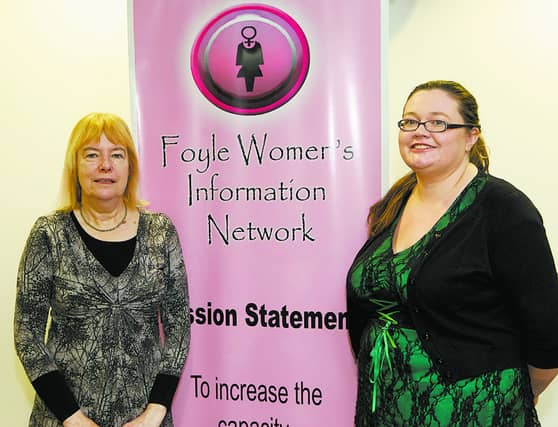
The event was held in the Holywell Trust building on Bishop Street and was attended by speakers, Gorretti Horgan, socialist activist and lecturer in social policy at the University of Ulster, and Louise Kennedy of the Foyle Women’s Information Network (FWIN), who also hosted the event.
The speakers said that 360,000 people will be affected by Universal Credit, paid to low income workers and the unemployed, and that claimants will be left, on average, seven weeks without any benefits due to the changes. This includes putting ‘200,000 children into poverty’.
Ms Horgan said that Universal Credit is essentially all benefits, except disability benefits, being paid together in a lump sum of around £500 a month for a couple with two children while a single claimant receives £317.82.
She outlined the proposed changes that are being suggested as part of the Welfare Reform and how it will affect people locally.
“Starting from last week, Universal Credit is being rolled out across Northern Ireland, this only applies to working age people, not if you’re retired so we don’t want older people getting worried about it” she said.
“The Two Child Policy and Universal Credit are actually linked. The Two Child Policy has been in since April; it doesn’t affect existing claimants. People already on benefits and claiming for more than two children, you will continue to get that payment until March 2020.”
Ms Horgan said there is a danger with this that people’s income will ‘take a real nosedive and fall off a cliff’ after its implementation. New claimants, also including those with any change of circumstance, will be directly affected.
“We like to call it the Two Child Policy because the idea of telling people that the state will only support you to have two children is highly unjust is actually like the One Child Policy in China because it’s one law for the rich and another for the poor.”
However, she added: “I am totally and absolutely against anybody being forced by financial reasons not to continue a pregnancy; that is absolutely awful.”
She also said that the fact that all claims for Universal Credit must be completed online was causing problems for those who are not computer literate or do not have access to a computer and that claims submitted to the system are said to have ‘disappeared’ due to computer or human error.
Ms Kennedy of the Women’s Information Network said that implementation of the cap for a two child family was ‘complicated’.
She said that the ideology of the two child cap is that you shouldn’t have more children than you can afford, however, she said that this does not allow for families that experience changes in circumstance through unemployment, deaths or marriage break-downs.
She also said that step-children or merging of families is not accounted for and unplanned pregnancies are not considered and there is no abortion provision but that no woman should be forced to consider abortion for this reason. Ms Kennedy also said that religious groups that may have objections to contraception or abortion would be discriminated against for following their faith.
There are some exceptions, such as multiple births and adopted, fostered or kinship care children but only those from this country who would ‘otherwise have been a burden on the state’.
She also highlighted the distressing ‘consensual conception exception’ condition which has been dubbed the ‘rape clause’ where women first have to prove they were raped to conceive an additional child to the two that the state will provide for. The woman would then be expected to name her rapist where possible despite what mental and emotional effect it would have on her. This in turn could in turn lead to criminal prosecutions, even if the named rapist was a husband or partner with whom a woman still lived with or was in fear of. The woman would then be expected to move away from that man to attain the benefit.
Ms Kennedy described the prospect of the new changes as ‘a bit terrifying’ and urged those who needed to seek help or advice to call the Welfare Changes Helpline.
“If you or anyone you know is worried about any of these things, pick up the phone to Welfare Changes Helpline and call free, it’s 9am -5pm, Monday to Friday, it’s run by the Law Centre, Citizen’s Advice and Advice NI and the number is 0808 802 0020.
“They want people to call because the Department of Communities are already saying there are not that many people calling it and they may want to stop funding it so – it’s a free line. All these changes are being made in dribs and drabs so it doesn’t seem like there’s a big demand at the minute but it will start affecting people as this all rolls in.”