

Broadcaster recalls interview with Richard Branson following his brush with death in Co Derry

By Cathal McGuigan
A BBC broadcaster has recalled speaking to Richard Branson after his brush with death in Co Derry.
Billionaire Richard Branson set off to attempt the world record for the first transatlantic journey in a hot air balloon from Maine, USA on July 2 1987.
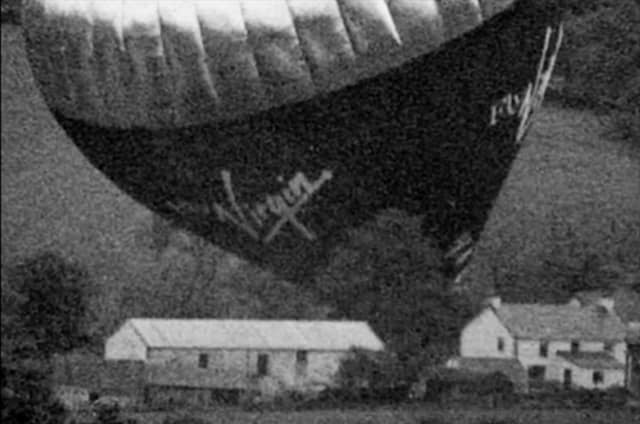
More than 3,070 miles away and 31 hours later the record was set when Branson and fellow adventurer Per Lindstrand briefly touched down near the City of Derry airport, narrowly missing a house and power lines.
BBC Radio Four announcer Mairead Devlin, then a junior reporter with Radio Foyle, interviewed Branson on the day. She spoke to Radio Foyle on the thirtieth anniversary of Branson’s crash.
“Obviously in those days we didn’t have mobile phones, we didn’t have sat-nav, we didn’t have anything like that, so when a big story, especially with someone who had the celebrity status of Richard Branson, was dropping in quite literally, everybody was sent all over the place,” Mairead said.
“I seem to remember that his balloon came down near Limavady, sort of scraped along the ground and then went off again.”
“Eventually it landed in the sea off Rathlin Island, but of course we were all in cars rallying around the back roads, obviously way over the speed limit, taking corners on two wheels.”
Mairead found it difficult to recall where she spoke to Mr Branson, although she thinks she caught up to him on Shipquay Street in Derry city.
“I had the radio car down in Shipquay Street and whoever the presenter was in those days, might have been Paul McFadden I think, said to me ‘we’re coming to you soon’ and Richard Branson was about to head off with somebody else, so I had to hold on to him, grip hold of his arm and not let him away. Everyone was trying to pull him away to get him, but we got the story,” she said.
“He just said that he really did think that it was over, that it was curtains for him, that he was going to die. He was very grateful to all the rescue people and he did promise that he would come back and see Northern Ireland properly.
“He was great and he was full of stories about coming back and I’m not sure that he ever did. He owes us a visit to talk about it now.”
Lindstand managed to dive out of the Flyer in the Irish Sea, but Branson was carried off in the balloon as it began to rise uncontrollably. The entrepreneur later found another opportunity to jump free and the pair were rescued from the freezing water by the Royal Navy.
In a recent documentary, Branson spoke about his terror and an “enormous feeling of loneliness” as the balloon began to rise over the Irish Sea.
“I saw my life flash before my eyes. It was just me standing on top of the capsule, looking down at the water,” he said.
“I’d had an extraordinary life and it looked like this was the last two or three minutes of it. I wrote a note to the kids, telling them how much I loved them and then I prepared to jump.”
The purpose-built Virgin Atlantic Flyer is now preserved at the Imperial War Museum, while fuel tanks which came off the Flyer when it bumped the ground are on display at the City of Derry airport.