

BREAKING: Housing crisis was major factor behind Derry's Protestant drift, new research reveals
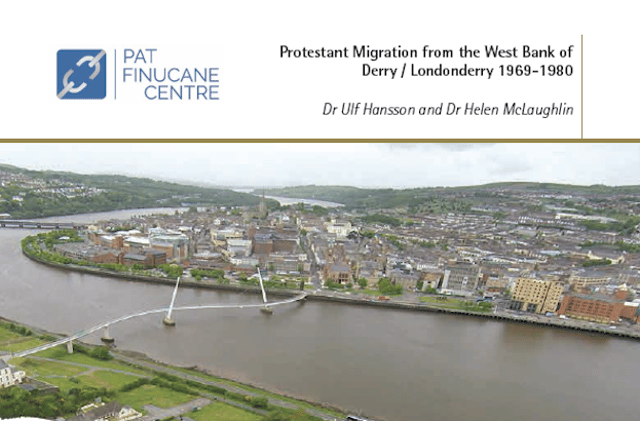

New research published this morning into Protestant migration from Derry’s west bank reveals that the city’s housing crisis was one of the major factors in the population drift here.
It finds that ‘substantial movement’ of the Protestant community away from the Cityside was already taking place before the Troubles had started.
And it also raises questions about the quality of Protestant leadership in the 1960s and 1970s - and suggests that the prospect of sharing space with Catholics may have been ‘unappealing’ for some.
The academic report - Protestant Migration from the West Bank of Derry/Londonderry 1969-1980, by Dr Ulf Hansson and Dr Helen McLaughlin – is being launched this morning at the Guildhall, by the Pat Finucane Centre, which commissioned the research.
According to the report’s findings: “The evidence shows that a number of complex and often inter-related factors contributed to Protestant migration from the west bank of Derry/Londonderry from 1969-1980 in particular.
“They point to: a fundamental shift in the position of Protestants within the city; safety and security issues; poor and limited housing on the Cityside and the availability of better housing elsewhere; the policy of skewing economic development and investment away from Derry/Londonderry and towards centres east of the Bann; and the lack of constructive leadership which could bring about a positive and effective assertion of Protestant identity in a changing landscape.
“Numerically significant studies such as TAR and Shirlow et al. indicate that direct intimidation does not feature in their research as the sole or main reason for migration. However, research which includes personal stories, by its very nature has sought out individuals who have experiences to share.”
Dramatic impact
In their conclusions, the authors state that housing policy and planning in Derry in the late 1960s and 1970s in particular had a ‘dramatic impact’ on the segregated nature of the city.
They comment: “Gerrymandering engineered a situation whereby the Cityside had a disproportionate Catholic majority, with other areas prevented from expansion and development.
“Poor attention to the housing stock meant that, when new estates were finally built for example at Lincoln Courts and Newbuildings, Protestant populations were displaced from their run-down places of residence on the Cityside on a supposedly temporary basis, but both the quality of the new housing, and the poor design of their redeveloped areas, meant that many were inclined to remain in their new Waterside homes.
“Some sources point to the possibility that more upwardly mobile Protestants moved away from the Cityside before the onset of the conflict, in order to take up residence in suburban areas with better housing, and as we have seen, there is some suggestion that the prospect of sharing space with Catholics may have been unappealing for some.
“These factors may go some way to explain the fact that even before 1969, substantial migration of the Protestant community away from the Cityside was already taking place.”
End of minority rule
The report further suggests that the end of unionist minority rule in Derry had an impact on the Cityside population, with ‘power imbalances’ being redressed while a sense of ‘ownership’ was eroded.
It states: “Nationalists gained control of the Council, and the housing system was reformed to prevent discrimination and to permit development of new housing. The security forces with which many Protestants strongly identified were exposed for their handling of Civil Rights marches, as a result of which significant reforms ensued.
“Symbolically, the close affinity which Protestants felt for the city centre was being challenged, and a sense of belonging and indeed ownership eroded. For those Protestants in poverty, any small possibility of joining with the Civil Rights movement in order to improve their living conditions was stymied by a leadership which framed it as a Republican conspiracy aimed at destroying Protestant identity, and further eroded by the increasing interest the Republican movement was taking in it.
“All of this amounted to a significant shift in position from minority rule and control over housing, employment and other issues vital to day to day life, to a system of nationalist majority rule with a fairer system of housing allocation. This must arguably have challenged the Protestant community’s sense of ownership and belonging, particularly in the Cityside, where Catholics and Nationalists were in a more concentrated majority. In such a context, the decision to move away from the west bank was taken by many.”
Security and safety
The researchers also examine security and safety issues as factors in the population shift. The authors comment: “The numerically significant surveys show that direct intimidation was not the only or principal cause of migration, but other evidence, in particular experiential evidence, shows that direct intimidation did happen, and where it did, it had a major, and in some cases immediate impact on individuals and on families and on where they felt able to live.
“In addition, ongoing unrest, violence and killings created an atmosphere of fear which caused people to move to areas considered safer. Factors such as the instability caused by major events such as internment and Bloody Sunday played a significant part.
“The targeting of security forces created a sense for many of being a community under attack, due to the close connection between the Protestant community and the forces, a feeling reinforced by the shooting of Protestant businessmen unconnected with the forces, and the targeting of Protestant owned businesses.”
Support
The research was funded by the Department of Foreign Affairs & Trade in Dublin, and also received financial support from the Good Relations team at Derry City and Strabane District Council.
An Advisory Group - consisting of Maureen Hetherington, Dawn Purvis, Professor Paddy Hillyard and Garbhan Downey - was established to provide advice to the researchers.