

Sideline View - Time for realism
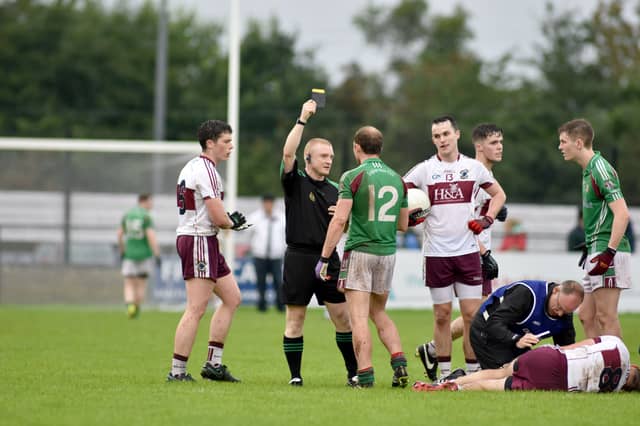

"It annoys me when people who don't know what they're talking about boo the referee." - Jonah Lomu
TWO things spring to mind when I think of referees. Firstly, we have never always agreed with all their decisions and this won’t change. Secondly, without them there would be no games. Those who spend their time belting out all sorts of obscenities at the man (or woman) in black need to remember that.
I learned my lesson. I was never one to be roaring mad at games but when Slaughtneil made their championship exit in 2002, I initially blamed Aidan McAlynn. I didn’t threaten him but in my own inner self I placed the blame at the Loup official’s door. He played enough extra time to give Dungiven a chance to get back into the game. That was my stance then.
I was part of our management team and Paul Bradley, on his senior debut, earned us a draw in the first-round game with Dungiven. A time when Slaughtneil had a poor championship record, our replay was going according to plan but we didn’t finish Dungiven off.
Leading by two points going into stoppage time, possibly the 68th minute, Dungiven substitute Paul Haran somehow got a boot to a loose ball and it squirmed between Damien Kearney and goalkeeper Padraig McKaigue. Goal. We were out.
On the final whistle, all hell broke loose with McAlynn attacked as he was ushered off the pitch. I saw the commotion but I just remember trudging across the field, crestfallen as we once again suffered a championship exit.
In time I forgave McAlynn and told him as much one day he was refereeing a school game. We had enough play that night to kill Dungiven off but we didn’t. We disputed a line ball in the second-half and after losing focus, the ball was played to an unmarked Fergal McGuigan who popped over the bar. In a game of inches, we lost by a point. We had more control over that line ball than Haran’s deflected shot.
HARD TO SWALLOW
Casting the mind back, we can all think of enough gut wrenching moments. In 2007, Damien Reddington’s late, late goal denied us an All-Ireland Minor title. But there was an earlier incident. Chrissy McKaigue won a close range free under the shadow of Hill 16. It was going to end Derry’s lengthy spell without a point. Longford whistler Derek Fahy took exception to McKaigue’s celebrations, hopped the ball and in the maroon breakaway Galway corner-back Keith Kelly went up to score a point.
Earlier that summer Cormac Arkinson’s first-half attempt for a point drifted wide in the Ulster Final at Clones but was given as a point. It was 10 years on since Raymond Cunningham’s 13th minute ‘point’ for Cavan was awarded against Derry to put the Breffni men 0-4 to 0-3 ahead and on their way to a one point win and their hands on the Anglo Celt Cup.
We always remember the highs and the lows, but the jaw dropping defeats will never really go away. They just linger annoyingly below the surface.
I have come to assess the situation better. Could the team have done anything in their own control to win the game? It isn’t always the referee’s fault. Players and managers will make as many mistakes as referees.
The late Kevin McAllister from Kilrea was refereeing a reserve game one day and was getting verbals from one of the players about ‘only’ being a reserve referee. ‘Bomber’ kept tight-lipped and continued with the game but when the same player squandered possession later in the game, McAllister quipped to the player that he was ‘only’ a reserve player.
I was right to forgive Aidan McAlynn. Referees are difficult to get and clubs struggle to get people to come forward. A former work colleague Harry Graham, a referee from Ahoghill, used to always say of the abuse directed at him during games:
“You’d think I gave up my night at home, to drive to the other side of County Antrim to do somebody’s ‘wee Johnny’ out of a decision,” or similar words.
LEAF ALONE
I went to report at a recent club game and Moneymore referee Joe Mulholland stepped out of his car on a balmy Wednesday night. Some 41 miles from home, Mulholland was the neutral referee at a derby game between Magilligan and Glack.
Myself, Mary K and Bernie Mullan where neutral but Mulholland was ‘leaf alone’ in the middle of the pitch.
Spectators from both sides were roaring all sorts but in fairness both managers were calmly watching their team as the game unravelled before their eyes. Some supporters, when they saw my notebook, suggested I report the poor refereeing.
With my impartial hat on, Joe’s performance was spot on. He may have missed a few things but on the whole he handled what was potentially a difficult game fairly well.
Two weeks ago, 2016 county final referee Benny Quinn took to Twitter to highlight a ‘threat’ at the end of an U14 game between Glen and Bellaghy he was officiating at.
Over the years, there have been incidents of referees being struck, verbally abused but the situation is getting considerably worse. It’s a tough gig.
If you are a player and playing poorly, you tend to get abuse from your own supporters and/or receive the curly finger from the manager.
If you are a manager and following a poor set of results the committee can show you the exit door. Referees are different, they get it from all sides – from players, managers and supporters of both teams. Not all the time.
It’s time to give respect and get respect. Some referee’s don’t help their case by carrying an aura of self-importance and control, refusing to interact with players. Some don’t explain a player’s genuine question of why a free was awarded, why a card was brandished or how many minutes of stoppage time are left.
In last year’s Ulster Club game between Cargin and Killyclogher, former Antrim wing back Tony Scullion asked Paudie Hughes the reasoning for his second booking, to which the Crossmaglen whistler allegedly uttered – ‘bye-bye.'
To a player these are viable and normal questions and differ drastically from a deluge of verbal manure often dished out to officials. There is a difference and referees shouldn’t tar everyone with the same brush.
It’s a tough job and the hierarchy don’t help the situation. Referees have to keep the score, the time, keep track of bookings and make judgements on all indiscretions - the bread and butter. It doesn’t end here. There are the hidden extras - from looking out for the mark to checking if a player has stolen yards from a sideline.
In the championship arena, there are linesmen, umpires and fourth officials to help. But on a random club league Sunday in the lashing rain in front of a partisan crowd, with nobody but himself for company, referees have a colossal job. We need to realise that and catch ourselves on.
There are more good cops than bad cops out there but GAA officialdom need to help one of the key commodities – the man in black. We may not always agree with them, but they are there to do a job.
Martin Sludden didn’t set off from Dromore to Croke Park in July 2012 to intentionally award Joe Sheridan that controversial goal and do Louth out of a Leinster title. Aidan McAlynn didn’t drive to Glenullin that night to knock Slaughtneil out of the 2002 championship. Anthony Campbell and his team of officials didn’t go to Celtic Park in October 2014 to award a goal they didn’t feel was over the line. In all three cases the officials ended up with more than they bargained for.
It needs to change. Sooner or later, something is going to get really out of hand and somebody is going to get seriously injured. Sadly it will take an extreme situation before the GAA hierarchy sit up and take notice.
As responsible adults, going to games, we have a duty to set an example for youngsters to follow.
What would happen if referees made a stand and downed tools? Where would we be?
As an association we really need to stop and think. Everything has gotten too damn serious. We all want to win, that is not the matter for debate. It is the way we treat people. Give respect, get respect.