

Slotted, drilled or solid brake discs: Which type is right for your car?


The best brake disc is not necessarily the most expensive one. Compatibility with the vehicle remains the most important consideration
Many drivers replace brake discs with the same type that came fitted from the factory, but that is not always the best choice.
The right brake disc depends on how and where you drive. For most Irish motorists, solid or ventilated discs offer the best balance of safety, durability and value, while slotted and drilled designs can provide benefits during repeated heavy braking or more demanding driving.
Brake discs are only part of the braking system. To deliver safe and consistent stopping performance, they should work alongside a quality car brake pad set matched to the vehicle and driving conditions. When replacing discs, it is often advisable to inspect or replace the pads as well, helping to ensure even wear, predictable braking behaviour and the best long-term results.
Understanding the different types of brake discs
Brake discs may look similar at first glance, but their design has a direct effect on cooling, braking consistency and long-term durability.
Solid brake discs use a single piece of metal and are commonly found on smaller vehicles and rear axles. They are simple, affordable and perfectly suitable for normal driving conditions.
Ventilated discs feature internal cooling channels between two friction surfaces. These channels improve airflow and help remove heat more efficiently. This design is now common on the front axle of many family cars, SUVs and larger vehicles.
Slotted brake discs include machined grooves on the braking surface. These grooves help clear water, dust and debris from the contact area between the pad and the disc. They are often chosen by drivers who want more consistent braking performance, especially in wet conditions.
Drilled brake discs contain holes that help release heat and gases generated during hard braking. They are frequently used on performance cars, although they may increase brake pad wear compared with conventional designs.
How to choose brake discs in 30 seconds
Many drivers focus on brand names first, but the most important factor is how the vehicle is actually used. City traffic, motorway journeys and enthusiastic driving place very different demands on the braking system.
The infographic below provides a quick guide to selecting the most suitable brake disc type based on driving habits.
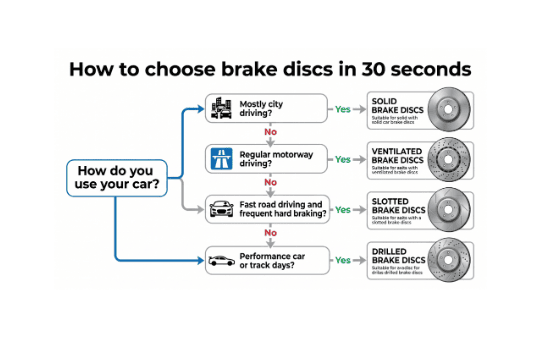
As a general rule, solid discs are suitable for lighter vehicles used mainly in urban environments. Ventilated discs are often the best choice for family cars that regularly cover motorway miles. Drivers who brake hard more frequently may benefit from slotted discs, while drilled discs are typically reserved for performance-focused applications.
Which brake discs work best on Irish roads?
Irish driving conditions present a unique combination of challenges. Drivers often encounter wet weather, narrow rural roads, stop-start traffic and long motorway journeys within the same week.
For most daily drivers, ventilated discs offer the best balance of performance and practicality. Their ability to manage heat helps maintain braking consistency during repeated stops and longer journeys.
Slotted discs can be particularly effective in wet conditions because the grooves help clear water from the braking surface more quickly. This can improve pedal feel when driving in heavy rain.
Drilled discs are less about everyday convenience and more about performance. While they can provide excellent cooling, their benefits are most noticeable when brakes are subjected to repeated high temperatures.
Popular brake disc choices according to AUTODOC customers
Based on customer feedback, technical specifications and market popularity, several models consistently stand out across different vehicle categories.
1. Best for small cars
ATE 24.0109-0123.1
A strong all-round choice for compact vehicles. Buyers frequently highlight its reliable fitment, corrosion-resistant coating and solid value for money.
2. Premium everyday option
Brembo Prime 08.7165.11
Brembo’s Prime range brings OEM-level quality to everyday driving. It combines dependable braking performance with good corrosion protection.
3. Built for higher-performance vehicles
TRW DF4464S
A ventilated design developed for vehicles that generate greater braking loads. Its larger dimensions and cooling channels help maintain performance during repeated braking.
4. A strong match for electric vehicles
Textar 92327203
Designed for applications where regenerative braking reduces the use of conventional brakes. Its protective coating helps minimise corrosion during periods of light brake use.
5. High-carbon technology for demanding conditions
Bosch 0 986 479 088
A ventilated high-carbon disc that combines strong thermal stability with long-term durability. Particularly well suited to motorway driving.
6. Performance-focused premium choice
Zimmermann Formula Z
A drilled, ventilated and two-piece design aimed at high-performance vehicles. Its advanced construction improves cooling while reducing weight compared with conventional performance
discs.
Other notable options include Ferodo Premier Coat+, Delphi BG3208C, ABS 16883 and Ridex 82B0003, each offering different strengths depending on budget and vehicle requirements.
Choosing the right brake disc for your vehicle
The best brake disc is not necessarily the most expensive one. Compatibility with the vehicle remains the most important consideration.
Always check the correct diameter, bolt pattern, centre bore and minimum thickness specifications recommended by the manufacturer.
Driving style should also influence the decision. Drivers who mainly travel around town may see little benefit from performance-oriented discs. On the other hand, vehicles that regularly tow trailers, carry heavy loads or spend significant time on motorways can benefit from improved cooling provided by ventilated designs.
Protective coatings are another feature worth considering. Coated discs generally resist corrosion better, which can be particularly useful in damp climates where vehicles are regularly exposed to moisture.
Regardless of disc type, brake discs should always be replaced in pairs on the same axle to ensure balanced braking performance.
Signs your brake discs may need replacing
Brake discs gradually wear down throughout their service life. In many cases, the warning signs appear long before performance becomes a safety issue. Drivers should pay attention to unusual noises, vibrations or visible damage.
The infographic below highlights some of the most common symptoms associated with worn brake discs.
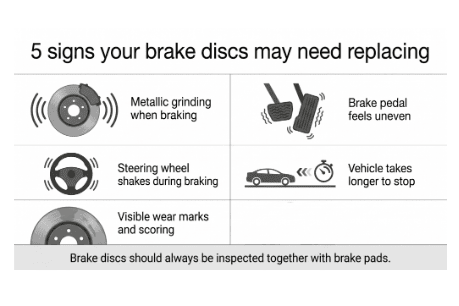
Figure 2. Common signs that brake discs may be approaching the end of their service life.
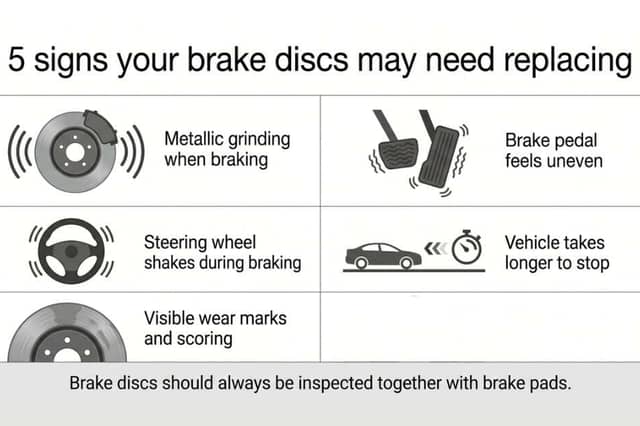
Typical warning signs include:
● Metallic grinding noises during braking
● Vibration through the brake pedal
● Steering wheel shake when slowing down
● Increased stopping distances
● Visible grooves or scoring on the disc surface
These symptoms can sometimes be linked to other braking components, including pads or calipers. However, any noticeable change in braking behaviour should be investigated as soon as possible.
The best choice depends on how you drive
There is no single brake disc that suits every vehicle and every driver.
For everyday motoring, solid and ventilated discs remain the most practical and cost-effective solutions. Drivers who regularly encounter demanding conditions may benefit from slotted designs, while drilled discs are generally best reserved for vehicles that experience higher braking loads.
The key is choosing a brake disc that matches the vehicle, the driving environment and the demands placed on the braking system. When selected correctly, a quality set of brake discs can deliver reliable performance and confidence for thousands of miles.