

Trust accused of ignoring Ambulance Service staff and lack of provision
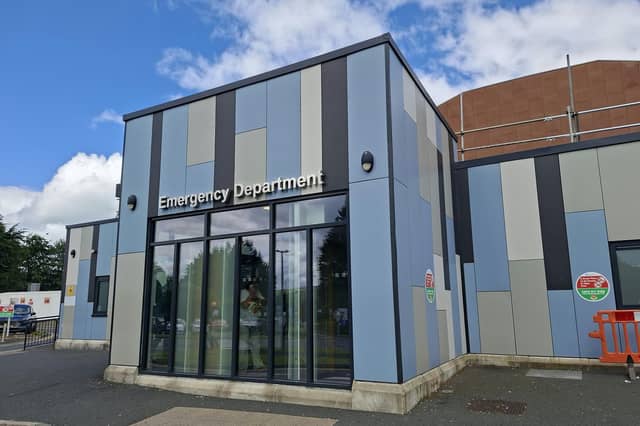

Two local hospital campaign groups have criticised the Western Trust’s response to an inspection report by the Regulation and Quality Improvement Authority (RQIA).
The Derry-based SoS Altnagelvin group has accused the Trust of “deliberately ignoring the concerns of staff” particularly Ambulance Service personnel.
The Fermanagh-based Save Our Acute Services (SOAS) group, said the statistics provided by the Western Trust focused exclusively “on admissions for in-patient surgical care and not arrivals [and] left out approximately three-quarters of those travelling from Fermanagh and Omagh to Altnagelvin”.
The RQIA report in question ‘Emergency General Surgery in the Western Trust Following the Temporary Suspension of Services at South West Acute Hospital: Follow up inspection to Emergency General Surgery Pathways Inspection November 2025 - February 2026’ was published on September 15, 2026.
It covered a follow up inspection conducted between July 29 and August 4, 2026, in South West Acute Hospital (SWAH) and Altnagelvin.
In an accompanying statement on its website, RQIA said the report “assessed the Western Trust’s implementation of the Quality Improvement Plan set out in the RQIA’s Inspection Report published on June 10, 2026”.
It added: “The inspection, and the recent follow-up report, forms part of RQIA’s actions following its 2024 Review, published in January 2025, of the pathways associated with the suspension of Emergency General Surgery (EGS) services at South West Acute Hospital [Enniskillen] in December 2022.”
Additional NIAS Ambulance capacity has not been put in place.
One of the two “urgent” recommendations identified in the 2024 Review was the need for the Department of Health “to consider the provision of a more sustainable and resilient ambulance capacity to strengthen the model supporting emergency surgical services within the Trust area, and address concerns about the impact on NIAS services more widely in the area”.
However, according to the September 2026 RQIA report: “Additional NIAS Ambulance capacity has not been put in place.”
As a result, RQIA has written to the Department of Health advising it “should take appropriate steps to address this matter which has remained outstanding since the original RQIA Review recommendations of October 2024, by the commissioning of additional NIAS emergency ambulance and crew capacity”.
Commenting on the RQIA report, Trust chief executive Karen Hargan said: “We welcome RQIA’s recognition of the significant progress made across all four Areas for Improvement. Patient safety remains our absolute priority and this report provides further independent assurance on the improvements to our Emergency General Surgery pathways.”
The transfer of Emergency General Surgery from SWAH to Altnagelvin has put additional pressure on our hospital.
An SoS Altnagelvin spokesperson described the Trust’s response as “disingenious”.
“In its championing of the Emergency General Surgery pathway, which was started as a result of its suspension in SWAH, meaning anyone requiring Emergency General Surgery services is transported to Altnagelvin, which is already under pressure, the Trust seemingly overlooked key elements of concern in the RQIA report, mainly outlined by staff in both hospitals,” added the spokesperson.
Under the heading ‘Staff engagement, collaborative team working and communication’ in the latest report, staff continue to raise concerns, particularly from the Ambulance Service whose feedback, according to RQIA “remains a matter of concern”.
“NIAS staff repeatedly raised the ‘perception of risk within the Enniskillen community and surrounding areas, for those patients waiting for an ambulance response in the community; and to wider system, organisational, workforce and operational pressures affecting NIAS’.
How many of those needing emergency medical treatment, or their families and friends, are driving to Altnagelvin out of sheer desperation at the lack of ambulances?
“Ambulance staff also highlighted ‘the impact of the Emergency General Surgery pathway on older and more vulnerable patients, including those living with frailty or dementia, citing long journeys and distance from family support networks. Concerns were also expressed regarding the transfer of higher-acuity patients’.
“Patients who had to travel from Enniskillen and the surrounding areas to Altnagelvin also raised concerns in the latest report, describing ‘challenges associated with the journey, including its length, discomfort and the impact on existing pain. Concerns were also raised regarding uncertainty around transport arrangements and the practical difficulties of travelling significant distances from home, including returning after discharge,’” said the SoS Altnagelvin spokesperson.
“The transfer of Emergency General Surgery from SWAH to Altnagelvin has put additional pressure on our hospital,” they added, “with around 55 patients a week travelling to Altnagelvin for treatment, and additional costs to the Ambulance Service and the Trust for private ambulances. This is just one of the areas of concern we have as a campaign relating to Altnagelvin.
“The fact the Trust conveniently forgot to address the widespread concern of the ambulance service and healthcare staff in its back-slapping press release highlights why our campaign is needed.”
Commenting on the Trust’s response to the RQIA report, SOAS spokesperson Donal O’Cofaigh said: “The exclusive focus on admissions for in-patient surgical care and not arrivals leaves out approximately three-quarters of those travelling from Fermanagh and Omagh to Altnagelvin.
“There is a human and social cost associated with everyone of those statistics and their families that is not being considered,” he added.
“That more than half of those arriving in Altnagelvin Emergency Department (ED) are ‘walk-ins’ also raises questions about patient safety.
“How many of those needing emergency medical treatment, or their families and friends, are driving to Altnagelvin out of sheer desperation at the lack of ambulances?
“The ‘Time to Treatment’ for emergency surgical patients in our community is always very significantly outside the safe target times for trauma and emergency care. Yet, the Trust has stopped publishing these figures since March 2025 - despite being expressly instructed by the Department of Health to publish these when surgery was suspended.
“ED admissions figures leave unanswered questions such as whether those patients are receiving the same treatment they would if emergency surgery was still available at SWAH. It also obscures the fact that those from the Fermanagh and Omagh District Council area arriving at Altnagelvin ED constitute an 5% extra pressure on an already grossly overstretched ED service and staff,” said Mr O’Cofaigh.
“There is only one way to reduce that pressure and these risks - it is for the Minister of Health to urgently bring forward the commissioning of a renewed and sustainable emergency surgical service at SWAH.”