

Revamped Museum of Free Derry set to open to the public this Monday
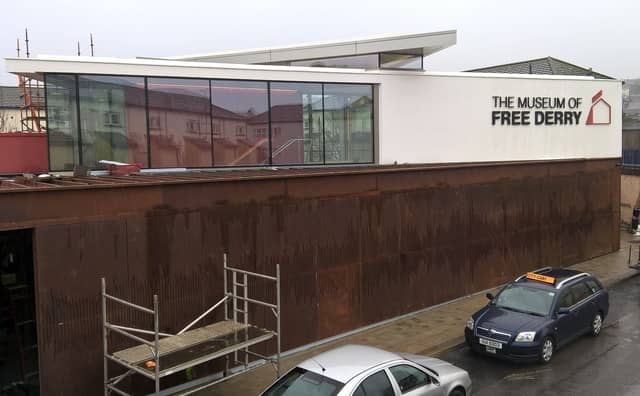

The Bloody Sunday Trust have said they are delighted to announce that the new Museum of Free Derry will open to the public this coming Monday, 20 February.
The new building, completed at a cost of around £2.4m, will host a full multi-media exhibition on the civil rights and early conflict era in the city, and also much needed and enhanced visitor facilities and education and research facilities.
Museum manager Adrian Kerr said: “We are all thrilled that the new museum is at long last ready to open. It has been a long and hard road, but the new building is worth the wait. It will allow us to do a lot more work in educating people about this very important era in our history, and will make a visit to the museum a much more rewarding and stimulating experience for all visitors, be they from the city or from across the world.
“It is, we feel, a stunning building, that places this history in a place where it deserves to be, in a flagship building that shows how important this history is and how important it is that people come here to learn about it.
“The previous museum was very successful, with over 160,000 visitors passing through its doors, but the new museum will be even more successful in attracting visitors. After two years in temporary premises it will be fantastic to have the museum back where it is supposed to be, in the heart of the Bogside where so much of our story happened.
“We would like to take this opportunity to thank all who helped in the creation of the new museum, the design team for all their work, and our funders who made this all possible. We would also like to thank the residents of Glenfada Park and the surrounding areas for their patience and support during the building work and all the disruption that it caused, and the many people, including elected representatives, from across the city who have worked hard to help us achieve this.”
The new Museum of Free Derry was designed by a team led by Brennan Associates (Architects) and cost approx. £2.4m. Funding was provided by the Heritage Lottery Fund, Tourism Northern Ireland (including European Regional Development Fund), the Department of Social Development, Department for Culture, Arts and Leisure, Derry City and Strabane District Council, Department of Foreign Affairs and Trade and Iona Enterprises.
The artwork on the front wall of the museum was created by local artist Locky Morris and is entitled ‘We Shall Overcome’
A spokesperson for the museum said: "The artwork was conceived as an integral part of the architecture of the museum itself. It uses the actual sound waveform of the moments on Bloody Sunday when the crowd sang 'We Shall Overcome’. These 21 seconds have in a sense been literally ‘cut into’ the fabric of the building and can be seen as a 'paean’ to community resistance amidst deadly force. The notion of a huge moment of seismographic shift is also held in play within the work.
"The linear form and repetitions make reference to the original wooden fence that would have faced north on a similar axis along this part of Glenfada Park. Indeed this plane draws a line with the renowned ‘rubble barricade’ that ran across Rossville Street at that time which also hints at the idea of ‘An bhearna bhaoil’ - the gap of danger or frontline.
"The deliberate use of thick steel with the rust patina, edginess and ‘elemental’ feel of the finish is meant to be redolent of a period of urban conflict – which may bring with it a flood of images of barbed wire, burnt vehicles, broken paving slabs and the temporary barriers of scaffold materials, rusted reinforcing mats, rubble and planks.
"Although it exists firmly at the heart of this place and has its genesis around this momentous event, it is also meant to resonate outside its local context. Its aim is to connect, historically and contemporaneously, with a wider international communal struggle and desire for Justice and Civil Rights. The song itself of course, already the civil rights anthem in the USA, had become an anthem for the civil rights movement here in the 1960s."