

My view with Father Paddy O'Kane: A place where heaven and earth come close
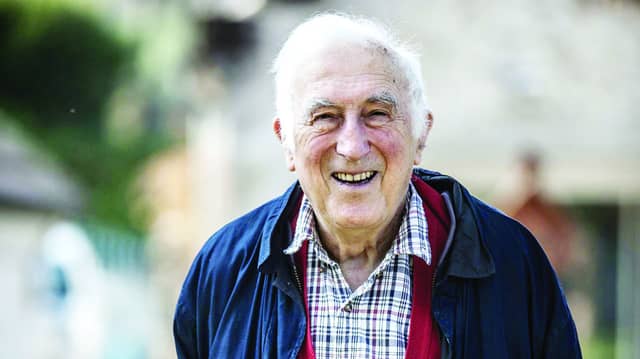

There are special places here on earth where the veil between heaven and Earth seems almost transparent –‘thin’ places, they are called; and there can be few ‘thinner’ than the village of Trosly 40 miles north of Paris.
Last week I met up there with two other Derry priests, Fr. Paddy Doherty and Fr. Paul Farren at L’Arch Community .
We joined three dozen Irish priests to do a retreat on St. John’s Gospel with Jean Vanier.
We talked naturally about our own joys and sorrows of priesthood and life in our parishes. Fr Doherty and I went for a walk one evening and got lost.
We met two ladies who not only gave us directions home but walked with me holding my hand. “How beautiful and friendly,” I thought at first, until the penny dropped and I realised she thought I had ‘special needs’!
But I digress. In 1964, a tall, handsome Canadian, an ex-naval officer, was invited to Trosly to visit an asylum for men with mental handicaps.
“It was a horrific place,” he says, “full of screaming and violence; and yet it filled me with a sense of wonderment.”
I sensed in these men a great cry – ‘Do you love me?’, ‘Will you come back?’” He visited other asylums, equally dismal, and then decided to act.
“What I love about the Good Samaritan,” Jean says, “is that he didn’t waste time weighing up the pros and cons, he just did something.”
He himself was similarly bold. Having bought a tumbledown cottage in Trosly, he invited two men with handicaps – Raphaël and Philippe – to leave their asylum and live with him. He called their home L’Arche, ‘the ark’.
“There was no huge idea,” he says, “no intention to change the world.”
He simply wanted to ease the suffering of two men. But, as he shared his life with Raphaël and Philippe, he gradually discovered that he was being transformed by them.
“God has chosen the weak and the foolish,” he says, rephrasing St Paul, “to confound those caught up in their heads.”
Raphaël and Philippe were enabling him to live from his heart, to escape ‘the tyranny of normality’, to laugh like a child. They were, he says, ‘teachers of tenderness’.
Others came to join him, the community grew.
Today there are 143 L’Arche communities in 35 countries, from Zimbabwe to Palestine, Uganda to the UK. In each one, ‘normal’ people live as assistants to people with handicaps. While Vanier is a devout Catholic, L’Arche welcomes people of all religions and none: “My feet are rooted in my faith, but my arms are wide open,” he says.
“What is important is not necessarily a belief in God, but a capacity to love people as they are. You cannot believe in God, but still believe in relationship.”
Now 89, he is white-haired, still very tall if not slightly stooped, but his mind is crystal clear. He has been listening to people’s difficulties for 53 years now.
“I’m not a healer or a curer; all I can be is a good listener. And that seems to be the healing part for people – that somebody appreciates them. My life in L’Arche has taught me that everybody is beautiful. Everybody. So to love people is to reveal to them that they are more beautiful than they dare believe” he says.
“We all have this fundamental need, always trying to prove that we are someone. But gradually we have to let the ego descend and the spirit rise up. It’s a long road. Buddha says that the man who conquers a million men in battle is less of a conqueror than the man who conquers his ego. And we need, through prayer, to be attentive to the ‘little voice’ that Newman speaks about – the voice with which God speaks to every human heart. Can we hear the voice, or are we too busy – addicted to doing too many things?
He has regular retreats for prostitutes and homeless people from Paris, including a retreat for gay couples.
“I’ve listened to these deeply wonderful people and heard them talking of their pain: rejected by the family, laughed at at school!” he says.’’
“I went into a prison recently where there were a lot of tough guys – you can imagine – and then one guy whom you saw immediately was fragile and closer to the feminine. And you just know what he has suffered.
“So what we can do is to listen to people’s pain, and hear what they’ve lived, and then begin to understand. And not to judge. Never to judge.”
Before I left I gave him a gift of one of my little paintings of Christ on the cross for which he was very grateful. I felt so privileged to have spent a week in the company of a saint.
Words of Wisdom
Strong people stand up for themselves, but the strongest people stand up for others.
Joke
There is a new restaurant on the moon. The food is great but the atmosphere is poor.