

Mother of SEN P7 says family 'in limbo' over September school place
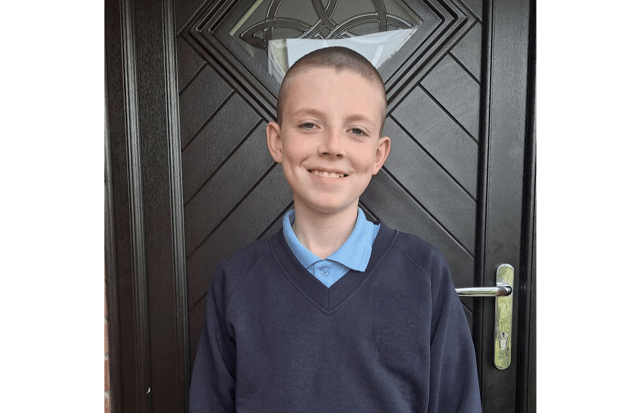

Hundreds of SEN children with no school places for incoming academic year
The mother of a Derry Primary 7 pupil described Monday as a “difficult day” for her son who, unlike his classmates, was not offered a post-primary school place for September.
The letters of offer for Year 8 school places in the North for 2026 were issued on Saturday. However, hundreds of children with Special Educational Needs (SEN) were left without places.
According to Education Authority (EA) figures, approximately 105 post-primary and 250 primary pupils have yet to receive confirmation of the school they will be attending in the coming academic year.
Speaking to the Derry News, Sabrina McCartney said: “Naturally all of the other children were talking about what schools they were going to and Riley, who has started to recognise he is different, has been made to feel even more different due to the fact he has no placement to share and no excitement about his future.
“Riley couldn’t join in those conversations,” added Sabrina, who explained her son had been diagnosed with Global Developmental Delay when he was five and a half and had received a pre-nursery statement.
“Riley would have difficulties with language and processing,” said Sabrina.
“Even when he was transitioning from nursery to primary school we had difficulties around placements because it was left too late by the time they identified how much need Riley actually had,” she added.
“We were told to go into mainstream, with support. Basically it was ‘see how he gets on, sink or swim’.
“And we were very lucky. Riley went into quite a good wee school, Hollybush, and he had a fabulous classroom assistant. Without her I don’t think he would have coped as well in mainstream but, in saying that, we did have one year with school refusal by Riley, which was very difficult.
“Riley has been very well supported by us as parents and we have been lucky he has had such a brilliant classroom assistant to support him throughout his mainstream career at Hollybush,” said Sabrina.
In Primary 6, Riley was re-assessed by an EA trainee associate psychologist - his first assessment since his pre-nursery year.
“I had to fight to have him re-assessed.” said Sabrina, “because we had no information about his cognitive strengths or weaknesses and they were letting him go on to post-primary.
“The re-assessment highlighted Riley did have difficulties and it was at that point they recommended he should go into specialist provision, such as a unit. They also allowed for over age retention of Primary 7s, so Riley got an additional year at Hollybush because emotionally and in terms of his learning he would not be at the same level as his peers.
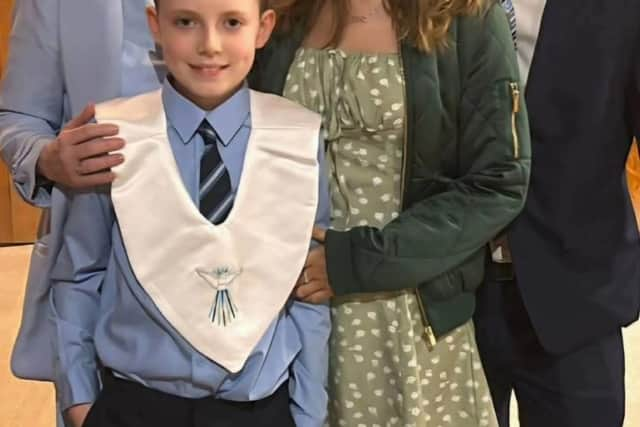
Riley with his mum and dad and sponsor on his Confirmation Day.
“We put down St Brigid’s College as our first choice and we then put down a mainstream school, Oakgrove Integrated College, as our second choice, because it is a smaller school.
“As much as the specialist provision was recommended, we felt Riley needed that nurturing environment and I always had it in the back of my mind, it was very hard to get placed in specialist provision in this area,” said Sabrina, who contrasted the growing availability of specialist provision in mainstream primary schools, with its shortage at post-primary, where she observed, no new post primary specialist provision had been added.
In the whole of Derry, St Joseph’s Boys’ School has 12 places for Autism Spectrum Disorder (ASD), St Brigid’s College / Coláiste Bhríde has 12 and Lisneal College has a composite unit for Years 8, 9 and 10, and has only two available spaces this year.
According to Sabrina who works in the Western Trust’s Children and Young People's Autism Service, SEN children are supposed to be allocated and notified about their post-primary school places before other Primary 7s.
“A fortnight ago, we were contacted by an EA SEN link officer and were told Riley had not been allocated a place in specialist provision in St Brigid’s but he had been allocated a place in Oakgrove. Apparently they had been meeting that week to discuss children,” said Sabrina.
“We were disappointed and really annoyed this had happened but we were trying to get our heads around whether he would be okay going to Oakgrove and we would receive a confirmation email within the week,” she added.
“The EA then phoned us back last Friday and said they had made a mistake, Riley’s place wasn’t confirmed. Basically, because Riley had been recommended for a specialist placement, the mainstream school, Oakgrove, would have to go through his statement and decide if it could meet his needs at all. It has 15 days to do so.
“Consequently we have been left in limbo with nothing to tell Riley. In addition, nobody can tell me what criteria were used. I phoned the EA on Monday and was told 24 kids had applied for the 12 places in St Brigid’s but they were unable to explain what the specific criteria the EA used to decide who got the places.
“I have asked for the minutes of the meeting where they discussed placements and apparently they don’t have minutes. I find this totally [unacceptable] because in my job we keep minutes of every child discussed at multi-disciplinary. I also asked for the criteria because if we are making a diagnosis of ASD, we have a specific set of criteria we have to meet, so where is the EA’s criteria as to how they prioritise the level of need. As of yet, nobody has been able to furnish me with this information,” said Sabrina, who added Riley had been anxious about moving schools since his first year of Primary 7.
Asked if she had a message for Education Minister Paul Givan, Sabrina said: “He needs to have a good long look at the SEN approach because there is something not tallying up here.
“We are talking about the future. We are talking about cutting classroom assistants. What we are not looking at are all of the places being provided in primary schools but these primary school children grow up to move into post-primary and we have nothing to support them.”
A spokesperson from the EA told The Derry News: “EA works intensively and year-round with schools to grow the number of school places for children with SEN. This includes supporting mainstream schools to establish specialist provision SEN classes.
“Since 2020, over 6,000 additional SEN places have been created across NI.
“However, only 26% of mainstream schools currently offer specialist provision classes. That figure has to expand substantially if we are to meet the needs of children and young people in our community.
“That cannot be achieved by the EA alone - it requires effective partnership working with schools.
“Our ongoing work with schools includes engagement with identified mainstream schools in areas of highest SEN need - which includes the North West.
“These schools have been selected based on a number of criteria, including location and available, or potentially available capacity for September 2026 and beyond.
“EA is committed to supporting schools establishing specialist provisions with a comprehensive package covering staffing, training, premises and ongoing financial support.”