

Memorial stone unveiled to Founder of Derry Shirt industry
‘We remember William Scott today and we give thanks for his vision, enterprise and industry’ - Dean Nigel Cairns
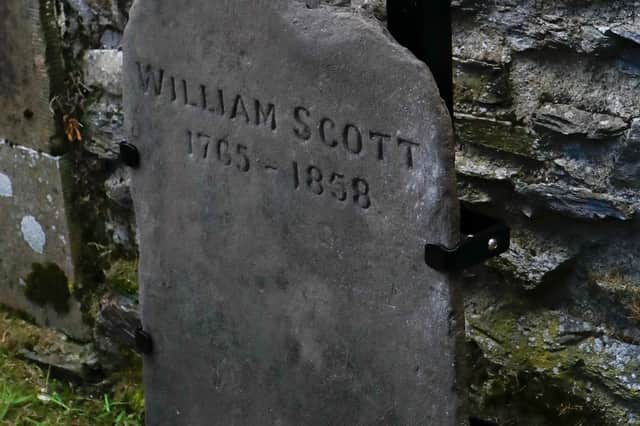
William Scott (1765 - 1858) the founder of the shirt industry in Derry has been remembered at a beautiful ceremony in St Columb’s Cathedral in the city, where he is buried.
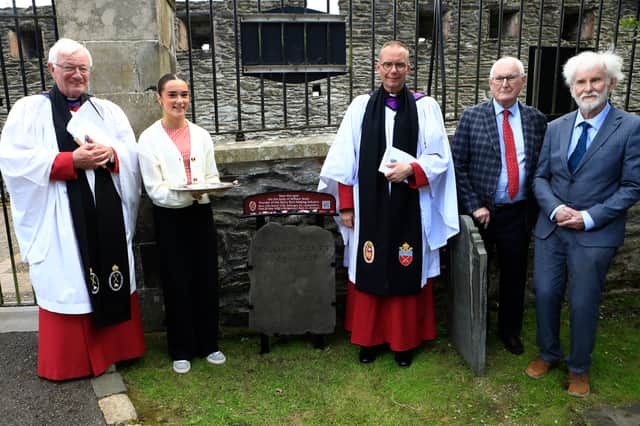
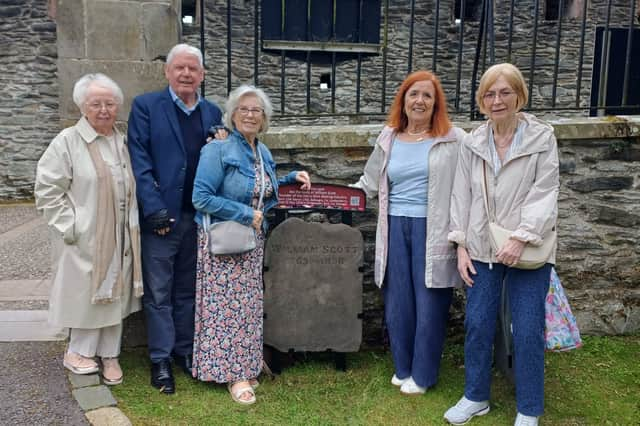
Following Evensong at the Cathedral on Sunday (June 28, 2026) a newly installed memorial to Mr Scott was unveiled by members of his family.
The memorial, situated at the back gates of St Columb’s Cathedral, leading on to the Derry Walls, was then dedicated by Dean Nigel Cairns and Canon John Merrick.

During Evensong, Dean Cairns remarked on the lesson from William Scott’s story that “it is never too late to begin - or even begin again”.
He added: “One of the remarkable details of his life is that he was already in his sixties when he launched the [shirt making] venture that changed the future of this area.
“The world might have considered his most productive years behind him but yet God evidently had other plans.
“I think that’s a great encouragement. God continues to call people into new forms of service throughout their lives, and God’s kingdom has no retirement age because we should never assume God is ever finished with us.
“So we remember William Scott today and we give thanks for his vision, enterprise and industry,” said Dean Cairns.
As well as his connections with Derry, William Scott had strong links to Bridgetown in Burt, County Donegal.
According to the commemorative booklet prepared by one of his descendants, Mr James Buchanan, himself a retired businessman, William Scott was born on March 12, 1765, in Ballougry, in the Liberties of Derry city.
He was the youngest of three sons of David Scott, a farmer, whose ancestors held the farm since 1610. After a limited education, Mr Scott was apprenticed to a weaver in Foyle Street.
Around 1790, when he became a master weaver, Mr Scott set up in business in Weaver’s Row. In that year he married Rebecca Scott, a distant cousin, from a well-to-do Church of Ireland family with a residence at Foyle Hill. The couple had a large family, several of whom died in childhood, but seven sons and two daughters survived.
Mr Scott was a committed Presbyterian, and for the unprecedented period of 70 years was an elder in the seceding congregation in Fountain Street. He was superintendent of the Sunday school for many years, and with another elder was responsible for establishing Fourth Derry to accommodate growing numbers of Presbyterians in the city.
In the meantime, Mr Scott’s weaving business flourished, and after 1829, when a steamer connection between Derry and Glasgow was established, he travelled regularly to Glasgow to sell the linen cloth made by his workers.
White linen shirts with collars and elaborate fronts, often starched, had become the new fashion for men, replacing the earlier unstructured open-necked undergarment which had often been of wool or flannel.
William Scott saw the potential for selling readymade garments at a time when young men were flocking to work in cities, often far away from their families and female relatives who would hitherto have made most of their clothing.
Rebecca Scott and her two daughters were fine needlewomen, and in early summer 1831, William Scott took a dozen shirts of their making, along with his linen webs to glasgow; William Gourlie and Son sold them and ordered more.
In 1832, a Derry man who had become a merchant in Melbourne, Australia, placed a large order, and the Scott womenfolk, helped by a new daughter-in-law, worked night and day to get it finished.
Orders continued to pour in, and a London agent was appointed; it was clear that more workers would be needed, and Mr Scott took on local women who worked in their own homes. They were trained by William Scott’s family, and later trained others in their turn.
An elaborate system of outworkers was established. Women, even in relatively distant areas such as Limavady and Carndonagh in County Donegal were issued with ready cut out material.
Demand was worldwide, with about a quarter of a million hand-sewn and hand-finished shirts leaving William Scott’s Derry warehouse each year.
Scott’s shirt pattern remained standard for at least a generation. The shirts had a cotton body, with a detachable linen collar and cuffs - so that they could be washed separately and thus far more frequently - sometimes with a linen embroidered front, and they were, to some extent, tailored to fit different body shapes.
The firm needed carters, pattern cutters, skilled needlewomen, finishers, inspectors and packers, as well as clerks to keep records of orders and payments.
About 1840, the Scotts bought the old military hospital on Bennett Lane (latterly Bennett Street) and adapted it for their needs.
By that date, William Scott and Son employed 250 weavers and more than 500 women making up the shirts, and paid out about £500 weekly in wages.
Former Factory Girls: Rita McCarron (86) & May Hegarty (92) at St Columb's Cathedral this afternoon at the commemoration for William Scott - Founder of the Derry Shirt Industry. (@mccarron1965) pic.twitter.com/4lU2d2Omkl
— Catherine McGinty (@CathMcGin_Tea) June 28, 2026
Demand was worldwide, with about a quarter of a million hand-sewn and hand-finished shirts leaving William Scott’s Derry warehouse each year.
The shirt industry became synonymous with Derry City for more than a century and more.
William Scott retired in 1850, when he was 85. His wife had died in 1835, and he moved to Bridgetown, Burt, County Donegal, to live with his son, James, who had also retired and bought a large farm there.
William Scott died on May 26, 1858, and was accorded a huge funeral, from Bridgetown, Burt, to St Columb’s graveyard, where the new memorial stone now stands.