Search


25 Mar 2026
Search
25 Mar 2026

Please allow ads as they help fund our trusted local news content.
Kindly add us to your ad blocker whitelist.
If you want further access to Ireland's best local journalism, consider contributing and/or subscribing to our free daily Newsletter .
Support our mission and join our community now.
To continue reading this article, you can subscribe for as little as €0.50 per week which will also give you access to all of our premium content and archived articles!
Alternatively, you can pay €0.50 per article, capped at €1 per day.
Thank you for supporting Ireland's best local journalism!

Séanna Walsh who read the statement from the IRA Army Council announcing the end to its armed campaign, in July 2005.

Durning ‘The War is Over’ - the concluding Féile Derry 2025 event - former BBC correnpondent Barney Rowan spoke about the significance of the IRA's decision to end its armed campaign and the major political and policing developments which followed.
The special archive publication which accompanied the talk is available by clicking this link: ‘28 July 2005 - 4 o’clock - and all is well’
It is hosted online by Open University Open Learn, headed by John D’Arcy who is its Ireland Director.
“It was one of those news periods when you run and run and you don’t get tired.
“You know it is big news and there is something that keeps you going, and then you collapse.
“By the time we get to the end of 2005, I was both physically and mentally wrecked by all of this.
“I knew for a couple of years I needed to get out of the BBC and [after] those events - the ending of the IRA’s armed campaign; the army signposting the end of the longest operation in British military history; and decommissioning - seemed to me like the time to go.
“But I quickly learned, even after I walked away from the BBC, you don’t walk away from this stuff. Only a matter of months later, in April 2006, I conducted an in-depth interview with a spokesperson for the UVF, which ran in The Belfast Telegraph and on UTV.”
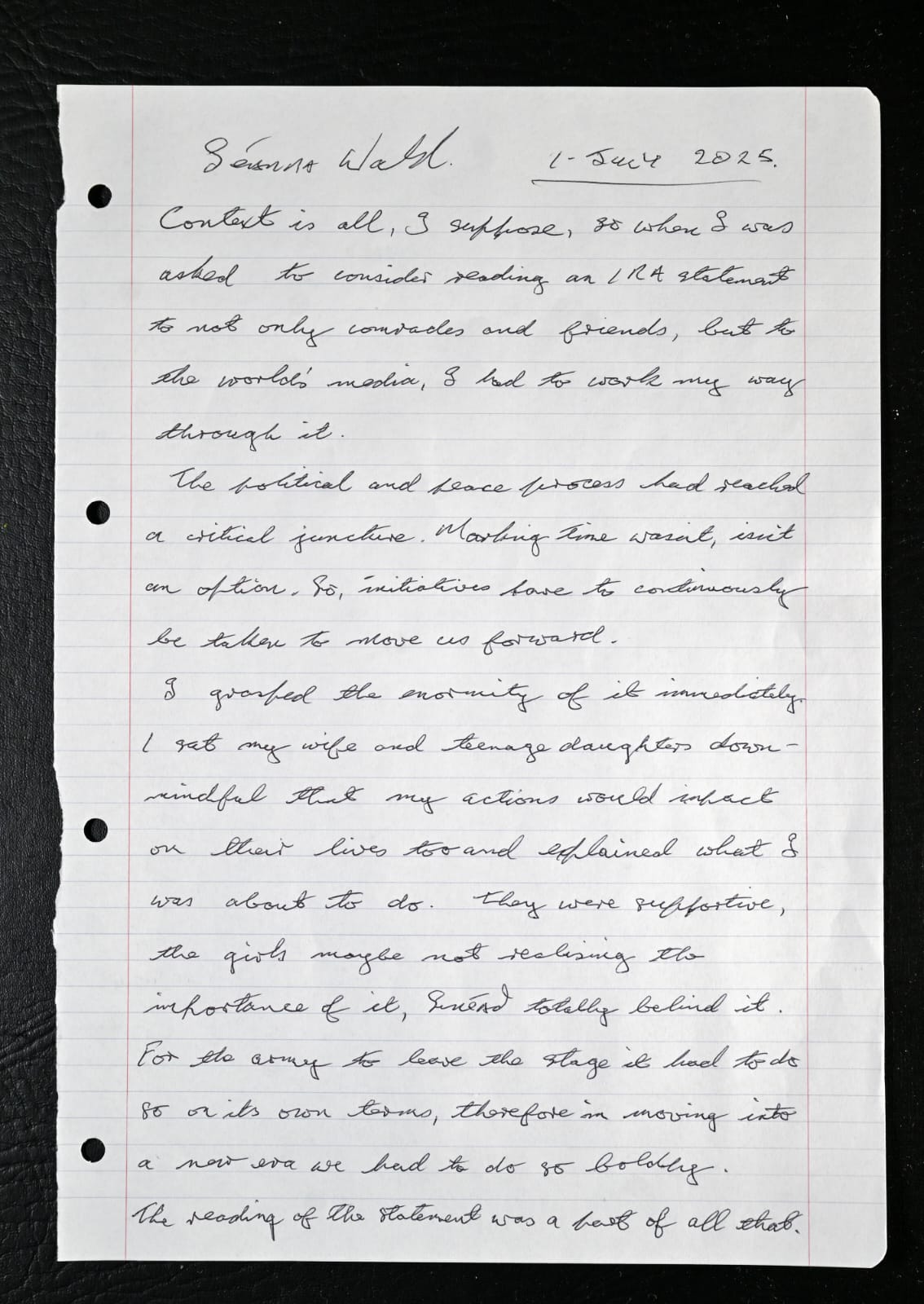
Seanna Walsh's handwriten note recalling the events of July 2005.
This was the August 2025 reflection of former BBC correspondent Barney Rowan on the momentous events of 2005 which began with the ending of the IRA’s armed campaign, at 4pm on Thursday, July 28.
He was speaking to The Derry News in advance of ‘The War is Over’ - a Féile Derry 2025 event during which he will consider the significance of that decision and the major political and policing developments that followed.
‘The War is Over’ is taking place in Cultúrlann Uí Chanáin at 7pm on Friday, August 15, when Mr Rowan will be joined in conversation with Irish Times Northern Editor Freya McClements.
The special archive publication ‘28 July 2005 - 4 o’clock - and all is well’ will be available on the night. It is also hosted online by Open University Open Learn, headed by John D’Arcy who is its Ireland Director.
The short, contemporary reflection, albeit handwritten, was the innovative methodology employed by Barney Rowan when curating the publication.
It contains 2025 retrospectives on the period 2005 to 2010 by: Rosie McCorley (former republican prisoner and later Stormont MLA); Richard McAuley (a senior aid to Gerry Adams); Kevin Winters (solicitor); Mervyn Wynne Jones (chief press officer, British Army headquarters in NI); Harold Good (former Methodist President and church witness to IRA decommissioning); Aaro Suonio (former Chef de Cabinet, Independent International Commission on Decommissioning [IICD]); Claire Hanna (SDLP Leader); Debbie Watters (former vice chair of the NI Policing Board); Jackie McDonald (UDA brigadier); Dawn Purvis (former MLA and Leader of the Progressive Unionist Party); and Aziz Abu Sarah (a peacemaker who uses travel as a tool for peacebuilding through his social enterprises Mejdi Tours).
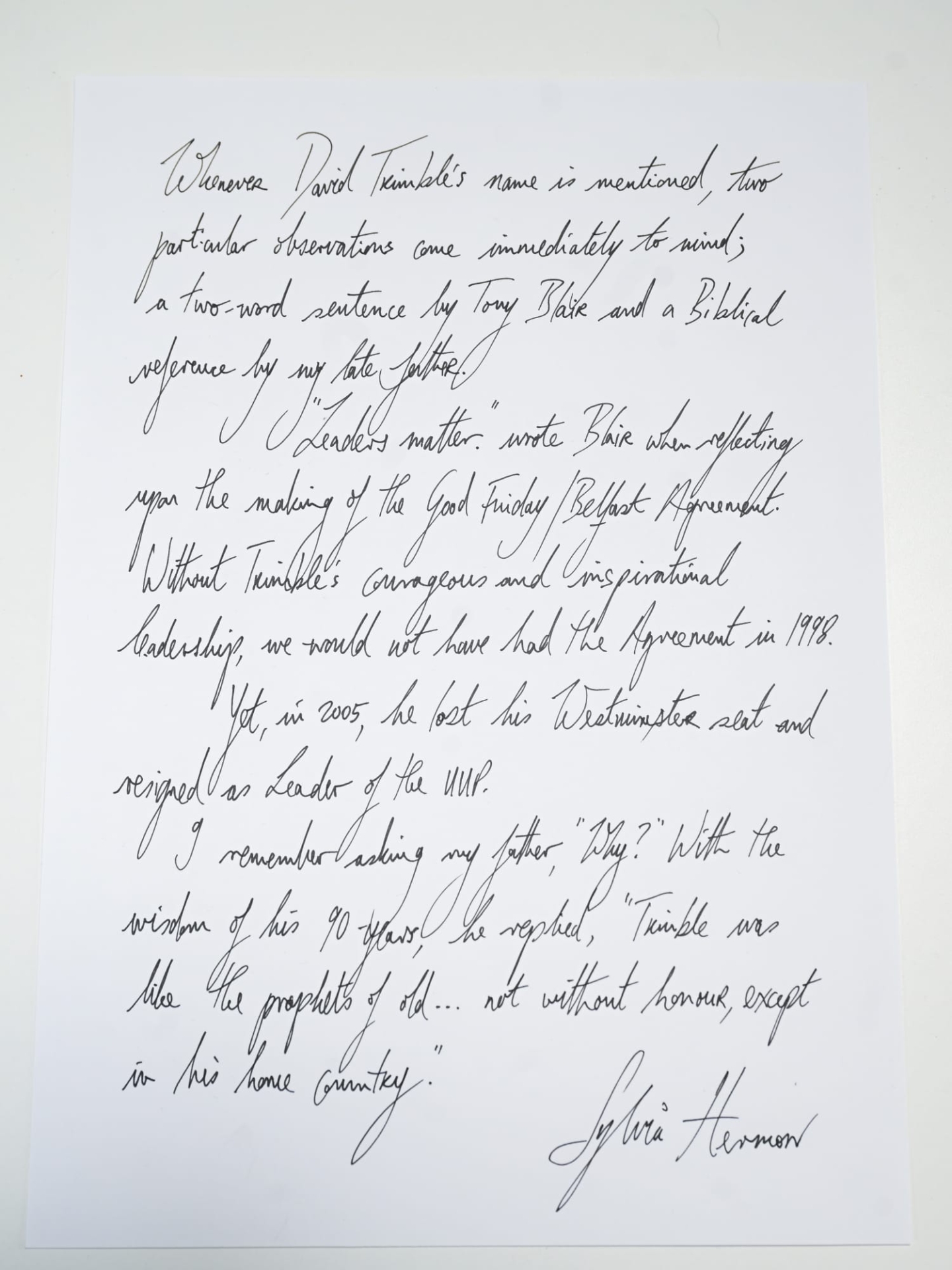
Sylvia Hermon's handwritten note recalling the events of 2005.
Sylvia Hermon (former UUP MP) and Belfast republican Séanna Walsh - one of the longest serving IRA prisoners - who read the order that the armed campaign would end at 4pm Thursday, July 28, in which all units were instructed to dump arms, also contributed.
Sylvia Hermon highlighted the importance of then UUP Leader David Trimble to the Good Friday Agreement.
Séanna Walsh wrote: “For the army (the IRA) to leave the stage it had to do so on its own terms, therefore in moving into a new era we had to do so boldly.
The reading of the statement was a part of all that.”
“I had this idea of asking people in 100 or so words to share a thought,” said Barney Rowan. “I think when we are asked to write with pen, we think more about what we are writing.
“I think when somebody has to sit down and compose a thought and then write it, it brings out something that is more real and more challenging. That was the idea behind the notes,” he added.
The most intriguing note was that of Aaro Suonio.
“The most significant period of decommissioning was that period September 17 to September 25, 2005 - two months after the IRA ends the armed campaign,” said Mr Rowan.
“Aaro was in Dublin. He wasn’t in the fields with the IICD, or the church witnesses or the IRA during the decommissioning but he was there to meet colleagues when they got back. His task was to organise the news conference for September 26 where General de Chastelain and the church witnesses would speak to what they had witnessed,” he added.
“I asked him if he kept a diary of that period and he said he had. I think he sent me 52 lines. 40 of them were redacted and 12 of them were written in Finnish. The 12 in Finnish were him making the arrangements as he travelled back from Dublin on September 25 for the news conference the following day, where de Chastelain and the witnesses would speak. The IRA issued a statement on that day saying that the process had been completed.
“I would have wanted to see what was below the redaction. When I looked at it I thought, ‘Here we are 20 years on and those 40 redacted lines speak loudly today to the secrecy and confidentiality of that process of decommissioning and in the two decades since that confidentiality has not been breached.
“I think those processes only work when there is confidentiality associated with them. Trimble wanted an inventory of what had been decommissioned. Paisley wanted photographic proof. Paisley also wanted his witness there but the IRA pushed all of that back.
“Former Presbyterian Moderator Ken Newell gave me a beautiful line. ‘Much better,’ he said, ‘talking eyes than silent photographs’. That sums that all up perfectly,” said Mr Rowan.
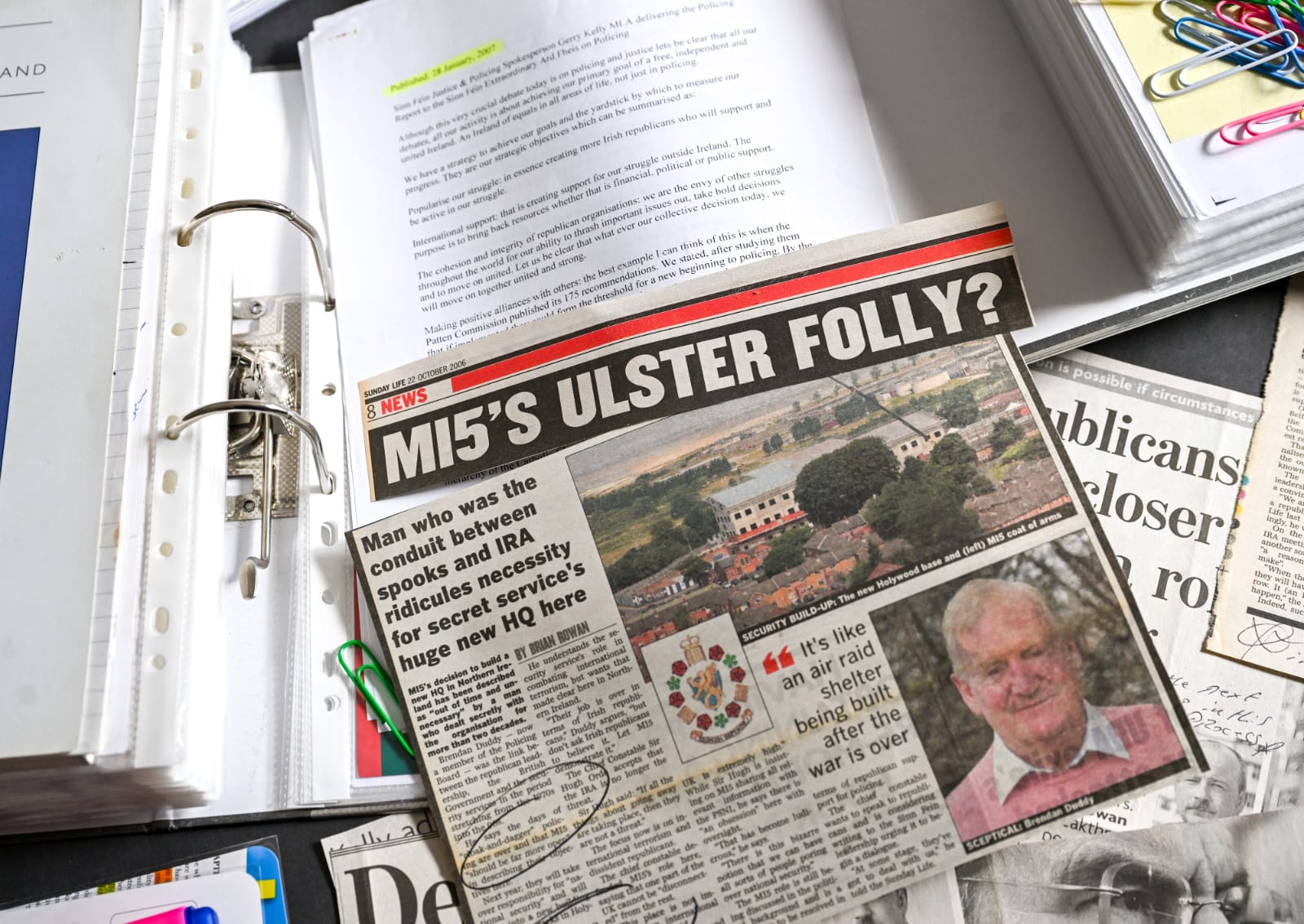
Derry's Brendan Duddy criticised the building of MI5 HQ in the North.
Looking back, Barney Rowan said everything considered, the period 2005 to 2010 was much more significant than 1994 to 1998.
“Essentially, the importance to our process was leadership,” he observed. "And here we are in 2025, in a leaderless world, with power and ego masquerading as leadership, a people being slaughtered and starved and too many leaders looking the other way.
“When people come to talk to me about that conflict, I have said to them recently, ‘We can’t help you’. What I mean by that is the conflict in the Middle East is way above our pay grade,” he added.
“We can tell them what worked here: quiet dialogues, ceasefires, negotiation, eventual agreement, the difficult issues being pushed away into commissions - prisoners, arms, policing - legacy left silent at that stage, although it is the unfinished piece of work in many senses.
“But the Middle East conflict is for the world powers and the world powers - Trump and Netanyahu. When I hear Trump's name being mentioned, in the same sentence as the Nobel Prize, I just think that stains the word peace. His name and peace are contradictions to me.


“When we look out of our own shell and we look into the wider world, I think we come to better appreciate what we’ve got and how far other people are away from what we’ve got,” said Mr Rowan, who described the sharing of his extensive primary source material with the Open University as a “deliberate shedding of the load of memories and records that relate to those times when this place lived and died”.
He added, with poignancy: “I think it is important to get a memory down or a record down while we are still capable of doing that because so many people who were critical to this process are no longer with us and they have taken their experiences, their knowledge, their truths with them.
“I wonder now who talks for those people. Who speaks for Martin McGuinness? Or who speaks for David Trimble? Or who speaks for Brendan Duddy or Mo Mowlam or Pat Hume or John Hume? In processes like this there is only one person who can speak for you and that is yourself.”
Addressing the issue of legacy, he said: “The sooner we address the legacy question and put it to rest, with some respect, the better.
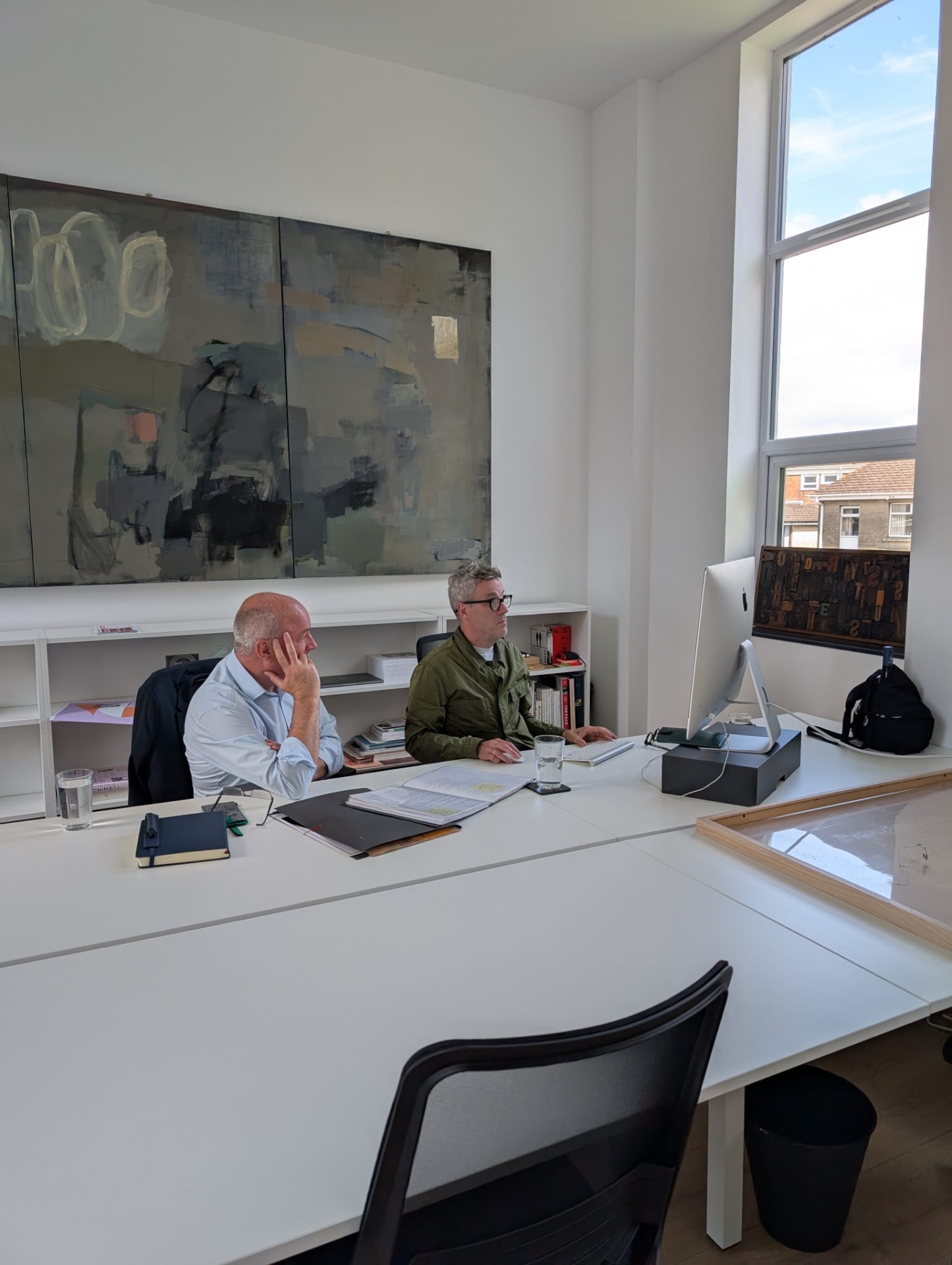
Barney Rowan and Ciaran Hurson signing off on the archive publication.
“And the sooner we hand this process to the next generations the better because the whole idea of ceasefires and political agreements and ending armed campaigns was to create space for next generations to shape their future.
“And we haven’t allowed that. It hasn’t happened. That is something that is absent and it is the next part of the journey - how we close those matters that need to be closed and how we free those next generations up to shape what they want to shape rather than what we think we need to shape.”
‘28 July 2005 - 4 o’clock - and all is well’ was designed by Ciaran Hurson with photography by MT Hurson.

Subscribe or register today to discover more from DonegalLive.ie
Buy the e-paper of the Donegal Democrat, Donegal People's Press, Donegal Post and Inish Times here for instant access to Donegal's premier news titles.
Keep up with the latest news from Donegal with our daily newsletter featuring the most important stories of the day delivered to your inbox every evening at 5pm.

This publication supports the work of the Press Council of Ireland and Office of the Press Ombudsman, and our staff operate within the Code of Practice of the Press Council. You can obtain a copy of the Code, or contact the Council, at www.presscouncil.ie, Lo-call 1800 208 080 or email: info@presscouncil.ie.