

Like old times in Buncrana: A short story by Hugh Gallagher

It was a glorious sunny August Monday around two o'clock in the afternoon when I finally boarded the bus for Buncrana.
Patrick Street was bathed in sunshine as people queued for buses.
Children became bored, their gaily coloured buckets and spades dangling from their hands.
Parents roared at their off-springs just like mine did when I was a wee boy.
Our family used to fill a third of the seats in one bus then.
Now as each bus arrived they clambered aboard, smiles appeared and minor problems were swept aside.
As our bus chugged away from Patrick Street and turned left down the Strand Road I glanced back and saw that another equally large queue was forming.
I was fifteen now and had just started work in the BSR in Bligh's Lane where I earned the princely sum of £2-16s-4d.
The excuse I had for going to 'Budgin' was that I needed a pocket watch and they were cheap there.
If truth be told, I was trying to prove I was grown-up and attempting to recall an earlier memory. I also intended to get my mother a present for her birthday.
As we neared the Customs Post at Brigend I paid more attention than usual but there didn't seem to be anybody there just a metal sign in middle of the road reading 'STAD – STOP'.
The bus shuddered to a halt anyway and then a man in a black uniform and peaked cap came to the door and waved his hand scornfully.
It was as if we had interrupted his meal.
We drove on, the old bus belching out a trail of black smoke from its rear end.
No matter how many times I travel to Buncrana I still remember that first time, as a child, when I saw Lisfannon beach, caught a waft from the sea air and marvelled at the incoming waves. Today I felt the same.
The children around me clambered nearer to the windows for a better view. Yet somehow I could see I was losing that earlier innocence.
Just past Lisfannon an elderly woman struggled from her seat and despite my effort to help her, made her own way to the door of the bus.
“Are you blind, son!” she rebuked the driver. “You've gone right past me stop!”
The driver too was elderly. He sat her down gently and apologised profusely. Next he did a three point turn on the main road bringing whatever holiday traffic there was to a halt. We drove the hundred yards or so back to where she should have alighted. Again he courteously helped her off. They exchanged a few words outside the bus and when he returned we resumed our trip to the seaside. As the bus trundled along I said to him.
“Was she grateful? That was a fine thing you did there!”
“Aye!” he said, and then he laughed loudly. “But do you know what?”
“Naw. What?”
“She said - “Thanks son. But you've left me off on the wrong side of the road!”
It was early afternoon when I made my way from Main Street to the covered amusements. Once inside I had a go at most of the games. My favourite was still the rifle range with its wee yellow ducks and impossible to win prizes. I spotted a girl of my age from the next street in there but was too shy to even say hello and I left.
My next stop was again in Main Street. We used to laugh at that name and there is a derogatory saying in Derry – Main Street – down wan street and up the same street!
I began looking for the pocket watch I had always wanted since my grandfather died and left his to my father. In four different shops I saw the same watch at four different prices.
Being so hot, I removed my jacket and loosened my tie. I bought an ice cream wafer on my way to the beach. The outdoor amusements were packed.
From the different rides came screams of delight. Families were all over the shore-front having picnics and cooling down. I removed my shoes and socks and made my way to the waters edge.
Rolling up my trousers legs I went for a paddle. All around me children and their mums and dads were rushing into the water.
Out in the bay the sun played tricks with the colours on the water, changing from greens and browns one minute to dappled silver to grey and white and sometimes blue the next time. I spent a couple of hours there just relaxing or talking to a few workmates and their friends.
At five o'clock I dragged myself away and ambled up to the town centre again. I had a huge plate full of fish and chips washed down with a cool glass of fizzy lemonade.
Next I returned to the task I had set for myself. For fifteen shillings I bought the pocket watch. Two shops down I bought my mother's birthday present – a vase for £3. This was a lot of money in 1965. The woman put it in a tall cardboard box and I carried it to the bus depot for the journey home. I also purchased 11 sticks of pink rock for my seven sisters, two brothers and my mother and father. I hated rock myself ever since I broke a tooth crunching a bar. At six thirty the bus left Buncrana. A young girl and boy fell fast asleep on their parents knees in the seat in front of me.
“It's the sea air that does it!” explained the father. “They'll not forget this day for a long time!”
As we left more day-trippers were making their way to the town centre. These were older people probably down for a dip in the sea or sun worshippers. Now they were off for a pint and an evening's entertainment in some local pub.
As we neared Lisfannon I could see the sun beginning to set and the sea glimmering. The box under my feet was starting to worry me especially when we neared the Customs Post. What if we're stopped: will I be caught, how much can you take over the Border anyhow? What if they lift me, I thought.
At the check-point we were indeed stopped. The Customs man I saw earlier in the day began searching all luggage in minute detail. When he arrived at my seat I was sweating.
“Anything to declare, young fella?” he asked.
“Naw! Just these bars of rock,” I lied.
“Who owns that cardboard box down beside your feet?”
“Where? What box?”
“That box, there! Down there!”
“Aw! That box ye mean. Dunno. It's empty but,” I said. I went to lift it but he just swung a boot at it and it went further under the next seat.
“Aye, you're right, son! So it is!” he declared.
All the way back to Derry I was worried. What if he's broken it I thought. All this journey for nothing. But I needn't have worried. I opened the box when I was on the Creggan bus home and discovered that the vase was intact. It looked fine.
“You're becoming a wee bit of a loner these days, son!” said my father on my arrival back home. “You want to watch that!”
I explained why I went to the seaside on my own but they still looked at me curiously. I distributed my gifts and went to bed contented.
Early the next morning I was awakened by my brothers Eugene and Liam.
“Get up. Get up!” shouted Eugene.
“Me ma wants ye!” cried Liam. “She's downstairs.”
Quickly I dressed and headed downstairs. All over the fireplace and floor lay her pink and white vase in little pieces. My mother was sweeping up the bits.
“Sorry, son!” she said. “I was lighting the fire when it suddenly split in two and fell. Then it broke into all these pieces.”
“Never worry yourself, ma! It's okay. Honestly. Sure it didn't cost that much. I'll get you something else when I get my next pay!”
Bloody Customs man, I thought. He did get me after all.
“Don't worry about that, son. How's your watch doing. Let me see it.”
Just then came the sound of shouting. I looked around just in time to see a silver object hit the last stair and shoot forward into the hall. There was a noise like 'Boing'. I rushed out to the hallway. At the top of the stairs stood my youngest sister, Ann. Behind me lay the remains of my watch, springs, winder, glass and brass wheels.
“It was an accident,” shouted my sister. The chain was dangling over the bannister and I pulled it to see what it was!” She started to cry.
“Ach, never mind, love,” said my mother. “Sure I'll get him a new one. Something else is bound to break now. These things happen in threes!”
“Did you enjoy your day at the seaside?” asked my father, coming in from the garden.
I sighed. “Aye, it was great,” I lied. “Just like old times but I missed all of you for company!”
I returned to bed with new memories.
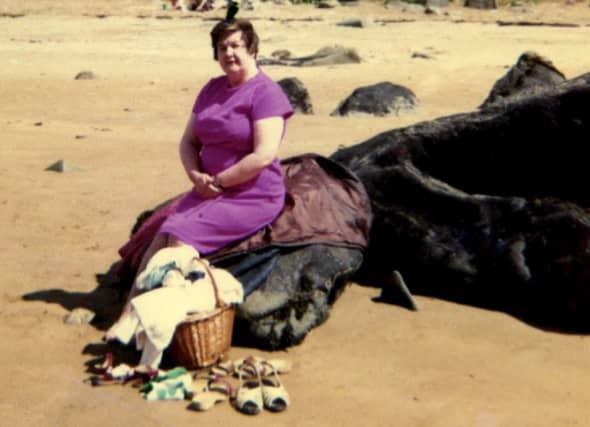
The photo above was one of the first photographs Hugh Gallagher ever took. It shows his late mother, Mary Gallagher (nee Page), sitting on the beach in Buncrana, Co. Donegal.
At her feet sits a basket of clothes and food. The shoes and clothes belong to some of her ten children.