

Inside Auschwitz: Walking through the valley of the shadow of death
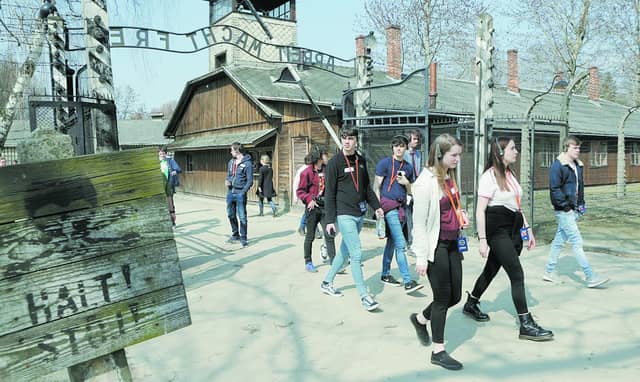

Derry News reporter Gareth Cross last week visited Auschwitz concentration camp in Poland as part of a trip organised by the Holocaust Educational Trust and their project 'Lessons from Auschwitz'. He attended with hundreds of school children from across Northern Ireland, including Derry and here shares his experiences of the trip.
It is not every day you are asked to visit Auschwitz, the site of the Nazi's most notorious concentration camp.
When asked I was initially unsure but as a lover of history with a strong interest in the Nazi rise to power I reluctantly agreed.
I went on the trip with the Holocaust Educational Trip, their Educators, hundreds of Northern Irish school children and other press.
Auschwitz was a network of three concentration camps set up by Nazis following their annexation of Poland during World War II.
It consisted of Auschwitz I, the original camp, Auschwitz II-Birkenau (a combination concentration/extermination camp) and Auschwitz III-Monowitz (a smaller labour camp).
During our visit we saw Auschwitz I and Auchwitz II-Birkenau where most of the murder took place.
The camp was first constructed in 1940 with the first exterminations starting in September 1941.
An estimated 1.3 million people were sent to the camp with at least 1.1 million killed there.
Around 90 percent of those killed in the camp were Jewish with Polish, Romani, Sinti, Soviet Prisoners of War and Homosexuals amongst the others killed at the camp.
The camp was run by the SS with the main Commander of the camp being Rudolf Hoss who was later hung at the camp after World War II.
The holocaust was not a new subject for me, I spent much time learning about the Holocaust in school at both GCSE and A Level. I knew all the facts and figures about deaths and the terrible conditions in which prisoners were forced to live.
I had also watched movies on the subject, the best being 1961's 'Judgement at Nuremberg' which shows real footage of concentration camps (including bodies stacked high) taken following their liberation by Allied troops.
When you start talking about people being murdered in the millions it is very difficult to comprehend. One death can be easily focused upon and rationalised, a person with their own personal story, but millions?
One of the striking things on first arriving at Auschwitz were a number of hotels and restaurants built directly facing it, with construction work ongoing for more. I couldn't help but think who would want to eat or stay so close to such a place. Even Nazi death camps aren't immune from commercialisation.
Walking under the famous 'Arbeit macht frei' 'Work sets you free' gates was a surreal experience.
Our guide for the day Karmil described the camp as an 'instrument of terror in occupied Poland'. Karmil was a very knowledgeable guide and seemed to be genuinely passionate about the subject at hand, so much so that I couldn't help but wonder if any of his family had been affected by the Holocaust.
He told us that each inmate was required to undertake 11 hours of slave labour each day with limited toilet breaks and meagre rations.
In the afternoon SS guards held role call in which inmates were inspected and some were ordered for deaths.
Inmates were made to wear striped pyjamas and uncomfortable shoes including Dutch clogs with no socks.
We were escorted around the original buildings of Auschwitz which now housed various museum exhibits.
The group was taken around rooms filled with personal possessions which had belonged to Auschwitz inmates. They were told that they were going to a new life before going to Auschwitz and brought all their wordly belongings with them. These were then taken from them on arrival and sorted by the Nazi's to find the most valuable objects.
We passed through rooms filled with piles upon piles of shoes that had belonged to the prisoners and shown rooms with suitcases that still had the names of those who had owned them. We were also shown piles of pots and shaving brushes, personal items that had since lost all meaning.
One of the most disturbing points of the trip was entering a room which housed over a tonne of female human hair. The hair was sold and used by the Nazi's to make soldier's uniforms and special warm boots for them to wear when on the Eastern front.
The level of dehumanisation at Auschwitz was such that after a few weeks german soldiers at the camp were no longer able to recognise inmates due to the radical change in appearance due to lack of food etc and that's when the famous system of tattooing of numbers on inmates arms started. Auschwitz was the only camp to use the system.
We also saw a wall which inmates had been lined up against and shot for the most minor of transgressions.
The group also walked through walls and walls adorned with pictures of inmates taken at the camp. Men, women and children, almost all with gaunt faces with some showing defiance in their picture. One in particular of a man with a haunted look of fear on his face will stay with me. Nearly every one of the pictures included a date of death.
The educators from the Holocaust Educational Trust made every attempt to personalise and individualise the suffering and death at Auschwitz. One of them pointed out that in one of the photos on the wall, a young girl of 14, she had a swollen lip, caused by a beating from an SS guard for something minor. She later died at the camp.
Her story seemed to have a profound affect on the group of students, especially the girls who were just a few years older.
The educators asked the group 'Why where they there? What crime had they committed?' and nobody had an answer. The only crime committed by the vast majority of those who perished at Auschwitz was simply being different to the ideals treasured by the Nazi regime.
One of the more affecting part's of the trip was visiting a room which had walls adorned with drawings done by children representing life in Auschwitz. The childish drawings representing some of the horror that went on (hangings etc) give it a whole new impact.
Before being shown the gas chamber we were told in detail about the deaths experienced by prisoners there.
The Nazi's discovered that large numbers could be killed quickly with the pesticide Zyklon B. We were told that murder by this method was 'very painful' and could last up to 20 minutes. Jewish inmates were then forced to retrieve the bodies from the gas chamber and burn the corpses. Before burning they were forced to remove the scalp, hair and dental work so that it could be melted down and sold. Hair was sold to the textile industry.
Around 22 thousand children were killed in the gas chambers while others were subject to pseudo-medical experiments conducted by the notorious 'Angel of Death' Dr Josef Mengele.
It is hard to fathom the evil that went on there.
In the second part of the trip we visited the Auschwitz II-Birkenau section of the camp where most of the mass murder took place. At Birkenau we were shown the famous train tracks. When prisoners arrived at Auschwitz they were sorted into two groups, men and women and children. They were then sorted into those who could be used for work and those would be immediately killed.
There we viewed the incredibly cramped living conditions and meagre washing and bathroom facilities.
Prisoners often slept 700 to small wooden huts invested with rats and cockroaches.
One striking aspect of the huts were prisoners lived was in one inmates had painted pictures on the wall for children. Even when faced with continued misery and certain death our guide explained, people still found it within themselves to do something to make children smile.
While the Holocaust may be considered long past history for some throughout the visit we passed large groups of young people visiting from Israel with some of them draped in the Israeli flag. For them and Jewish people in general the wounds of the Holocaust still linger with many of their descendants having been killed. Their obvious emotion made things seem abit more raw and real.
After our tour we attended a short memorial ceremony conducted by Rabbi Barry Marcus which featured poetry and short speeches. Rabbi Marcus touched on the importance of the lessons learnt from the Holocaust today and the issue of anti-Semitism which is still prevalent across the world.
His speech was very thought provoking.
Head of the Holocaust Educational Trust Karen Pollack said that she was particularly proud to bring Northern Irish students on the trip due to our own history of divided society.
After the tour was over I spoke with some of the local students on the trip to find out what they had made of it.
They had met with a Holocaust survivor before the trip and were challenged to take the lessons learned and put them into practice at their schools and in their local communities as ambassadors.
Tiernan Cusack from St Columb's College said that the trip had been a 'good experience' and that he felt 'nobody should ever be treated differently because of their religion and culture.'
His schoolmate Patrick Merrigan said that he was particularly struck by the cramped living conditions and the clothes that the prisoners had been made to wear.
Erika McClelland from Foyle and Londonderry College said that it was 'very insightful and emotional to see the hair of so many women'. She said that the trip helped her to humanise and understand what had taken place at Auschwitz.
Her schoolmate Ellis Gilchrist said she had been affected by the stories about children and that she felt hearing people's personal stories made the experience more powerful. She said it was important to make it personal rather than just think of them as a mass of people who had been killed.
The main point from the trip that stuck out me was a quote from Spanish born American philosopher George Santayana offered by Rabbi Marcus during the memorial service ‘Those who cannot remember the past are condemned to repeat it.’
He also quoted a line from the Pslam of David which he said he felt summed up the experience of Auschwitz 'Yea, though I walk through the valley of the shadow of death, I will fear no evil'.
The lessons learned from the Holocaust are as relevant today as they ever were.