

Magherafelt stroke survivor hails new 24/7 lifesaving service at Stormont event
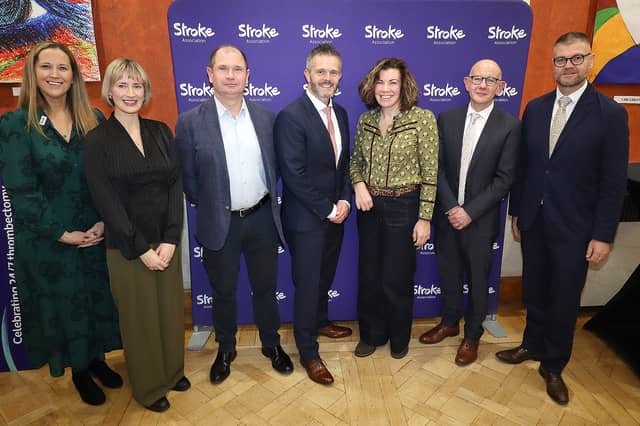

Clodagh Dunlop MBE, who had to wait eight hours for a thrombectomy in 2015, joined clinicians and campaigners to celebrate the milestone.
Just over 40 stroke patients have now benefited from lifesaving thrombectomy treatment since the Health Minister Robbie Butler announced in September that the service would finally be available 24 hours a day, seven days a week in Northern Ireland.
Thrombectomy is a game-changing treatment which removes the blood clot which causes stroke. 1.9 million brain cells are lost every minute after a stroke, so the quicker someone receives the treatment, the better chance they have of making a good recovery. When delivered in a timely manner, the procedure can save brain function, reduce disability, and ultimately change lives. It is also cost effective for health services as it reduces the need for long-term care and rehabilitation.
However, prior to September, thrombectomy was only available in Northern Ireland daily between 8am and 5pm. So, anyone admitted to hospital outside these hours would have to wait until the following morning – which can make a huge difference to the impact of their stroke and recovery.
But already, over half of the procedures carried out so far have taken place out of hours between 5pm and 8am.This highlights the vital importance of ensuring stroke patients access to this treatment regardless of the time of day or night.
On Monday night, the Stroke Association hosted a special celebration event at Stormont to mark the introduction of 24/7 thrombectomy services in Northern Ireland. The event brought together clinicians, stroke survivors, politicians and campaigners to celebrate the significant milestone in stroke care and recognise the collective efforts that helped make it a reality.
Clodagh Dunlop MBE, from Magherafelt, who attended the celebration event, had a brain stem stroke in 2015, which initially left her with locked-in syndrome. She was completely paralysed and she was only able to communicate using her eyes.
She said: “When I had my stroke at 2am, thrombectomy was not available 24/7 in Northern Ireland. I had to wait until 10 o’clock the following day for this life-saving treatment, hours that changed my life forever. I almost died; I spent weeks on life support followed by eight months in hospital learning to speak and move again. The fact that thrombectomy is now available 24/7 in Northern Ireland is incredibly emotional. It is the result of years of campaigning by many people and means future stroke patients can receive the right treatment at the right time.”
Lauren Shaw, Policy and Influencing Lead at the Stroke Association said: “24/7 thrombectomy is already changing the lives of people affected by stroke in Northern Ireland, which we should all be incredibly proud of. This has only been possible because of the clinicians who worked so hard to expand the service, the stroke survivors who shared their experiences and campaigned for change, and those who came together to make 24/7 access to thrombectomy a reality.
“Now we need to build on that progress by making the whole emergency stroke pathway as fast and effective as possible, and ensuring people get the specialist rehabilitation and support they need to recover and live well after stroke.”
Belfast Health and Social Care Trust interventional neuroradiologist, Dr Graham Smyth, who delivers the service and performs the procedure said: "It is fantastic for the patient and our team when a person having a stroke improves during the procedure. Thrombectomy can almost double the chance of a person having a stroke becoming independent again. Getting the 24/7 service up and running provides an incredibly important piece of the jigsaw in stroke services for people across Northern Ireland."
The Stroke Association supports stroke survivors and their families by phone, at home, and in the community. Find out more at www.stroke.org.uk .