

Former staff member shares inspirational story of Derry engineering firm after its closure last week
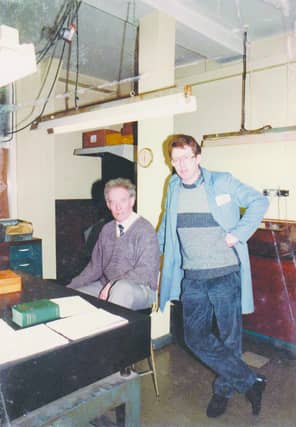

A Derry man who was instrumental in the creation of one of Derry’s most successful manufacturing companies has spoken of his sadness at the closure of the firm.
Schivo NI, formerly known as Maydown Precision Engineering (MPE), closed its doors on Friday with the loss of 40 jobs.
The move comes after administrators have been unable to find a buyer for the plant, which makes parts for aircraft manufacturers.
Maydown Precision Engineering provided employment in Derry for around 200 people over a 30-year period, with the Schivo closure described as the ‘end of the era’ for the manufacturing industry in the city.
The Maydown plant had formerly been the site of Molins, which provided cigarette-making machinery to the tobacco industry.
In 1984, Molins dropped a bombshell on its workers that it was to cease operating in the northwest, despite the factory being one of its productive plants.
However, out of the ashes of Molins came an initiative which not only created one of the most successful engineering companies in the north, but also led to a legacy of self-help and social enterprise which continues to this day.
Speaking to the Derry News on Friday, Conal McFeely of Creggan Enterprises, who was instrumental in the setting up of the community-based organisation which ran Maydown Precision Engineering, spoke of his sadness at the Schivo closure and some of the factors he believes contributed to the closure.
“First of all, it’s a sad day when we’re talking the loss of jobs in the manufacturing sector, but we should never forget what the workers at Maydown Precision Engineering did because that has been a symbol of good practise and local people coming together in the face of adversity.
“I’ll never forget that day, October 26, 1984. I was the shop steward at Molins and was called into a communication meeting at the White Horse Inn at Campsie with three senior executives who had been flown in by Molins.
“I’ll also never forget the heading of statement they read out – the discontinuation of its Londonderry operation, which they said would take effect as of 11am that morning.
“So it took them six minutes to shut down a factory, which was my first experience of the fickleness of multinational corporations.
“I walked out of that meeting having to tell 500 people that the factory was closing down and they were losing their jobs.”
However, the workers responded with an initiative that created a 30-year legacy which has since become a by-word for self-help in the face of adversity.
“The workers did something that was quite unique, they staged a work-in where they occupied the factory, and took on this multi-national company.
“We then began with self-help initiative to save the factory, where we convinced the workers to use their redundancy money to acquire the machinery and the plant from Molins, who then handed over the equipment to the workers, saving over 200 jobs.”
The new company, Maydown Precision Engineering, was created, a community-based engineering company, based on the same idea as the Credit Union movement.
“We had £750,000 of contact work, and Maydown Precision Engineering was not only a catalyst for the regeneration of Derry, it also was a model of self-help that inspired people not only in Derry, but across the world,” he added.
Indeed, the spirit shown by workers at Maydown Precision Engineering was felt as far away as New Zealand in wake of the earthquake which struck Christchurch in 2010.
“I was contacted by someone in the wake of that who said that they had entered the phrase ‘spirit of self-help’ into Google, and the three responses they got was number one, Maydown Precision Engineering, number two, the Derry Credit Union with the Rath Mor centre the third,” he said.
“They invited me out there and they adopted the same model we used in Maydown to get back on their feet.”
Mr McFeely also recently addressed a conference in Ballymena, an area which has also suffering devastating losses recently in the manufacturing sector.
“I was attending at Northern Ireland Housing Executive (NIHE) conference in Ballymena, looking at the setting up of social economy initiatives, and I took a question from the floor from a local group up there who are taking over a former police station.
“I spoke to them about my experience of starting up Creggan Enterprises, and Ballymena has suffered the loss of both the Michelin and Gallaher plant, so there’s a lot of similarities there.”
Mr McFeely added that it was his belief that the demise of Maydown Precision Engineering began when the ownership began being relinquished to multi-nationals again.
“I have no doubt that when the new owners took over, it was their intention from the start to asset strip the plant, not grow the company,” he added.
“When the ownership was taken away from the community, and back into the private sector, it again showed us the fickle nature of these multi-nationals.”
Mr McFeely added that Derry should not only focus on attracting foreign direct investment as the single key to economic regeneration, but equally concentrate on social enterprise models such as those used at Maydown Precision Engineering and Creggan Enterprises.
“What we need to realise is that foreign direct investment is not the only answer, we should be focussing on our own indigenous base, investing in our people with social enterprise models, not carpetbaggers who come in and strip everything until there’s nothing left.”
He added: “I think we should pay homage to those workers at Maydown Precision, who had a can-co attitude, and through a trade union movement pulled off a Herculean task, and kept engineering alive in this city for three decades.”
Meanwhile, Liam Gallagher, of the UNITE workers, described the closure as the ‘end of an era of almost half a century of manufacturing at Maydown’.
“It’s very sad news, there was around eight to 12 workers left at the plant who were finishing off an order, but the failure to find a buyer means that's the end of it now,” he said.
“It’s a shame because you have people who have been working there for over 40 years, and they will find it very hard to find new work in manufacturing despite the skillsets they have.
“It’s high time that the manufacturing sector here was given some sort of assistance, similar to that in Scotland where there’s help with energy and transport costs, because we’re looking at a situation where our manufacturing ability is being lost, and we now have the end of an era where half a century of manufacturing in Maydown has come to an end.”