

Praise Be: an expression of love - Fr Paddy O'Kane

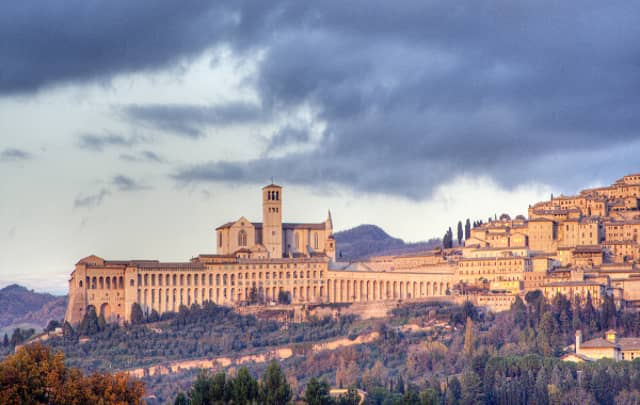

I have been to Assisi (pictured) twice, a beautiful peaceful town where, with my fellow pilgrims, we were given a deeper insight into the life of St. Francis who is regarded as one of the most outstanding saints in our Church.
There, we first heard his Canticle of the Creatures clearly explained. ‘Praised Be’ is the English translation of ‘Laudato si,’ the first two words in the Canticle, written in 1226, and also of the Pope’s encyclical.
It continues: “Praised be you, O my Lord and God, with all your creatures, and especially our Brother Sun … Praised by you, Most High, for Sister Moon and the Stars … for our Brother Wind … for our Sister Water
This new encyclical, ‘Laudato si’: on the care of this our common home, called earth, is his latest expression of his love for humanity by Pope Francis , and he is once again urging us to expand our understanding of what it means to love our neighbours.
Like previous popes, Francis urges that we protect the Creation that was given to us. And as we have come to expect, he places emphasis on the poor as those who suffer most – in this case, from the inequality caused by the exploitation of natural resources in poorer countries and natural disasters such as flooding or drought brought on by climate change also mostly in poorer countries.
To return to caring about the planet, as native people once did, is to practise love for neighbour on many levels, we are told.
Now, with this new papacy of the second Francis in this twenty first century, we are witnessing a break with the theology of control and domination over the natural world, as found in Genesis 1;28, in favour of a theology of care and harmony.
It reminds us of how deeply this Pope is connected to the great saint of 800 years ago. Francis of Assisi was caring towards human beings, but his practice went far beyond people. His reputation as the environmental saint is based on stories from his life (c.1181-1226).
These include him preaching to birds and negotiating peace with a wolf, of helping animals that have been caught in nets, traps and cages, blessing and freeing them, after he scolds them for being so foolish as to be captured.
When Francis of Assisi met animals, he would often connect with them as if we are all members of the same wide family. He purchased doves from village vendors and then set them free from their cages.
Rooted in a deep Christian humanism, the sort of caring that fed Francis of Assisi is also inspiring Pope Francis.
Jon Sweeney, writing in the Tablet, says that Francis seemed to look into the eyes of creatures and see himself in them.
You have to slow down if you want to be caring, he adds. Francis of Assisi stopped and took the time to care for those that most of us carelessly pass by.
“Francis was connected to the physical world in ways that saints before and after him have found strange, shocking and maybe even heretical – ways that make him different from most of us,” according to Jon Sweeney.
He crossed lines time and again, including the well-established line separating the human world from the animal one. He knew that most people- with the exception of poets and mystics- ignore the presence of the divine all around them and are blind to the ways that God is incarnate in all of Creation – not simply in humankind. The old Irish blessing printed below is in keeping with Saint Francis’ thinking.
It has taken nearly 800 years and a second Francis, but with ‘Laudato si’ the brave insights of the Canticle of the Creatures have moved to the mainstream of the teaching of the Catholic Church.
Praise be to God for that too! Deep Peace of the running wave to you Deep Peace of the of the shining stars to you Deep Peace of the quiet earth to you Deep Peace of the of the Prince of Peace to you (Early Irish Monastic blessing)