

My Memories of Derry: Liam Quigley
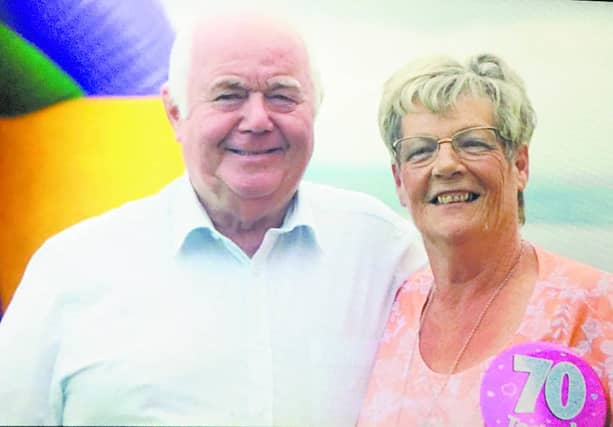

by Ursula Duddy A 73-year-old Derry man who will celebrate 50 years of wedded bliss with his other half this year said he has been lucky in life and wouldn’t change a thing. Liam Quigley from Maybrook Park is married to his wife. Bernie. 50 years this year and is father to seven children, Gary, Damien, Adrian, Jacqueline, Bridgeen, Liam and Jonathan and also grandfather to 13 grandchildren. In today’s ‘Memories of Derry’, Liam shares his story with us and takes a walk down memory lane with many a great story, starting with the day he was born. “I was born in the City and County Hospital in 1943, I was a war baby,” he said. “Things were tight for people then and my mother and father had to live in overcrowded housing conditions, living with relatives. “We lived in the Brandywell for a while with my Granny and Granda at Deanery Place and then we moved to Burnfoot for a wee while before we eventually went into Springtown Camp. The first settled home we had would have been in Springtown Camp in 1947 or 1948. “I remember bits and pieces living there, I remember going to school from Springtown Camp. At that time I was going to school in Rosemount. There were two schools in Rosemount at that time. There was a girl’s school which was where the Rosemount Resource Centre is now, facing out onto the by-wash; Mary-Ann Coyle’s school – that was the infants’ school. Then when you reached first class you moved down to Helen Street to the big school and that’s still there. “My Granny and Granda on my father’s side came from Rosemount where I would’ve went for my lunch. I look now at the wains getting lifted and laid going to school…we got a penny for the bus and you had to walk from Springtown into Eden Terrace to get the bus to Rosemount. “But that penny meant you could buy a penny dainty so, more times than enough, you would have walked from Springtown Camp up to Rosemount and at that time it was a big Cowan’s dainty. “Springtown was a great community and it’s sad to see that it’s an industrial estate in the present day because it would have been a brilliant community. “The people there had nothing but they were survivors and I think that is embedded in that generation of people. They were people that could cope with almost anything. “When we were growing up, we had nothing but we had everything but this generation is growing up with everything but have nothing. “We were left to our own devices and we learned in the street and played in the street, you weren’t running round with your head stuck in a mobile phone or computer. “Fun to us at that time was going down waiting on the Buncrana train to come, running up on the bridge, the train going underneath and the smoke coming up all over you. You were stinking with smoke and there were wee burns but you would have cleaned yourself off before you went back into the house and you got washed in front of the fire in a big tin bath. “I had a sister that died as a baby in Springtown Camp so I think that was probably one of the reasons we were allocated a house in Creggan. When we moved from Springtown up to Creggan, it was to a big brand new house in Dunree Gardens. They were solid houses, there were no cavities in them and they had steel-framed windows. My abiding memory of it was waking up in the morning and the condensation running down the walls and my father used to say, ‘The sand to build these houses was brought from the beach in Lisfannon and when the tide comes in, the walls start crying’…and we believed that story!” Among other stories that came to Liam’s mind about growing up in Creggan, was going to the Gasyard and picking up pram wheels and a large rope which was then fashioned into a cart. Liam recalls whizzing down Bligh’s Lane on his handmade cart before going over the Lecky Road direction for a bag of coke, a fuel similar to coal. He said getting the cart back up Bluigh’s Lane wasn’t quite so easy as he had to pull it back up like a horse. He also recalled being sent Brewster’s and Stevenson’s on William Street with a pillowcase to fill with ‘hard bread’, which had just been on sale the day before and wasn’t considered fresh one day later. “They were resourceful and that’s why I think that generation are so resilient,” he said. Liam said he has many fond memories of growing up in Creggan: “I remember going up to the new modern Creggan Estate with the white houses in Dunree Gardens and Central Drive. There was no such thing as central heating then, central heating was when you went to bed with a busman’s coat over you in bed. “We grew up in Creggan, I would have been around six when we moved there. That’s where I grew up until we got married in 1967. “Funny enough, Bernie’s father, Willie, practically adopted me before I ever met her. We were working in a building site down in Eglinton and her father worked in the boiler house. There was me and Michael Kerrigan worked there and we used to go in to him every day and he made us a cup of tea in the boiler in a tin mug. “My father was the boss on the site and we used to be watching out for him but Willie used to say, ‘Never mind him, come on in and get a cup of tea!’ Willie looked after us and that was before I ever met Bernie so I had no bother getting permission to marry her, he knew me well! “We met in the 60s and I would have spent a lot of time going to my grandparents’ houses in Rosemount and the Brandywell. At that time growing up in Derry, the different areas were very partisan and very fierce and very protective of their own area. There was a great community spirit. “Rosemount was a village within the city and basically the Brandywell was the enemy! I think that reflected in the days of the football, in the days of the D&D when Rosemount played Foyle Harps. I had a foot in both camps but the manager lived a few doors down from my Granny and I saw all the trophies and they were the glamour team so I got in there!” Liam first fell truly in love with the beautiful game by going to watch Derry City play at the Brandywell when he was just a boy of about six-years-old. “The first football match I went to was in 1949, I went with my Granda Porter to the Brandywell to watch Derry City playing and that was the year they won the cup, 1949,” he said. “My Granda Porter was a big man, about 6 foot 6 inches, and he worked in the Gasyard. I mind him taking me to the Brandywell and just lifting me straight over the turnstiles. He was like a hero. “At that time it was the Southend Park end was the unreserved end of the Brandywell and there was a lot of characters like Danny McDaid, Hawker Lynch and Johnny Cuttams and the banter was good. It became a religion, watching the football, and even as you got older when I was going up to Bernie’s house, we were all at the same match but we all had a different version of it! “I followed Derry then right through the glory years until they left the Irish League, the 60s was their best period when they were winning everything with a good side. “It’s different times now and football is a different game. I remember, a way back, Jimmy Kelly who played for Derry was one of the hardest shots with his left foot and it was the old heavy ball then, that would have been twice the weight of the ball they use now and if it was a bad day that ball got heavier and heavier. “I mind the famous Elisha Scott, a goalkeeper who played for Liverpool, when he was with Belfast Celtic, he said in a statement in a book, he didn’t mind that he couldn’t stop the ball when Jimmy Kelly hit it straight at him but when it hit the Brandywell wall and came back, he still couldn’t stop it!” Liam said he witnessed many changed in his community as he grew up: “Growing up in the Creggan we watched it develop from nothing. We watched St Mary’s school getting built, we watched the chapel getting built. The Boys’ Club was down in Beechwood Crescent and until the chapel was built it was called St Eugene’s Upper Club and it was a big barn and a wooden hut and that’s where everything took place. You were down there five nights a week and the Bishop’s Field, there was nothing there, you played football there from dinnertime until it got dark. The more people played the further back the goal went, two coats were moved back so you had the full field with sometimes 20 a side. You could play from morning to night and you could probably run the full length of the Bishop’s Field from Central Drive to Iniscarn Road! “Football was a way of life and I think that’s how a lot of boys developed their skills. You had a makeshift ball because you weren’t able to go into a shop and buy a ball because you didn’t have the money. You made a ball out of socks or something – they were good times!” Liam said there was thriving entertainment in the city when he was growing up and the culture wasn’t so much based around alcohol as he believes it is today. “We were running to dances and you had a bottle of Coke or a mineral and a girl would have frowned at you if you came in with the smell of drink on you,” he smiled. “We didn’t go into pubs and girls weren’t allowed in anyway back then! It wasn’t the place to go to meet girls. “But there was dance halls, picture houses and a lot of community stuff. During the week you would have run to The Corinthian and it was one and six to get in and if you were in early on a Monday night you got a free ticket for the Wednesday night and it was two and six for the The Corinthian on a Friday night and two and six for The Guildhall on a Saturday night. Sometimes you slipped up to The Memorial Hall on a Friday night too so for six and six took you to four dances in a week; that would be about 60p in today’s money. “My first week’s wages as an apprentice joiner was 17 and six and you had to take your pay packet home, unopened, and hand it in and I got handed back two and six so I had to earn whatever else I needed to keep me going all week. So you were doing wee jobs for people, boys would lay the floor down and pay you for nailing it, things like that – so you always earned the extra money. “I remember the showbands going in the 60s, nearly every street in Creggan had a showband in it and fellas that were going out to play music might have been playing in Cork and they would be landing back about seven in the morning and they were rolling out of a van and going straight down to work in the BSR. “It was a way of life and we hadn’t even got the roads we have now but people done these things and they were playing for buttons. “We used to go to St Columb’s Hall and it used to be good with Bishop Daly running all the concerts. He used to bring all the big acts because there was nothing on in England on a Sunday; the only theatre that was on was the London Palladium. So if the big acts were in London on a Saturday they were free on a Sunday so he would have brought over big acts like Roy Orbison, Jim Reeves, Val Doonican, The Bachelors, and we would have paid five shillings to get in to see them. “There were some fantastic acts; Frank Carson was the resident comedian and Don O’Doherty was the resident compère. Sunday night at St Columb’s Hall…you wouldn’t have wanted to have been anywhere else. “Where we lived in Dunree Gardens, one of the best bands in Derry was Johnny Quigley’s showband, Johnny Quigley’s All-Stars. Out the back of their house in Central Drive, they had a wooden floor laid out and the band rehearsed all their moves for the stage there and they brought music back from Am,Erica, Latin American stuff, and all the jazz long before any other showband. It was fresh and they were some band made up of three or four brothers and cousins and other people. “There were showbands everywhere in Derry and they were maybe working in BSR or on building sites but away playing music at the weekends.” Liam said the times he grew up in were simpler and a world away from the fast-paced lives we lead now. He also believes there was a much stronger emphasis on community. “The likes of the old Brandywell, nobody had an inside toilet, your toilet roll was cut up newspapers and I remember all the men of the street would have gathered at the corner and talked, sang and harmonised, that was their entertainment. And if you went along you were chased because children weren’t allowed! “Everybody looked after you because they knew who you were. There were five houses in Deanery Place and everyone of them knew you, even to this present day, people will know me from there. “There were communities and community spirit, especially in the Brandywell where the Grotto and the Lourdes Hall, which isn’t there any more, they were all built with voluntary effort. Then you had the likes of the Long Tower Carnuival and the festivals.” Liam said he has seen a great deal of change in Derry throughout his lifetime, some for good and some for bad. “I think we are missing that community spirit now. Nobody in them days would have locked their front doors, so people could just walk in. Now you daren’t leave your doors unlocked. “I think Derry has changed a lot for the better cosmetically but I don’t think it has changed for the better employment or career wise. Back then, the bulk of people employed were women in the shirt factory and the men had to go away and get work but in the 60s there was a lot of building work so there was plenty of employment in the building game. “I worked on these houses here in Maybrook Park as a 16-year-old. I worked on every one of them and my father was the boss building these houses and I never thought 30 years later we would end up living in it. I nearly know all the original tenants. “When these houses were getting built, Altnagelvin Hospital was also getting built and Prehen was getting built so there was plenty of building work about. “These houses were built for Du Pont workers and Belmont was built for policemen. If you needed a policeman up there you didn’t dial 999, you kicked the wall! “There have been good times in Derry and they’re a great community of people to grow up in but it’s lacking. All the redevelopment has improved the city but it’s lacking in other areas. “Community spirit is not what it was. I think that old sense of community is gone and gone forever; it will never come back again. It’s a different world. It’s not a very environmentally friendly world. You see young people now, like our grandchildren, there would be two in one room and three on the stairs all doing their own thing and the only reason they come to our house is because we’ve got good internet!” Liam said that he and his wife, Bernie, moved to Sheffield for a time but returned home and reared their family in Derry and welcomed 13 of those grandchildren who now enjoy using their Granda’s internet! This was a decision he has never regretted despite having lived through the Troubles here. “We knew people who went to far off fields but we brought our family up in Derry and we have done every bit as well,” he said. “It did us no harm staying in Derry and growing up in your own environment. I was in the building game in Sheffield and was working on a big hospital. There was a roof on it shaped like an old thrupenny bit and the English men couldn’t make head nor tail of it but I struck it all out on the ground because we were used to doing that here. “This English fella that was labouring to me asked how I knew to do that and I told him that was how we were taught here. He asked me to show him how to do different things. “Then, when we came back to Derry, years later when the Troubles had started and I was taking the wain to playgroup down in Kildrum Gardens, an army Land Rover came by and the boy came jumping out of the back of it and came running over. “He was a red cap and asked if I had worked on the hospital in Sheffield. It was that fella, he remembered me and I said, ‘It’s great to see you again but get away from me unless you want to get me shot!’ “I remember or first house was in Rosemount in Donegal Street, a wee small house we bought and it was 1968 and the bedrooms were up in the roof space and the kitchen and toilet were out the back and you were tramping on mice every day of the week. Then the Troubles had started and everything was flying over our roof and the wains were up sleeping in bed at Rosemount Factory corner. “We got allocated a luxury house then up in Foyle Hill in Rathowen Park then Motorman came up and invaded and all the windows were broken, except ours, because ours were facing out the ways. Then we moved from there to Galliagh and that was relatively quiet for while until things started spreading down there but we have been here in Maybrook Park for nearly 35 years now and the wains have all grown up and are doing well for themselves.” Liam said that, looking back over the years, he has been lucky in life and has no regrets. “I have been lucky in life in more ways than one and I have nothing to regret,” he said. “We lived through the times and remember the experiences and we have had more good times than bad. We are married 50 years now and the 50 years have been brilliant and as the song says, we did it our way!”