

Did Amelia Earhart die as a castaway on a remote island?

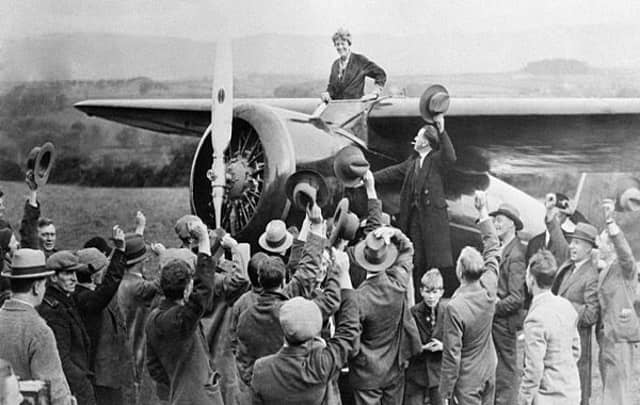

The mystery surrounding the disappearance of Amelia Earhart, the aviation legend with close links to Derry, has taken a new twist.
Leading newspaper, USA Today, has reported that researchers now believe they have found evidence that Earhart, the first woman to fly solo across the Atlantic making an unscheduled landing in Ballyarnett on the outskirts of Derry, may have died as a desert island castaway.
At the age of 34, Earhart set off from Harbour Grace, Newfoundland, intending to fly to Paris in her single engine Lockheed Vega 5B to become the first woman to fly the Atlantic.
After a flight lasting 14 hours 56 minutes, encountering storms and mechanical problems, she landed 84 years ago, on May 21, in Gallagher’s field.
Earhart went missing over the Pacific Ocean in 1937 after setting herself the challenge of being the first woman to fly around the world.
However, after taking off from Lae New Guinea, bound for Howland Island in the middle of the Pacific Ocean she disappeared, never to be seen again. Her plane was last seen on radar on July 2, 1937.
A rescue attempt lasted 17 days and searched more than 250,000 square miles of ocean, but the search was fruitless.
It was originally believed she had died in a plane crash, but new data relating to remains found on a remote island just three years after Earhart’s disappearance, suggest she may have perished as a castaway.
The International Group for Historic Aircraft Recovery (TIGHAR) said in September that they found evidence that Earhart made more than 100 radio transmissions in the days after her plane went missing, signifying that she had landed the plane safely.
Just last week, TIGHAR shared more new evidence indicating that partial skeletal remains found in 1940 on the island of Nikumaroro, between Hawaii and Australia, could belong to Earhart.
The bones had been examined by a doctor from British Authorities in 1940 but dismissed as they were deemed to be male and the remains were lost.
Then in 1998 TIGHAR anthropologists, Karen Burns and Richard Jantz, examined files on the matter and concluded ‘the morphology of the recovered bones, insofar as we can tell by applying contemporary forensic methods to measurements taken at the time, appears consistent with a female of Earhart’s height and ethnic origin’.
The las findings were made 18 years ago, however, TIGHAR shared the news just last week that forensic imaging specialist, Jeff Glickman, combined his knowledge with what had already been suggested to focus on the length of the forearm bones. They appeared to be that of a middle-aged European woman and were longer than average.
By comparing photographs of Earhart with visibly bare forearms to the remains of the castaway,
TIGHAR noted in a statement that Earhart’s arms were ‘virtually identical to the castaway’s.’
TIGHAR added: “The match does not, of course, prove that the castaway was Amelia Earhart, but it is a significant new data point that tips the scales further in that direction.”
Photo shows Amelia Earhart when she landed in Ballyarnett.