

Derry MLA fights Civil Service Pride 2026 ban

Decision to bar staff from marching under official banner slammed
Foyle MLA Sinéad McLaughlin (SDLP) has challenged the decision by NI civil service (NICS) not to participate in Pride 2026.
The organisation has banned its staff from marching as an official bloc or under the NCIS banner.
Staff were informed by internal communication that “in current legal and case law context, the NCIS is not in a position to participate in Pride 2026 events in an official capacity, where colleagues would be identifiable as representing the organisation”.
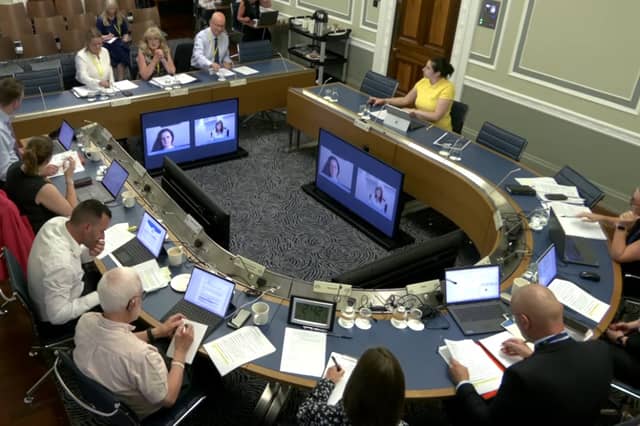
Ms McLaughlin’s intervention came during an Equality Commission for Northern Ireland (ECNI) oral briefing to the Assembly’s Committee for the Executive Office.
READ NEXT: ‘I could never imagine being as happy, doing anything else in my life’ - Fr Francis Bradley
The ECNI delegation comprised: Geraldine McGahey (chief commissioner), Neil Anderson (deputy chief commissioner) and Louise Conlon (chief executive officer).
Its briefing on Wednesday afternoon concerned the “implications of the April 2025 landmark UK Supreme Court ruling (For Women Scotland Ltd v The Scottish Ministers) that defined ‘sex’ as biological under equality law”.
As a result of that ruling, Scotland’s High Court equivalent - the Outer House Court of Session - ruled on June 19, 2026, “sex segregation in prisons in Scotland is lawful” and there was a “justification for maintaining sex segregation in prisons”.

Ms McLaughlin referred to the “legal uncertainty” in the North around the Supreme Court’s ruling and the “key questions that remain unresolved”.
Since the Supreme Court ruling, the North has been waiting on guidance from ECNI on its implications for this jurisdiction because the law in the Six Counties differs from Britain as a result of the Windsor Framework.
Agreed by the EU Commission and the British Government in February 2023, the Windsor Framework included arrangements respecting the integrity of the UK and the EU single market and protecting the Good Friday Agreement in all its dimensions.
Ms McLaughlin added: “The fact that you are not able to give precise or clear guidance at this stage in the absence of legal clarity is really important, yet today the head of the Civil Service has said in the current legal and case law context, the NICS is not in a position to participate in Pride events this year.
“The NICS should be an inclusive employer. Surely, within the context, if there is no clarity, why would a decision be made that the NICS should not take part in Pride?” she asked.
“My concern is, how can the public institutions ensure that our LGBTQ+ community continues to feel respected and included and protected while these legal questions are still to be resolved?
“There is such a gap between the two positions that I can’t understand why such a decision has been made in the lack of legal clarity, which still has to be given, and yet this decision has been made,” queried Ms McLaughlin.
The head of the Civil Service has said in the current legal and case law context, the NICS is not in a position to participate in Pride events this year.
Addressing the Assembly Committee Geraldine McGahey said she wanted to be “really clear from the outset, the Commission is not challenging the judgement of the Supreme Court in For Women Scotland, which was an important judgement”.
“We have repeatedly stated in unambiguous terms that were it not for the Government’s commitment under Article 2 of the Windsor Framework, courts and tribunals in Northern Ireland would and should deem the judgement in For Women Scotland as highly persuasive in respect of interpreting terms such as ‘sex’ ‘men’ and ‘women’ in Northern Ireland equality law,” added Ms McGahey.
“Immediately following the handing down of the judgement, the Commission received queries regarding a potential breach of Article 2 of the Windsor Framework, and as required under our duties, legal advices were obtained which consequently highlighted significant uncertainties in respect of the legal framework, and, therefore, work on the development of guidance that we already had underway was suspended pending the necessary clarification.
“However, the legal reality is that Article 2 of the Windsor Framework does exist and has potential legal significance in Northern Ireland - a matter, incidentally, that was affirmed in ‘Dillon’”.
Article 2 of the Windsor Framework is a legally binding British Government commitment ensuring Brexit does not reduce human rights and equality protections in the North.
Having “carefully considered how best to fulfil [its] responsibilities in this area” ECNI has asked the court for “clarity”, said Ms McGahey.
“Ultimately, only the courts can provide a definitive interpretation of how these legal provisions apply in Northern Ireland,” she added.
“The question of whether EU Directives, as interpreted by the Court of Justice of the EU, require Northern Ireland equality law to have different meanings for words like ‘sex’, ‘man’ and ‘woman’ compared with Great Britain equality laws, very much remains live,” said Ms McGahey.
The ECNI case is being presided over by Mr Justice McAlinden.
According to Ms McGahey, he was “very clear that he wants to make sure that everyone who wants to have a say will have a say”.
The question of whether EU Directives, as interpreted by the Court of Justice of the EU, require Northern Ireland equality law to have different meanings for words like ‘sex’, ‘man’ and ‘woman’ compared with Great Britain equality laws, very much remains live.
There is a deadline of June 28, 2026 for any party to notify their desire to be an intervener or a notice party.
ECNI has had representations from the British Secretary of State and the Cabinet Office, Department of Education, Good Law Project, Rainbow, Women’s Rights Network, and the Commissioner for Children and Young People. PSNI also wants to be a notice party.
There will be a Review Hearing on September 7, 2026, and two weeks commencing November 30, 2026, have been set aside for the leave hearing itself. The hearing will take place in spring 2027.