

Derry man John McDevitt vows to continue the fight to clear his name
Demonstrating supreme resilience in the face of ongoing injustice, Derry man John McDevitt has vowed to continue the fight to clear his name.
Mr McDevitt and his mother Agnes spoke to The Derry News following the decision by the Court of Appeal in Belfast on September 11, 2026 to uphold his convictions for murder and firearms charges.
Mr McDevitt’s convictions relate to the 1984 Easter Monday killing of British Soldier Private Neil Clarke in Derry’s Bishop Street.
Mrs McDevitt (86) who is living with pulmonary fibrosis, said that she had hoped to see justice done in the Appeal Court.
“There is no justice in the system at all,” she added. “Thank God, I’ll never give up. We will never give up.
“I was really disappointed for John but I knew from day one he was innocent. His car was never taken away from my door for forensic examination and it would have been torn apart if John had done what they said he had done.
“John was a peacemaker. He loved to see everybody happy. I remember when he was talking about Neil Clarke, he said, ‘Mother, that fella has a mother too the same as me. He felt for that soldier,” said a clearly upset Mrs McDevitt.
[John’s] car was never taken away from my door for forensic examination and it would have been torn apart if John had done what they said he had done.
“After the initial shock of my appeal being refused, I have processed things. I have also been inundated with messages of support from people in Derry and beyond expressing shock and disbelief at the court’s decision, people who fully believe in my innocence and know that I had nothing to do with driving guns or gunmen. I just want them to know that I will never give up fighting this injustice, said Mr Mc Devitt
“I have spoken to my legal team and they are fully committed to continuing on until I some day, hopefully, get justice. It is a travesty of justice what happened here today,” he added.
“I personally have a moral obligation to both myself and to anybody else who has been a victim of injustice to continue fighting this. So, while I am disappointed and it is a setback and is going to take a long, long time and I am conscious of the fact I am 61 years of age and have survived cancer, I have a moral obligation to continue fighting this and clear my name.
“But you know, having thought about it and having studied it all, this was not about justice, this was a political judgement. In fact, in many ways a dishonest judgement that was not reflective of the weight of the 15 new points of evidence which included two expert reports .
“It was designed to close down an avenue and prevent opening the floodgates for other cases. That avenue would have exposed the police for what they did during that era.
“There are many, many other people, I am conscious of at least 40 plus people who could potentially be impacted in this. People who were questioned by the very same detectives as me. Pure and simple these are dirty cops who acted with impunity. What they did in that era and what they got away with in that era is outrageous,” said Mr McDevitt.
Mr McDevitt (61) was convicted on December 12, 1986 by Mr Justice MacDermott sitting without a jury. He challenged the prosecution evidence at trial, giving evidence in his own defence during a voir dire on the admissibility of a statement of admission.
Mr McDevitt asserted at his trial evidence his statement had been obtained by police using coercive and oppressive interview techniques.
I personally have a moral obligation to both myself and to anybody else who has been a victim of injustice to continue fighting this.
However, he was convicted by the Diplock Court and received a sentence of life imprisonment. Mr McDevitt served more than 11 years in jail and was released in late 1995.
Harte Coyle Collins, the legal firm acting for Mr McDevitt, applied to the Criminal Cases Review Commission (CCRC) on his behalf in 2002. That application was refused in 2006, despite the discovery of some significant new evidence.
Mr McDevitt’s legal team made a second application to the CCRC in 2019, on the basis of further new evidence obtained from public domain sources. This application resulted in the referral of Mr McDevitt’s murder conviction back to the Court of Appeal on October 30, 2024, on the basis the conviction was potentially unsafe.
In making the referral, the CCRC relied on the discrediting of some of the interviewing police officers arising from the successful appeals of some of the UDR 4 in 1992. Further submissions by Harte Coyle Collins to the CCRC in 2025 resulted in the referral of another four convictions back to the Court of Appeal in April 2025. The evidence underpinning the further four convictions emanated from the same statement of admission.
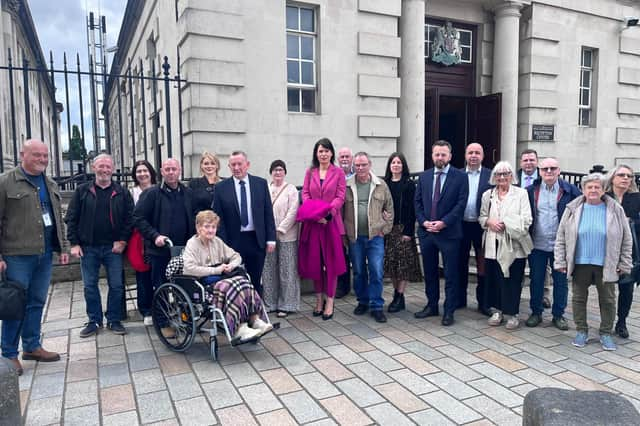

The safety of Mr McDevitt’s five convictions was reviewed by the Court of Appeal on June 17 and 18, 2026.
The appeal was heard by Chief Justice Siobhan Keegan, Justice Adrian Colton and Justice Stephen Fowler. Their judgement was delivered on Friday morning, September 11, by Chief Justice Siobhan Keegan. They upheld Mr McDevitt’s convictions.
Clearly emotional and comforting his mother, Mr McDevitt said there had been 15 applications to admit fresh evidence in his appeal.
“In my opinion, the judges just rode roughshod over everything. They did not attach the proper weight and consideration that they should have,” he said.
“Again it is back to being a political judgement and is not about justice,” he added.
“I know a lot of things have changed here regarding the judiciary but in my view this decision throws the independence of the judiciary into question. To me, it is all about protecting the State. It is about protecting these rogue police officers who clearly were involved in wrongdoing, not just in my case, but in a significant number of other cases too. It is about denying justice in order to prevent exposing what these detectives got up to in Castlereagh and other interrogation centres.
“Some of these police officers have been described by the CCRC as officers whose credibility in criminal proceedings as witnesses of truth is substantially weakened, for example during the 1992 Court of Appeal case for the ‘UDR Four’ when they were severely criticised. They were also heavily criticised in the Patrick Thompson Judgement (2024 Court of Appeal Ruling).
To me, it is all about protecting the State. It is about protecting these rogue police officers who clearly were involved in wrongdoing, not just in my case, but in a significant number of other cases too.
“The RUC officers who interviewed me and the others discredited by the UDR 4 case are completely without integrity or credibility. Even if they did have it, it went out the window a long time ago, and that should have been reflected in today’s judgement just as it was in previous cases.
“In addition, the courts in Northern Ireland do not operate in a vacuum. The courts are very aware of what really went on in places like Castlereagh. The courts have dealt with cases, hundreds, maybe thousands, over the years. There is truth in what people are saying here -the brutality, the threats, the inducements, the coercion, the oppression, everything they did to obtain confessions,” said Mr McDevitt.
Vividly describing his treatment in Castlereagh, Mr McDevitt said he had been “incredibly naïve”
“I had never before been in a police barracks in my life. I was interviewed for 50 hours by two teams of detectives. I was like putty in their hands, if you want to put it that way. I did my best to try and explain things but they weren’t having it, they weren’t having any of it! They seemed to have one objective and that was to get a statement at any cost,” he said.
“And the other thing about it is this, my car sat at my mother's house for a month. If they really believed that I drove gunmen, why then did they not confiscate the car which could have held vital forensic evidence? They did not do any of that, none of it, because they knew it was pointless as there never were any guns or gunmen in my car. People like Colum Eastwood and Pat Ramsey, Amnesty International, Relatives for Justice, Cunamh, The Pat Finucane Centre and other bodies who have stood with me over the years and throughout the appeal, know this,” said Mr McDevitt.
“I think they just wanted somebody to pin the blame on, to tick a box, and it didn’t matter if they were innocent. A forensic examination of my car would have proved I was innocent, but then that would not have suited them.
“Then there was the whole thing about the machine gun which they produced to me in Castlereagh, which is strictly prohibited under the police code of conduct and which they subsequently denied doing. I was able to describe that gun, which they brought into one of my interrogations to frighten and intimidate me, in fine detail, the colour of it, the colour of the handles and everything else about it.
“The CCRC proved later the gun had existed. My legal team argued at the appeal that I had got the date the machine gun was produced to me correct in my evidence at trial. They also submitted a fresh schedule of interviews to the Court of Appeal. Bear in mind, I was 19 years old and had never been in a police station in my life. There were no windows in the interview rooms, no clocks, no watches. I was being questioned continuously for hours on end with no solicitor present, I was disorientated, confused, frightened, scared and tired. I didn’t know if it was daylight or dark.
“Even though the CCRC proved there had indeed been such a gun in Castlereagh at the time, thus giving my claims full credibility, my evidence was dismissed because I got a date wrong under oppressive circumstances,” said Mr McDevitt.
“There is no doubt in my mind that today’s judgement had nothing to do with truth and justice,” added Mr McDevitt. “It was a political one for the purpose of not wanting the house of cards to collapse – they don’t want the potentially hundreds of cases involving the same police officers coming before the courts, hence denying my appeal in order to close an avenue to other potential cases.”
Mr McDevitt also revealed, that three days before the Court of Appeal judgement, his legal team had received correspondence from the PSNI saying they had discovered more RUC disciplinary files relevant to his appeal.
“This information was communicated three months after the appeal was heard and reserved,” said Mr McDevitt.
“This and the fact that my original interview notes and custody record had conveniently gone missing, thus denying me the opportunity to have my papers ESDA tested,” he added.
They don’t want the potentially hundreds of cases involving the same police officers coming before the courts, hence denying my appeal in order to close an avenue to other potential cases.”
Mr McDevitt also alluded to journalist Liam Clarke’s assertion in a Sunday Times article (November 21, 1999) that British Intelligence had known in advance about the planned Easter Monday ambush in which Neil Clarke died but did not intervene to stop it, in order to protect an agent who ‘control-led’ the weapon used to shoot Clarke and was passing intelligence to the army.
“How would the family of that soldier feel if they knew an innocent man had been convicted of his killing and that he was allowed to die by British intelligence services to protect an agent?” said Mr McDevitt, who also expressed gratitude for the unfailing support he had received over the years from the people of Derry, and Bishop Edward Daly and John Hume, among many others.
“Meantime I will continue in my endeavours for Truth and Justice regardless of how long that may take.”