

Derry archaeological digs halted due to lack of funding


Plans for archaeological digs at ancient sites around Derry have been put on hold due to funding constraints.
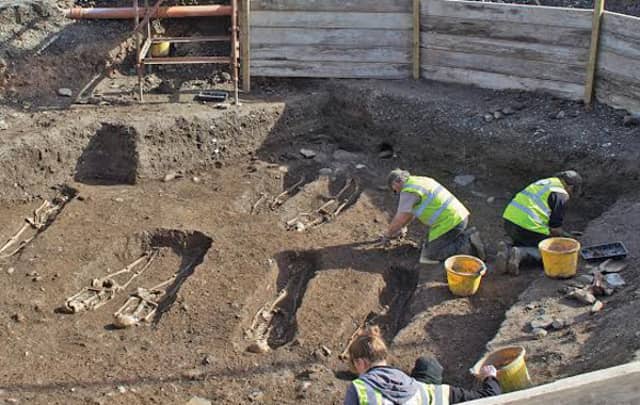
In 2013, excavations took place at Bishop Street car park adjacent to the City Walls and St Augustine's Church which unearthed 15 skeletons that were said to have dated back to the 17th century.
The digs (pictured) were organised by the Northern Ireland Environment Agency (NIEA) Derry City Council and the Centre for Archaeological Fieldwork at Queen's University.
The execavations proved ‘extremely successful’, according to the Department of the Environment (DOE) and there had been plans to further explore the city’s archaeological potential.
However, the DOE has now said further digs, as well as specialist analysis of the skeletons and other items found three years ago, has been halted because of a lack of funding.
A DOE spokesperson said: “The 2013 excavations at Bishop Street car park confirmed that important evidence for the medieval and later history of the City is preserved beneath the ground surface there.
“A preliminary report on the results of the excavation has been completed. This recommended that some further specialist analysis of the finds take place which would be dependent on funding being made available.
“DOE is currently exploring ways in which to fund this specialist analysis.
In 2014, the lead archaeologist at the Bishop Street digs, Emily Murray, announced proposals to investigate all ancient church sites in the city using ground penetrating radar.
These plans have now been put on hold until resources can be found and a long-term plan has been agreed.
The DOE spokesperson said: “We would not recommend any further research excavation at the Bishop Street car park until such a long-term plan, both for the area in general and the archaeological remains in particular, has been agreed.
“Funding remains a challenging area for the present and DOE currently has no plans to return to the City to examine all the ancient church sites through excavation, or ground penetrating radar.
“However, we remain open to discussion on potential partnerships with local bodies and the community, working collaboratively to source funding and bring about such works in the future.”