

UN vehicle ended up in Lebanese ‘danger area’, Seán Rooney inquest hears
Non-state actors known to be a danger to UN peacekeepers were particularly represented in the area where Private Seán Rooney was shot dead, an inquest into his death has heard.
Private Rooney was killed in December 2022 after the UN peacekeeping vehicle he was driving was attacked while on a transport mission in Lebanon.
The inquest, now in its second week, heard Pte Rooney was in the second Toyota Land Cruiser of a two-vehicle convoy to Beirut Airport that got split up after stopping at an outpost known as EP-28, which marked the end of the UN’s area of operations.
A peacekeeper in the lead vehicle told the inquest on Tuesday that a group of non-state actors known to be a danger to Unifil (United Nations Interim Force in Lebanon) peacekeepers was considered to be particularly represented in the area where Pte Rooney and his colleagues in the second car ended up.
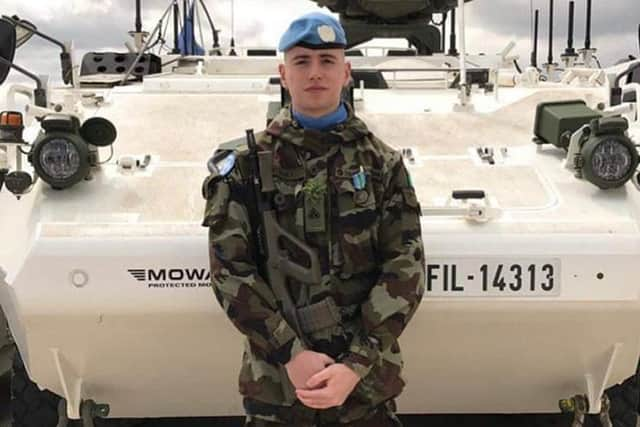

There had been an issue with the key fob in Pte Rooney’s vehicle and it departed EP-28 several minutes after the lead Land Cruiser.
The lead vehicle turned on to a coastal highway known by peacekeepers as the Main Supply Route (MSR), but Pte Rooney’s vehicle missed the turn and proceeded towards a village where it was surrounded and attacked, later being fired upon as he tried to drive away.
At the inquest on Tuesday, Gunner Jordan Tarrant Lowry – who was in the lead vehicle with the convoy’s commanding officer Captain David Kelly – said the peacekeepers in the lead vehicle had turned on to the highway and travelled slowly about 200-300 metres over two minutes before they realised the second Land Cruiser was not behind them.
He said he could not remember who noticed, but added that he thought it was Cpt Kelly.
Questioned by Sean Guerin SC, the barrister for Pte Rooney’s family, Gnr Tarrant Lowry said he “vaguely” remembered a conversation with other Defence Forces members two days after the attack for which a note of the meeting was taken.
The jury heard that the note detailed that a decision was taken to reverse back down the MSR, with the quote “who gives a f***” also recorded.
Gnr Tarrant Lowry said he did not remember who said it but added it “must have” been Cpt Kelly who took the decision to reverse down the MSR.
He also said the captain took over driving the vehicle during the reversing manoeuvre.
Gnr Tarrant Lowry told the inquest the lead vehicle returned to EP-28 to see if Pte Rooney’s vehicle had returned there but when they saw it had not, the captain’s vehicle “spun around straight away”.
Suggested by Mr Guerin that this meant the captain had not made contact with his second-in-command in Pte Rooney’s vehicle before reaching EP-28, Gnr Tarrant Lowry said: “That makes sense.”
He said the lead vehicle then returned to the junction as Cpt Kelly communicated with his second-in-command, Corporal Josh Phelan.
Gnr Tarrant Lowry said the captain made contact with the tactical operations centre (TOC) at the Irish UN base UNP-245, also known as Camp Shamrock, after the final call with Cpl Phelan, in which gunshots were heard.
He said Cpt Kelly had made a request to follow into the area where the second vehicle had been attacked but the TOC directed that it “get eyes on” – meaning to get as close as it could to observe the situation but not to get involved.
The jury heard that Gnr Tarrant Lowry had said in a deposition that Cpt Kelly knew Pte Rooney had missed the turn and “had gone straight into the danger area”.
The panel was told that the area had been described as “DFOM central”, referring to the military term of denial of freedom of movement, which is when a group restricts troops’ ability to travel, such as what happened to Pte Rooney and his colleagues before the attack turned fatal.
Gnr Tarrant Lowry agreed with Mr Guerin that the attack happened in an area where non-state actors who were known to be a danger to Unifil troops were “particularly represented”.
The inquest previously heard that Cpl Phelan sent a Google Maps screenshot of the second vehicle’s location to Cpt Kelly during the DFOM.
Asked if he remembered the commanding officer communicating that location, Gnr Tarrant Lowry said he could not remember.
Asked if the absence of such a communication in his deposition suggested it did not happen, he agreed.
Earlier on Tuesday, Gnr Tarrant Lowry, who was one of two peacekeepers who had been granted bereavement leave and were being taken to Beirut Airport in the convoy and therefore considered a passenger rather than an active member of the mission, said it would be an essential expectation that someone would be paying attention to see if the next vehicle was following.
The jury heard that after the initial separation, the lead vehicle passed through a village and slowed to a point that it was able to observe the score on a soccer match on a television screen in one building.
Gnr Tarrant Lowry also said it was his recollection that the vehicle stopped at one point and the village would have been well lit compared with other points on the route.
He accepted this would have been a good opportunity to check if Pte Rooney’s car was behind them but he had no recollection if a check was made.