

Battling back: the story of the Magherafelt woman who overcame 'locked-in' syndrome
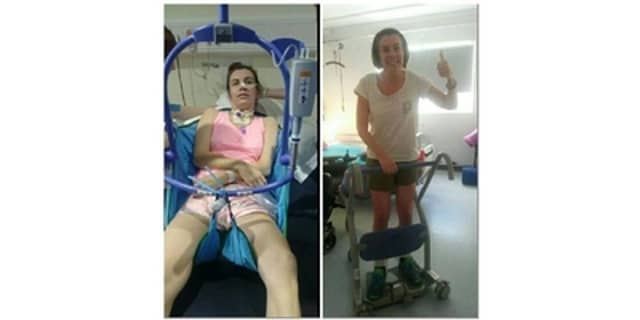

ON Easter Monday 2015 Clodagh Dunlop was enjoying a day off work at home when life as she knew came crashing to a halt.
Having spurned the initial thought of a 13-mile run to The Ponderosa and back from her Desertmartin home, she instead took it easy – but when she got up to answer the door to her sister Diane who popped round for a visit, she knew immediately something wasn’t right.
That was the moment her life changed forever. Taken to Antrim hospital by her sister, Clodagh, who celebrated her 39th birthday recently, then suffered a massive brain stem stroke and when she woke up two days later in intensive care at Belfast’s Royal Victoria Hospital she discovered she was trapped inside her body, unable to move or speak, yet aware of everything around her.
At just 35 years of age, the front-line police officer was left with locked-in syndrome, a rare condition that causes total paralysis, apart from the muscles that regulate eye movement.
The prognosis was grim. There is no treatment or cure and it's very rare for patients to recover any significant motor function. For the few who do, a lifetime of severe disability often awaits.
But against the odds, Clodagh has made an extraordinary return to health which has now allowed her to walk, drive, return to work 18 months later and she even choose to do a sky dive to mark the anniversary of the day she almost lost her life.
“I had gone skydiving the year before I became ill. In hospital I would fall asleep and dream of skydiving, with my arms flapping in the wind. Then I would wake from that dream into my nightmare of not being able to move my body.
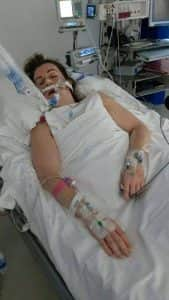
Reflecting on her lowest point, Clodagh admits that lying in the intensive care unit unable to move or speak was “the most terrifying experience of her life”.
“It was like restarting my life again. I was so helpless and vulnerable. My face was completely paralysed, so whatever I was thinking internally couldn’t be seen by others outside. My sister has said that one of the most painful things she had to do was watch silent tears roll down my face.”
Clodagh considers herself “very fortunate” as it was discovered early that she could communicate by blinking.
“My partner Adrian asked me to blink once if I could hear him. When I did, he said to me 'Clodagh you will be OK'. I knew he wasn’t giving me any promises but I held on to that hope throughout my long recovery.”
Using an electronic eyegaze spellboard, speech and language therapists were slowly able to spell out Clodagh’s thoughts. And her first message to Adrian wasn’t “I love you”, rather a practical plea for help, as she spelt out “make me signs”.
“I was in pain, uncomfortable and hot. So I wanted signs made such as 'leave the fan on', 'leave the sheet off my bed,' 'put a compress on my head' and 'put lip balm on my lips'.
“I looked comfortable and peaceful lying in bed but inside I was screaming ‘I’m in pain’, ‘I’ve got an itch’, ‘I need to wipe my eyes or 'the hair in my ponytail feels like it’s burning a hole in my head’.”
Another significant moment in Clodagh’s recovery came six weeks later when she made her first sound: “My best friend described it like an animal dying.”
That was only the beginning of a very long journey Clodagh took towards being able to talk again.
“As a result of the stroke every muscle in my mouth stopped working – my tongue, my teeth and my lips. I had to begin to teach myself to swallow again, how to puff up my cheeks, how to lick my lips and learn how to eat foods again in order to retrain my mouth how to talk.
“I always say my biggest achievement in life is being able to drink a glass of water again,” said Clodagh, who progressed from being tube fed, to drinking thickened fluids and being spoon fed by Adrian.
Moved to the brain injury rehabilitation centre in Belfast’s Musgrave Hospital, where medics told her she would spend the rest of her life in a wheelchair, a determined Clodagh worked hard at proving them wrong.
“I wanted to do physiotherapy 12 hours a day, but they also made me realise you need to rest after a brain injury to heal.”
Now four years following her stroke, Clodagh is well versed at public speaking. She’s had to be. She has a string of awards for her bravery at fighting back from locked-in syndrome and a passion for sharing her story of not giving up – her latest speech at International Women’s Day where she spoke on the resilience of women.
There is still a weakness on her right hand side. While she uses a stick daily and a manual wheelchair if required, she made big progress this January by walking unaided – and finally last Sunday, walked a mile unaided in Antrim for The Stroke Association’s ‘Step out For Stroke’ event.
Her next goal is to get rid of her stick permanently and one day run again.
“Before my stroke I was determined to run a six-minute mile. Some day I would love to do a 5k, no matter how long it takes,” said Clodagh, who enjoys strengthening her body by riding her especially adapted trike and hopes to take part in the 97-mile Lap of the Lough event this summer.
Throughout her own battles, Clodagh has used her experience of illness and recovery to help and encourage others.
“I always want people to know that no matter how difficult today seems, tomorrow can be different and that real difficulties can be overcome. My advice is never to give up, but give yourself small goals.
“I used to break down my goals every day – from being able to move a finger, to move five fingers to scratching my nose. When the goals are more simplistic, they are more achievable and equally rewarding. I cried the day I was able to clean my own teeth, because I was overjoyed.
“Before the stroke I was guilty of being hard on myself. We all need to look inwardly and realise we are more successful than we give ourselves credit for.”
Clodagh is in touch with others with locked-in syndrome across the world, including the United States, the Phillipines and Ireland and has penned a book about her experience, which she hopes to publish later this year.
“Above all I want my story to be a story of hope. Sometimes people give me pity because my right side is so weak, and yet I'm so grateful for every day to be able to get out of bed and tell my family I love them. I’ve learnt that to grow old is a gift.”