

Archaeological survey done on ancient fort found in Co Derry


An archeological survey led by the Queen's University Belfast Community Archaeology Program started on March 11 on the remains of a stone-made Crannog near Moneymore.
An archeological survey led by the Queen's University Belfast Community Archaeology Program started on March 11 on the remains of a stone-made Crannog near Moneymore.
The survey plans to study the old structures around the Crannog to make accurate drawings of the monument.
The Crannog discovered near Moneymore is composed of a stone circle with a defensive wall.
Usually found throughout the UK and Ireland, Crannogs are man-made structures built to support houses or settlements usually in loughs or estuaries.
Through time the landscape around the Moneymore Crannog changed.
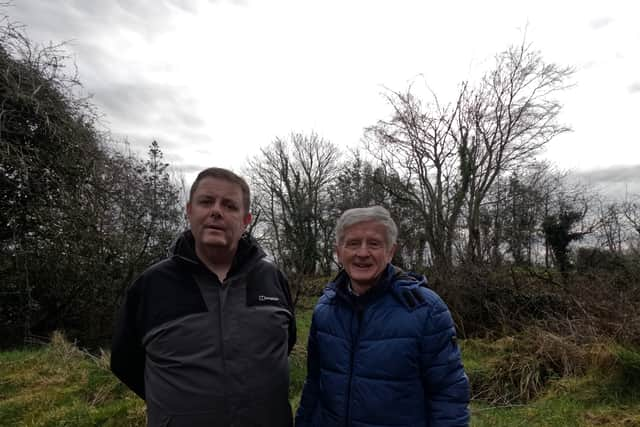
(Above) Seamus O'Brien and Jody Wilson from the Loup & District Historical Society.
Brian Sloan and Ruairí Ó Baoill, the two field archaeologists on sites for the Centre for Community Archaeology QUB, can only imagine what the story is of the Crannog so far.
They said that a family might have lived there, with possible animals. The stone wall was also big enough for two small houses.
Another hypothesis is that this Crannog might have been used as a hiding place by Hugh O’Neill during the Flight of the Earls 400 years ago before leaving Ireland through Buncrana.
However, this again is only speculation.
Ruairí Ó Baoill said it may date back to between 7 and 11 AD, also called the early medieval period.
“It is an interesting site, primarily because we don't know what it is,” said Brian Sloan.
“You're trying to picture what it would have been like, back in its heyday back when it was actually constructed.
“We can only pose the questions,” said Brian while thinking about what the archeological remains could have been. He also explains that folklore stories of people living nearby are often useful to maybe understand a part of the story.
One element that the archeologist did find surprising is that in the tradition, Crannogs are made out of wood or soil. However, this one is made out of large and heavy stones.
“It's not an ordinary ring fort, because it's in the middle of a lake. It's not an ordinary Crannogh because it's made out of stones,” said Brian.
“It's an awful undertaking to actually bring the stones out here.
“If you can think about having to bring soil or clay it's easier just to adjust something that's already there.
If you think all that stone was quarried, somewhere and to have to bring it from the quarry site to the edge of the lake bed, then have to load up on boats.
“When you're talking about the early mediaeval boats, how many of these big stones can fit in the wee boat?”
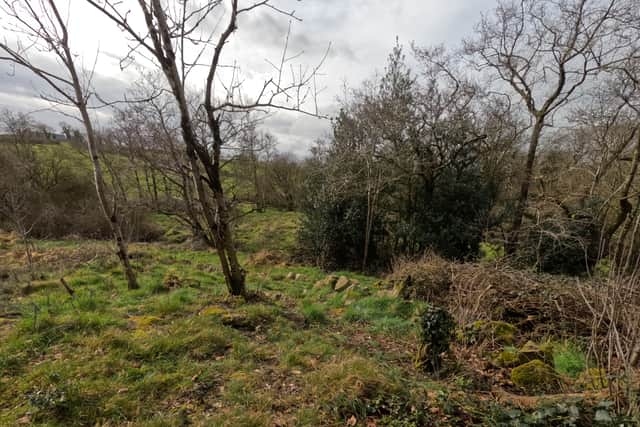
(Above) Entrance of the Crannog.
First discovered in late 2019 by the late Sean Corey, who was the president of the Loup and District Historical Society, he fought to have it examined by an archaeological team.
Seamus O’Brien, the secretary of the Loup and District Historical Society said that unfortunately, the archeological research on the site started the day Mr Corey passed away.
Sean Corey spent weeks removing plants and trees covering the Crannog to make it accessible for research.
“He has been trying for years to get some surveys on site and ironically just when they arrived, he passed away. It would be great as a legacy to him if we did carry on,” said Seamus O’Brien.
(Above) Medieval Crannogh's wall made out of stones.