

A short story by Hugh Gallagher: Going their seperate ways

To Pat Gillespie leaving school was an achievement in itself.
The day he descended the long steps leading from the CBS Tech to the Lecky Road, for the last time, would live in his memory forever.
Even though it was raining he savoured every second of the journey.
He even smiled at Brother McGivern, the Brow O' The Hill tyrant.
Many a time he had cursed him, under his breath, during the four long years he had been there.
He began to recall the fear he had for the 'strap'. Almost to a man the Christian Brothers were cruel, he thought. 'Christian' would be the last word he would use to describe some of them.
He remembered the welts which they left on his hands on a winter's morning because he was two minutes late, or the time his whole class was punished severely just because one boy, Harry Doherty, couldn't recite his Shakespeare properly, word for word.
Somehow Pat considered that he had got off lightly, at least when he thought of the treatment they had meted out to others.
People like Charlie Harkin, who was expelled for thumping a mad teacher, whose favourite trick was to go through the class hitting pupils on the head with a piece of wood shaped like a baton.
Of course, he used to apologise profusely afterwards. Pat smiled as he recalled the cheer which arose when Charlie stopped him in his tracks one day with a right hook to the chin.
He wondered why that teacher had never returned to school.
Perhaps the men with the 'white coats' took him away.
Then there were the times when he witnessed boys being taken into the 'games room' and beaten senseless for crimes such as going to the pictures on a Saturday morning instead of going to school. All that was to be forgotten now but never forgiven.
What good was learning lines from Shakespeare anyway, thought Pat as he rounded the corner at the Gas-yard to head up Stanley's Walk towards Creggan.
Apart from being an immensely boring exercise in discovering who had the best memory, it was of no practical use.
Pat was fifteen years old and his academic qualifications consisted of two passes, French and Geography in the Senior Technical Certificate Exam of 1964.
If he had stayed on he would probably have got a couple of 'A' Levels. No, the folded letter he had in his breast pocket contained all the future he desired. No more Saturday morning school for him!
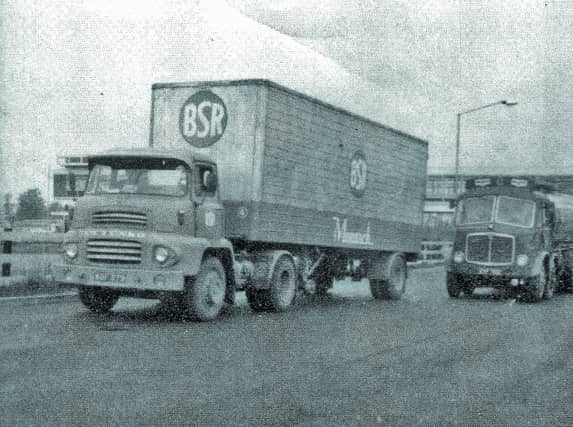
The letter had arrived that morning. He was standing waiting for it to drop through the letter-box. It was from Monarch Electric Ltd., known local as the B.S.R. (Birmingham Sound Reproducers).
The letter invited him to attend for an interview the day after he would leave school and that was a Thursday.
His mother and father were against his decision to look for work but they had given in, eventually. His parents tried to look pleased when he showed the letter around the family.
“How much a week, do ye get?” asked his younger brother, James.
“How should I know,” replied Pat. “I'll tell ye if I get the job!”
His sister Tracey said, “My friend, Anne Doherty, told me everybody gets a free record player. If you get one, Pat, can I listen to Dickie Rock on it?”
Pat smiled at this. “I would say, for definite, that nobody gets a free record player!”
On the morning of the interview Pat straightened his tie and brushed his good blazer. When he was ready to go, he had to restrain his mother as she attempted to comb his black curly hair. He was embarrassed but she slipped a two-bob bit into his pocket in case he'd need it. As he set off down the street she shouted, “Good luck, son!”
A long queue had formed by the time he arrived, five minutes early. His interview was for ten o'clock. Some of his friends were in the line, Martin Doherty, Colm Breslin and Harry Clarke.
“Hand your letter to that wan up there!” said Harry, pointing to an elderly lady seated at a table.
After he had done this he returned to his place in the queue.
“No dobbers are getting jobs,” shouted Martin, from the front.
“Well, hadn't you better go home then!” replied Pat.
There was a ripple of laughter from the gathering. “Quiet, please!” shouted the woman.
Martin Doherty was the first of Pat's friends to emerge from the interviews. The queue was starting to dwindle and he was getting very nervous. “What's it like, Martin?” he asked.
“Wee buns! To a genius like me!” he said.
“Big headed git!” said Pat. When it was his turn he knocked softly at the door and entered.
“Sit down there, mate,” said an English man, pointing to a chair in front of him. “I won't be a tick!” He dunked a digestive biscuit into his tea and sat chewing it. It was as if Pat didn't exist, the way he stared past him into thin air. After a couple of minutes a red haired man came in and joined them.
“Name!” he said loudly.
“Pat Gillespie, sir!” replied Pat. His father had told him always to address his elders as 'sir'. The man pulled out his application form from a pile in front of him and handed it to the English man.
“Right, lad,” he said. “Tell me this – can you start on Monday!”
“Yes, sir!” replied Pat.
“Report to this office at eight o'clock sharp then!” he said. “The wages are £2.-16s.-4d a week to start with. When you are eighteen it will rise to £4.-4s-0d. And when you are twenty-one you can expect to get twelve guineas. On your way out, send in the next in line!”
Pat ran all the way home to tell the family the good news. After a few minutes his father, who was unemployed, took him into the kitchen for 'a quiet chat'.
“Listen, son!” he began. “That crowd are famous for taking young lads, like yourself, on at fifteen. Then they turf them out at eighteen or twenty-one. Then they replace them with more fifteen year-olds. Be prepared for the bad times as well as the good. Look at me. I can't get a job and yet the B.S.R. won't even give me an interview. So, don't give them the slightest excuse to sack you.”
“Okay, da. I know the craic!”
Twenty people in all started the same morning as Pat did. They were shown where the clocking-in cards would be; shown around the old factory which was dirty, dark and noisy and taken to the new factory which was all modern and spotlessly clean. The only noise in the new factory came from air guns, drills and presses. Pat was shown the assembly lines and the sub-assembly benches where he would work. Eventually, about nine-thirty he and Martin Doherty went to their section. The foreman, Eddie McCabe, explains things to them.
“It's just like one long bench, really,” he said. “The centre spindle of a record player arrives here from the plating shop. It is reamed, assembled and then inspected before it goes to the assembly line. Your job, Pat, for the first week, will be to use a hand-press which seals the keepers and springs into the spindles.” Turning to Martin he said, “Sit down there at that bench!” He did as he was told and the foreman sat beside him. In front of them sat a metal tray with compartments propped up at a 45% angle. There were six sections containing spindles, two different kinds of metal pins, keepers, levers and springs. A rectangular block of steel with a small hole drilled in it plus a crude bolt served as tools. The foreman lifted a spindle, took two keepers from the tray and placed one of them in the slot at the top and hit it home with the flat end of the bolt. Turning the spindle around he inserted the spring until it clipped on, added a lever, held it with his left thumb and forefinger, took the second knurled pin and hit that home. “You should be able to complete one hundred of these a hour, after one week, Martin!” he said. Martin looked up at Pat. He seemed bemused and raised his shoulders and eyebrows as if to say, why me!
“You can do it, Martin. No bother to you!” said Pat, slapping his back.
“Never you worry about him, son!” said the foreman. “You'll be on that job as well, come next Monday! C'mon I'll show you what to do on that hand-press over there, temporarily of course!”
After five minutes Pat was merrily thumping away with the hand-press. The handle was cold. His job was to insert the completed spindle in a special slot in the press and swing the handle around. The press came down and sealed the pins.
The first morning was uneventful. After dinner-time they got around to discussing the social life of the factory. During that break, Pat learned how to play shove half'penny, how to get on the football team and where the best dances took place. A favourite game, played during working hours, he learned, was guessing the names of film and film stars from initials.
Pat was in a great mood on Tuesday morning as he clocked in. Before he reached his press, the foreman stopped him, “Report to the main office at once, Gillespie!” he said. “You're for the high jump!” What could he mean, he thought. All the others were already there when he arrived, followed closely by the foreman. There was Martin, the other two builders, Charlie and Eddie and Johnny White, the inspector. The reason for the meeting soon became obvious. Three hundred shiny spindles had been destroyed. In no time at all, the finger of suspicion pointed firmly at Pat.
“You were battering away all yesterday afternoon and there were two pins stuck in the press,” said the foreman. “All you were doing was wrecking spindles! Have you anything to say for yourself?”
The others began to file out of the office as Pat sat silently, head bowed. Everybody, except Martin, that is. When they had all gone he closed the door and said, “It was my fault. Yep, it was me who put them pins there. I was carrying-on during dinner-time. I wanted to see if the press would smash things! Pat's innocent!”
“Right! You, Gillespie!” said Eddie McCabe. “Get you back to work and count yourself lucky. Stand outside and I'll talk to you in a minute. You stay where you are, Doherty! I think you know what happens next!”
After five minutes Martin emerged from the office, smiling. “I've been sacked!” he announced, as if it was no big deal. He, himself, was still shaking.
“Why are you smiling, then?” asked Pat.
“Because I have already arranged to return to the C.B.S. Tech in September,” he replied. “I hated the site of this dump from the minute I laid eyes on it. See you later, alligator!” With that he turned and walked away, whistling.
It was almost twelve years later before Pat and Martin met again. Pat was sitting on a low wall, having a crafty smoke, while he was waiting for his brother, James, and his family to come out of St Eugene's Cathedral. James was getting married to a schoolteacher, Carmel O'Neill. Her family didn't like him and the feeling was mutual. A right bunch of toffee-nosed twits was his description of them. The B.S.R. had long since closed. Since then he had been in England working, mostly on building sites. If it hadn't been for his mother's pleading, he wouldn't have attended the wedding at all.
While the signing ceremony was taking place he decided to have a dander around the grounds, looking at the grotto and the beautiful flowers. Suddenly he spotted a priest coming out of the Bishop's house. He moved closer for a better look. Holy Moses, he thought, it is him! He raced over and got there just as the priest was getting into his green mini car. “What about ye, Martin!” said Pat.
“Do I know you?” asked the priest.
“I'm Pat Gillespie!” said Pat. “Remember - the CBS and the B.S.R.”
The priest smiled and threw his arms around him. “I didn't even recognise you, Pat! Didn't you used to have black hair and be skinny as a rake! Where did you get that belly?”
“Look who's talking. When did you get religious?”
There was silence for a minute before Martin spoke. “When I went back to school I decided to become a Christian Brother but then I changed my mind and joined the priesthood. I'm based in California now, home on holidays. Here to see the Bishop!” Just then Pat's mother appeared.
“I'll be on my way now, Pat. Will I see you again!” said the priest.
“Hardly!” said Pat. “I'm off to England for good come Monday!” He waved good-bye and as the car pulled away he shouted. “See you later, alligator!”
His mother was raging on hearing this. “Is that any way to address a priest,” she shouted.
“Give over, ma! Sure, isn't the man an old friend!”
“Miracles will never cease!” she declared.