

PSNI say more than half of sexual offences in past year involved a child


On Wednesday, the PSNI launched the next phase of its seven-year commitment to tackle violence against women and children.
More than half of all sexual offences recorded in Northern Ireland in the past year involved children, the Police Service of Northern Ireland (PSNI) said.
The PSNI said sexual offences involving children are “a significant concern”, accounting for 51.7% of all recorded sexual offences.
Meanwhile, including non-sexual offences, 8,174 offences involving child victims were recorded in the past year.
On Wednesday, the PSNI launched a new strategic framework, broadening the service’s Violence against Women and Children Strategic Framework 2026–2029, to explicitly include children.
The PSNI said children are also “very often witnesses to domestic abuse in the home”.
The Operation Encompass scheme, where police notify a child’s school before the next school day if they attend a domestic abuse incident involving the child’s household, had 57,896 notifications between September 2021 and July 2026.
Detective Chief Superintendent Zoë McKee, head of the PSNI’s public protection branch, said the statistics show the necessity for having children represented.
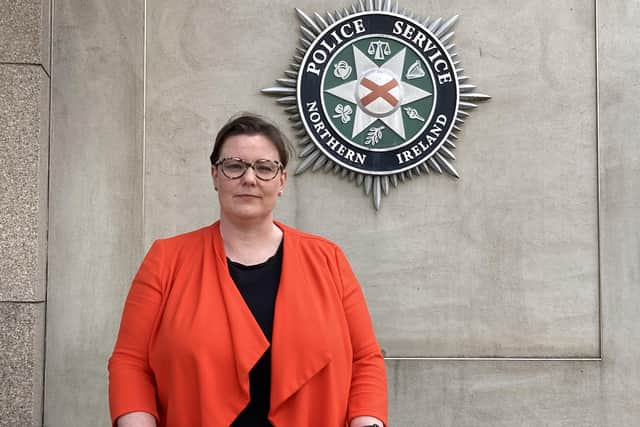
“Children experience violence, abuse and exploitation in their own right. They can also be profoundly affected by domestic abuse, coercive control and violence occurring within families and relationships.
“We are also seeing more and more young adults as perpetrators of online abuse and domestic violence offences,” she said.
“Our commitment to women has not been diluted by explicitly including children. It has been strengthened.
“We also know that young men and boys need to be brought into the conversation earlier and that entrenched attitudes and behaviours need to be strongly challenged, as we have continued to do through our Power to Change campaign.
“By expanding our framework we can place a sustained focus not only on prevention but also early intervention and education.”
The new framework builds on the Tackling Violence against Women and Girls Action Plan introduced in 2022, a seven-year commitment to tackle violence and abuse and improve protection for women and children across Northern Ireland.
In the 12 months ending on November 15 of this year, sexual offences involving female victims increased by 7% compared to the same time period in 2023.
Overall, however, the PSNI Violence Against Women and Girls dashboard identified 13.6% fewer recorded offences than in the same period in 2023, down from 26,126 to 22,571.
According to the PSNI, in that time, violence with injury involving female victims decreased by 12.2%, and violence without injury by 7.9%.
Stalking and harassment involving female victims decreased by 7.3%.
The PSNI said that over the last three years “significant progress has been made but there is more to do”.
Ms McKee said: “Four years ago, we made a seven-year commitment to improve policing’s response to violence against women and girls. That commitment has not changed.
“We have made significant progress, including strengthening specialist investigative capability, improving our response to stalking, coercive and controlling behaviour and non-fatal strangulation, increasing training, strengthening partnership working and improving safeguarding and support for victims.
“But progress cannot mean standing still.
“We have listened to victims, communities and partners. We have learned from operational experience and independent scrutiny. We are seeing new forms of offending and technology-enabled abuse, and our understanding of how we can prevent violence continues to develop.”
In the first three years of the original programme, 38 of 41 actions were reported complete. The refreshed framework builds on specialist learning, protective mechanisms, improved recording and partnership work, while placing greater emphasis on child-centred safeguarding, repeat perpetrators, victim feedback and the quality of investigations.
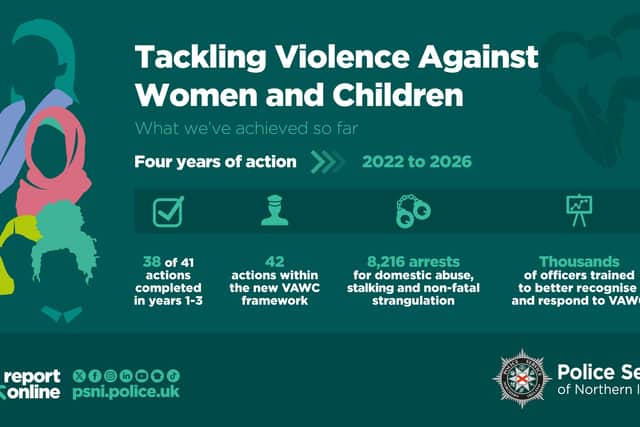
The accompanying delivery plan contains 42 core actions, of which 22 are new commitments, 17 are enhanced commitments and three are carried forward.
It sets out four commitments that will guide PSNI activity to 2029 – protect, prevent, pursue and prepare.
Under protect, PSNI will focus on safeguarding women and children and improving victims’ experiences.
Prevent aims to increase the emphasis on identifying vulnerability and intervening before violence escalates.
While Pursue will focus on identifying, investigating and disrupting perpetrators, particularly repeat and high-risk offenders.
And Prepare will ensure policing continues to develop its people, leadership, technology, intelligence and learning to respond to emerging threats.
The framework recognises six areas of harm: domestic abuse and interpersonal violence; sexual violence; violence against children; harmful cultural practices; cyber-enabled violence; and high-harm perpetration.
Ms McKee continued: “Responsibility for violence always rests with those who perpetrate it.
“We want victims and survivors to know that we will listen, safeguard and support them. At the same time, we will increasingly focus our attention on perpetrator behaviour, patterns of offending and those who present the greatest risk.
“Our ambition is not simply to count arrests, investigations or activity. Success means safer lives, earlier intervention, greater confidence and better outcomes for women, children and communities.
“Policing cannot achieve this alone. Preventing violence and abuse requires strong partnerships across government, justice, health and social care, education, local government and the voluntary and community sector.
“Our ambition is clear – a Northern Ireland where every woman and every child across Northern Ireland should live free from violence, abuse and fear.”