

Ministers defend timing of £300m funding announcement amid election stunt claims
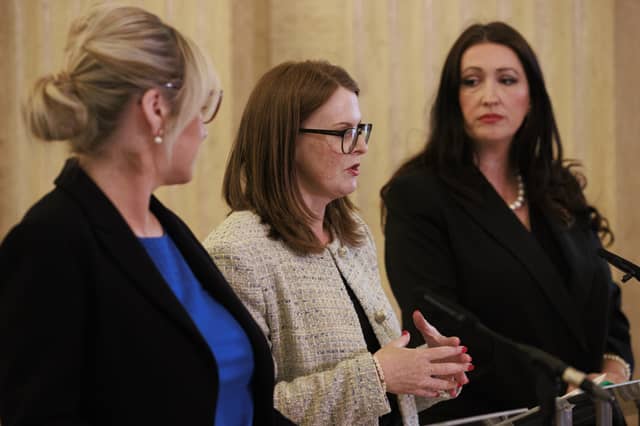

Stormont leaders have defended the timing of a £300 million funding announcement amid claims of a pre-election stunt.
Executive ministers met on Monday to agree the in-year June monitoring round exercise, at which previously unallocated funds were distributed to departments.
Health, education and social house building were the main beneficiaries of the allocation of £250 million of resource spend and £50 million of capital money.
Some £122 million is allocated to the under-pressure Department of Health.
An outstanding pay settlement for non-teaching educational support workers will be funded from £43.7 million allocated to the Department of Education.
First Minister Michelle O’Neill, deputy First Minister Emma Little-Pengelly and Finance Minister Caoimhe Archibald made the monitoring round announcement in the Great Hall of Parliament Buildings on Monday.
Leader of the opposition, the SDLP’s Matthew O’Toole, called the timing “shameful and shocking”, saying it was in contravention of guidance on how ministers should be operating in a pre-election period.
“The pre-election guidance for civil servants is quite clear that civil servants are not supposed to facilitate activity that can be perceived as jeopardising the impartiality of the civil service,” he said.
“I do not know how you can describe a monitoring round, which could have happened on Friday, in four days’ time, that allocates hundreds of millions of pounds to public services, isn’t anything other than political and jeopardising of civil service impartiality?
“I think it’s disappointing. I think it’s shocking. And I think it’s important that the official opposition call it out.
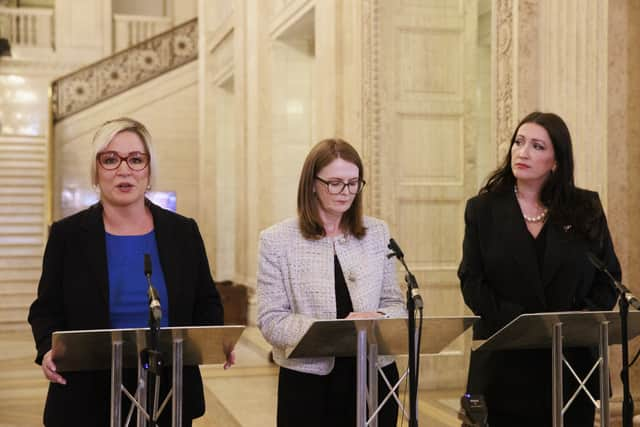
The ministers dismissed the criticism, saying the monitoring round process was routine Stormont business. They also stressed the need to give departments certainty on funding as soon as possible.
“Why should this wait?” said Sinn Fein First Minister Ms O’Neill.
“This is money that needs to be allocated to our departments, this is very much business as usual. And the Westminster election shouldn’t disrupt as much as we possibly can, our own business.
“Also, our departments need confirmation in terms of the allocations which they received, so now they can get on with actually delivering the projects, which right across our departments will benefit from some of this funding today.
“So, it’s very much a business-as-usual approach to the June monitoring, which we do every year in June.
“And I’m glad that we’ve actually been able to get the four parties of the Executive to agree that this is the right course of action today.”
DUP deputy First Minister Ms Little-Pengelly rejected the suggestion that the monitoring round should have been delayed.
“Just like our health system can’t wait, our non-teaching education staff have waited too long, I think it’s really important that this is an executive that delivers and that means that we have to take action,” she said.
“This is a fairly balanced settlement today, we have been fair to a range of departments, no department will be particularly happy with what they have got.
“But we all know the crisis that there is within the health department, for example, they’re crying out for those additional funds, and it is right that we have moved swiftly in order to meet some of that need.”
The Finance Minister said the decisions on Monday did not contravene pre-election guidance.
“Of course, I considered the pre-election guidance when considering to do the June monitoring round today,” said Dr Archibald.
“And it’s my view and my department’s view that this is normal routine business for the Assembly and the Executive. And, as Michelle has said, it happens every year.
“And our departments needed certainty in relation to their funding allocations so that they are able to make decisions around living within their budget.
“Our health workers, our education workers, all those delivering right across our public services need certainty, and today we have been able to give them that.”
Former UUP health minister Robin Swann voted against the Stormont budget that was agreed by the other Executive parties earlier this year.
He opposed the budget plan after claiming the allocation to his department would inflict significant damage on health service delivery.
Ahead of the monitoring round, the department said it required about £270 million to avoid having to make “catastrophic cuts” to services this year.
That was before funding to pay for an annual pay uplift for health workers is factored in.
While the £122 million falls short of what the department says it requires, current UUP Health Minister Mike Nesbitt supported the monitoring round decisions on Monday.
“I welcome the additional funding being provided to my department in-year,” he said.
“While this makes some contribution to reducing the deficit position facing the health and social care (HSC) system, a significant shortfall still remains.
“I am still not in a position to balance the health budget without taking measures which would be regarded as having a catastrophic impact on services. I have repeatedly made clear I will not be sanctioning such measures.
“The ongoing and significant budgetary shortfall is before a 2024/25 pay uplift can be considered.
“The financial position therefore remains very challenging and work continues across the HSC system to deliver the maximum possible savings and efficiency.”
As well as money to resolve the pay dispute involving educational support workers, the Department of Education will receive a further £44.5 million in the monitoring round – £29.5 million to address pressures in the education system and £15 million for capital works to improve the school estate.
A total of £35 million is being given to the Department for Justice while the Department for Communities has been allocated £20 million for new build social housing and £10 million for safe cladding works.
The Department for Communities will get a further £10 million for discretionary support, which helps people with short-term living expenses, and its Supporting People programme, as well as for homelessness interventions.