

Agreement on contentious flags needed to break ‘coercive control’, MLAs told
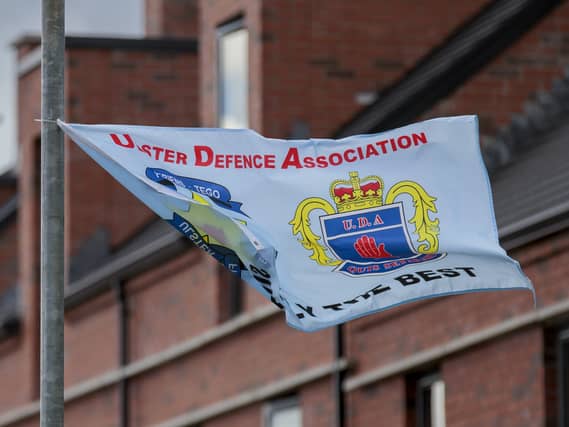

A proposed Bill aims to address concerns over unauthorised flags on public property by introducing new regulations.
A failure to find political agreement on policies to deal with the flying of contentious flags will leave Northern Ireland “trapped” in an ongoing form of “coercive control”, MLAs have been told.
As a Stormont committee continued its scrutiny of Alliance MLA Paula Bradshaw’s Display of Flags and Emblems Bill, Professor Dominic Bryan said it was “about time somebody has tried to move this on”.
The Bill aims to address concerns over unauthorised flags on public property by introducing new regulation.
Prof Bryan oversaw the Commission on Flags, Identity, Culture and Tradition (FICT) which made a number of recommendations in a 2021 report which have not been enacted.
The academic told Stormont’s Infrastructure Committee there was agreement that displaying flags indicating support for paramilitary organisations was a form of “coercive control, usually in working-class urban areas”.
He said: “The long-standing practice of expressing national and cultural identities through public displays of flags has, in part, been appropriated by some groups to mark territory, leaving flags up much of the year, using symbols in a way that many in the population find disrespectful and sometimes threatening.”
Prof Bryan said the flying of Union or tricolour flags were also associated by many with the “demarcation of space by paramilitary groups”.
He said police and the Department for Infrastructure had been “unable to sufficiently impact this contemporary problem”.
He said: “We’re at a point where, after a long, long wait, Stormont is now looking at a piece of legislation to try and change things, and I think I will say that it’s about time somebody has tried to move this on.
“Because unless we can move this process on in some way, we are trapped in an ongoing process of territorial control, coercive control, and we have taken people’s ability to express culture, to express their identity, to celebrate and commemorate it, and we’ve handed it over to another type of process.”
Prof Bryan added: “I think broadly, most people agree that the ability to fly and celebrate things using flags to commemorate, to dress areas, is a reasonable one for most people to undertake.
“A code of conduct somehow embedded into this place in a way that people can agree on how to go about these things is a good thing.”
The committee also heard from PSNI Chief Superintendent Gillian Kearney, who said the force had this year removed 35 items, including 12 under terrorism legislation.